Menu
FREE ART CONSULTATION
PreviewPreview AR previewAR preview Buy Print Buy PrintBuy Hand Made Painting Buy Hand Made Painting SendSend
DetailsDetails Add to favorites Add to favorites DownloadDownload SimilarsSimilars X-RayX-Ray DiaporamaDiaporama

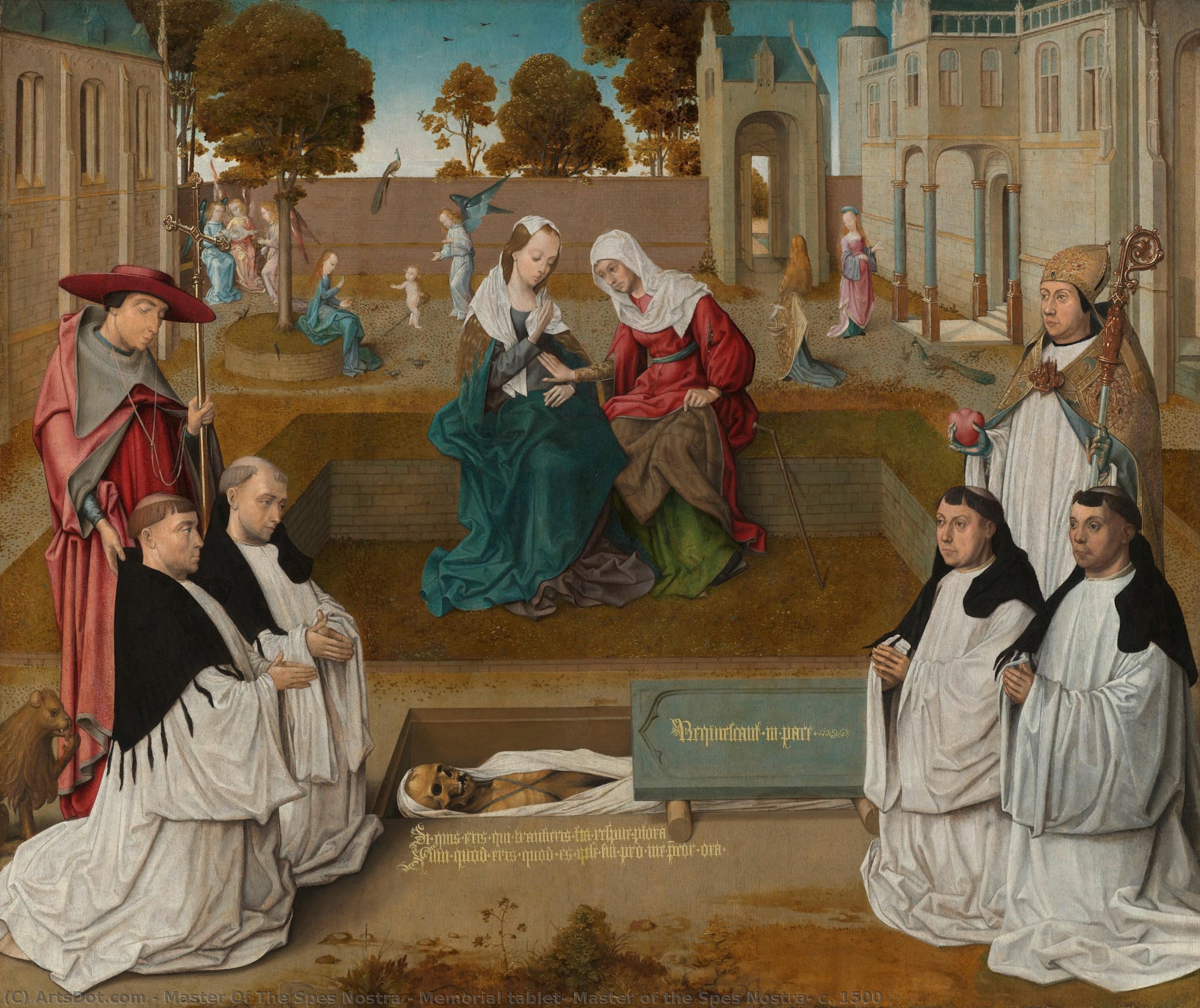
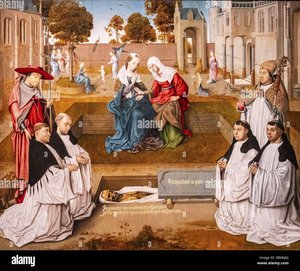
Memorial tablet, Master of the Spes Nostra, c. 1500

  • Creation date1500
  • Dimensions89.0 x 104.0 cm

Discover the enigmatic Master of the Spes Nostra – a 15th-century Dutch painter renowned for his detailed realism & the poignant 'Memorial Tablet'. Explore his legacy!

Purchase a high-resolution, enhanced digital image, far superior to the online preview.

Each file is meticulously prepared by our in-house specialists using advanced tools and expert manual retouching. We ensure every image has exceptional clarity, precise color accuracy, and fine detail.

The final file is delivered via email within 72 hours, optimized for immediate use in professional, editorial, and print environments. This is the same quality trusted by top-tier design studios, publishers, and galleries.

Digital Image

Download a high-resolution file for personal display, printing, and creative projects. (Buy Print Buy PrintBuy Hand Made Painting Buy Hand Made Painting)

Total Price

$ 24.00

Included in Every Digital Image Order

Expert Digital Delivery, Guaranteed

When you choose ArtsDot.com, you're not just getting an image - you're receiving a professionally enhanced digital artwork, crafted with precision and backed by a satisfaction guarantee. Here's everything that comes with your order, automatically:

shipping_icon
Fast Email Delivery

Your high-resolution digital image file will be emailed to you within 72 hours of ordering - ready for immediate use.

canvas_icon
AI-Enhanced Digital File

Your artwork is professionally optimized using advanced AI tools and manual editing, ensuring maximum detail, clarity, and color accuracy.

insurance_icon
Free Lifetime Re-Delivery

Accidentally deleted or lost your file? No worries - we'll resend it to you anytime, free of charge.

tax_icon
No Import Fees - Ever

Enjoy your artwork instantly with zero customs, duties, or delivery fees - digital downloads are always tax-free.

color_icon
Color Accuracy Guarantee

We ensure your digital image reflects the original colors as closely as possible using professional tools and color management.

return_icon
60-Day Satisfaction Guarantee

If you're not satisfied with your digital image, we'll revise it or refund 100% within 60 days - no questions asked.

guarantee_icon
100% Money-Back Guarantee

Not satisfied? Get a full refund within 60 days of receiving your digital file - no questions asked.

discount_icon
Bulk Order Discounts

Buy 3 images, save 10% - Buy 5, save 15% - Buy 10+, save 20%. Great for creative projects, galleries, and agencies.

In the foreground of this painting there is a half-open grave with a semi-decomposed body. Kneeling on the left are two canons and St Jerome in a cardinal’s robes with a lion, and on the right there are two more kneeling canons with St Augustine holding a heart.4 The white-clad priests flanking the grave are identified by their tonsures, white surplices and black, asymmetrical copes as canons regular of the Augustinian order. The crossed bands on the skeleton’s chest, which is a stole that priests wear underneath the chasuble, show that the body is that of a priest. The dead man speaks to us in the inscription below the grave: ‘Whosoever passeth by, behold and lament’. Below that is written: ‘I am what thou shall be, what thou art I have been; pray for me, I beseech thee’. The inscription on the gravestone reads ‘May they rest in peace’. The plural pronoun indicates that the painting is an epitaph for the four canons depicted in it. It is not known whether there was a source for this text.5 Seated on a grassy bank on the edge of an enclosed garden in the middleground is the pregnant Virgin, who is being greeted by Elizabeth, the mother of John the Baptist. This is the Visitation, where the Virgin and Elizabeth usually greet each other standing up. As far as is known, this scene of a seated Virgin and Elizabeth is unique. The door to the hortus conclusus is open, as it is in the pictures by Geertgen tot Sint Jans (SK-A-3901), the Master of Delft (SK-A-3141), and the Master of the Virgo inter Virgines (SK-A-501). In the garden behind the Visitation are three musician angels. The Virgin, now seated under a tree, and another angel are watching over the Christ Child, who is playing with a hobbyhorse. There are two women by the gatehouse on the right. The Visitation and the scene of Christ’s childhood allude to the imminence of mankind’s redemption. The peacocks in the cloister garden also stand for eternal life.6 The scene in the foreground confronted the viewer with death, but the scene just behind it gives a glimmer of hope. It contains a clear reference to the ‘Salve regina’, a medieval hymn that was often sung at funerals.7 It is likely that this painting served as an epitaph and was placed near a tomb. Its purpose must have been to encourage the viewer to meditate on his or her own mortality.8 It looks as if the background is meant to be a priory garden, with a church on the left and a refectory on the right, possibly the priory of the canons depicted in the foreground. Their asymmetrical black copes of cloth or sheepskin, known as ‘cacullae’, make it likely that they were canons regular of the general chapter of Sion.9 They were priests who had sworn the monastic oaths and lived as a community following the rule of St Augustine. There were no fewer than 15 priories of this chapter in the County of Holland.10 Van Luttervelt suggested in 1952 that the painting was commissioned by the Augustinian Priory of Our Lady on Mount Sion near Delft, whose patron saints were Augustine and Jerome. This seems unlikely, for this epitaph would never have survived the fire at the priory in 1544, which completely destroyed the nave of the church, the iconoclasm of 1566, and the demolition of the priory in 1572.11 Bangs identified the four canons as the four regulars who were successive rectors of Mariënpoel Convent near Leiden around 1500, who died soon after one another: Johannes Crispiani and Gijsbert N., who both died in 1496, followed by Gerard Dirksz in 1504 and Sebastian Fransz in 1507. The latter would be the canon on the far right, who was added at a later stage.12 Other authors proposed locating the epitaph in the regulars’ Priory of Our Lady of the Visitation, just outside the gates of Haarlem,13 or in the Augustinian priory of Hieronymusdal dedicated to St Jerome, which is generally called Lopsen, in Oegstgeest near Leiden. The latter is an interesting idea, because manuscripts were illuminated in the priory, and painters were active there in the late 15th century.14 However, there are no solid arguments to support any of these options.15 Infrared reflectography revealed a brushed underdrawing for almost the entire painting. The drapery folds in the foreground figures were built up with an extensive network of hatchings (fig. a), the small figures were defined with a few lines, and the architecture was painstakingly constructed with the aid of a ruler (fig. b). One notable feature is the use of delicate, modelling hatchings in a dark red glaze in the red parts of the garments of St Jerome and Elizabeth which are closely related to the underdrawing in both style and manner of drawing. The canon on the far right was added at a later stage, and was painted partly on top of St Augustine’s robe and the other canon (fig. c). The Rijksmuseum bought the painting in Paris in 1906 as The Burial of a Patriarch, at which time the body in the grave was completely overpainted with a white shroud on which there were a bishop’s m../..

Artist Biography

a glimpse into the life and artistry of a 15th-century dutch painter

in the realm of art, there exist numerous enigmatic figures, but few are as intriguing as the master of the spes nostra, a painter from the netherlands who flourished between 1450 and 1520. this anonymous artist has left an indelible mark on the world of art, particularly in the northern netherlands, with his detailed and realistic style.

the artistic legacy

the master of the spes nostra's most renowned work is the memorial tablet, a painting that not only showcases his skill but also serves as a poignant reminder of mortality. this piece, dated around 1500, is a testament to the artist's mastery of oil on panel, a technique that was gaining popularity during the dutch golden age.
  • key artistic contributions:
    • detailed and realistic style, characteristic of the northern netherlands school.
    • use of oil on panel, reflecting the artistic innovations of the time.
    • inclusion in the prestigious rijksmuseum's collection, a testament to the artist's significance.
  • notable works:
    • memorial tablet, c. 1500 (rijksmuseum, amsterdam)
    • other works, though less documented, are believed to be part of private and museum collections in the netherlands.

influence and legacy

despite the veil of anonymity surrounding the master of the spes nostra, his influence on subsequent artists is undeniable. the meticulousness and realism that characterize his work have been studied by art historians and emulated by numerous painters.
  • artistic movement: part of the northern netherlands school, known for its detailed realism.
  • notable mentions in art history: featured in various art collections and museums, including the rijksmuseum.

conclusion

the master of the spes nostra, though shrouded in mystery, has left an indelible mark on the world of art. his detailed style and use of oil on panel have influenced generations of artists, ensuring his place in the annals of art history.
  • explore more:
    • visit master of the spes nostra's page on ArtsDot.com for more artworks and detailed information.
    • discover the rijksmuseum's collection, featuring numerous works from the dutch golden age, on rijksmuseum's page on ArtsDot.com.
  • learn more about:
    • the dutch golden age and its influence on art history.
    • the techniques used by the master of the spes nostra and other artists of his time.
unravel the mysteries of the art world with ArtsDot.com, your gateway to the world's most renowned artworks and artists.
master of the spes nostra

master of the spes nostra

1450 - 1520 , Netherlands

Quick Facts

  • Artistic Movement Or Style: Early Netherlandish painting
  • Artists Or Movements Influenced By This Artist: ['Pieter Bruegel the Elder']
  • Artists Who Influenced This Artist:
    • Robert Campin
    • Filippo Lippi
  • Date Of Birth: c. 1450
  • Date Of Death: 1516
  • Full Name: Jheronimus van Aken (c. 1450 – 9 August 1516)
  • Nationality: Dutch
  • Notable Artworks:
    • The Garden of Earthly Delights
    • Adoration of the Magi
    • Saint Jerome in his Study
  • Place Of Birth: 's-Hertogenbosch, Brabant