

![The Raising Of The Cross [center, Left, And Right Panels] — Master Of The Starck Triptych](/media/artworks/images-full/34/fd/34fd5da97e191237c16e0ab1717190af.jpg)
 Preview
 Send
Send Share
Share
 Details

 Download
 Similars
 X-Ray
X-Ray Diaporama
The Raising of the Cross [center, left, and right panels]
 1490
1490 65.0 x 24.0 cm
 Read More
Purchase a high-resolution, enhanced digital image, far superior to the online preview.
Each file is meticulously prepared by our in-house specialists using advanced tools and expert manual retouching. We ensure every image has exceptional clarity, precise color accuracy, and fine detail.
The final file is delivered via email within 72 hours, optimized for immediate use in professional, editorial, and print environments. This is the same quality trusted by top-tier design studios, publishers, and galleries.
Digital Image
Download a high-resolution file for personal display, printing, and creative projects. ( Buy Print Buy Hand Made Painting)
Included in Every Digital Image Order
Expert Digital Delivery, Guaranteed
When you choose ArtsDot.com, you're not just getting an image - you're receiving a professionally enhanced digital artwork, crafted with precision and backed by a satisfaction guarantee. Here's everything that comes with your order, automatically:

Fast Email Delivery
Your high-resolution digital image file will be emailed to you within 72 hours of ordering - ready for immediate use.

AI-Enhanced Digital File
Your artwork is professionally optimized using advanced AI tools and manual editing, ensuring maximum detail, clarity, and color accuracy.

Free Lifetime Re-Delivery
Accidentally deleted or lost your file? No worries - we'll resend it to you anytime, free of charge.

No Import Fees - Ever
Enjoy your artwork instantly with zero customs, duties, or delivery fees - digital downloads are always tax-free.

Color Accuracy Guarantee
We ensure your digital image reflects the original colors as closely as possible using professional tools and color management.

60-Day Satisfaction Guarantee
If you're not satisfied with your digital image, we'll revise it or refund 100% within 60 days - no questions asked.

100% Money-Back Guarantee
Not satisfied? Get a full refund within 60 days of receiving your digital file - no questions asked.

Bulk Order Discounts
Buy 3 images, save 10% - Buy 5, save 15% - Buy 10+, save 20%. Great for creative projects, galleries, and agencies.
Related Artworks








Artist Biography
The Enigmatic Master of the Starck Triptych
The identity of the artist responsible for the celebrated Starck Triptych remains one of Nuremberg’s most enduring artistic mysteries. Active around 1480-1495, this unnamed craftsman operated within a vibrant artistic milieu characterized by collaboration and stylistic convergence—a hallmark of the burgeoning Renaissance in Germany. His contribution to this monumental panel painting, commissioned by Georg Starck, a prominent Nuremberg patrician, cemented his place as a pivotal figure in late Gothic and early Renaissance art production. To study his work is to peer through a veil of anonymity into the very heart of a transformative era in European history.
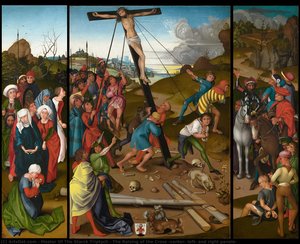
The fame of this master stems not solely from the sheer scale of his commissions, but from the profound emotional resonance found within his panels. His most notable achievement, The Raising of the Cross, serves as a breathtaking testament to his ability to weave narrative tension with spiritual gravity. In this rare example of an intact portable triptych, the artist captures a moment of immense physical and divine struggle. The central panel depicts the vertical ascent of the T-shaped cross, where Jesus, marked by blood and a crown of thorns, is hoisted upward by a group of men. The surrounding landscape, rendered with a hilly, grassy expanse, provides a stark, naturalistic backdrop to the visceral human drama unfolding in the foreground.
A Tapestry of Influence and Collaboration
While definitive attribution remains elusive, scholarly consensus suggests that the Master of the Starck Triptych was deeply influenced by the titans of Nuremberg painting: Hans Pleydenwurff and Michael Wolgemut. This artist did not work in isolation but rather within a shared workshop culture where styles bled into one another. Pleydenwurff’s meticulous attention to detail and masterful use of color palettes—particularly evident in his depictions of heavy, flowing drapery—clearly permeated the artist's approach. Simultaneously, the Master mirrored Wolgemut’s innovative compositional techniques and expressive rendering of human figures, creating a bridge between the rigid traditions of the past and the burgeoning realism of the future.
This collaborative spirit reflects a broader trend within Nuremberg at the time, where artists routinely engaged in shared projects to elevate the quality of local art production. The exterior wings of his triptychs often feature beloved figures such as Saint Barbara and Saint Catherine, representing the active and contemplative lives. Through these figures, the artist demonstrates a sophisticated understanding of religious iconography, using the saints to anchor the viewer's devotion before they are confronted by the intense, kinetic energy of the central narrative.
Technique, Style, and Lasting Legacy
Stylistically, the Master's work aligns closely with the prevailing aesthetic sensibilities of the late fifteenth century. Employing tempera paint on panel—a technique favored for its durability and capacity for luminous glazing—he skillfully executed intricate drapery folds that seem to possess their own weight and movement. However, he simultaneously embraced elements indicative of Renaissance innovation, notably a heightened realism in portraying facial expressions and anatomical details. The faces of the onlookers in his work are far from idealized; they possess pale, ruddy, or tanned skin, with some displaying gaping mouths or weathered features that ground the divine event in a recognizable human reality.
The historical significance of the Master of the Starck Triptych lies in his role as a stylistic conduit. His ability to blend the ornamental elegance of the Gothic tradition with the emerging naturalism of the German Renaissance helped define the visual language of Northern Europe. Even without a name to claim, his hand is visible in the way light catches a crimson robe or how a single drop of blood trickles from a nail. He remains a silent but powerful architect of the Nuremberg school, leaving behind a legacy of profound beauty and enduring mystery.
master of the starck triptych
Germany
Quick Facts
- Artistic Movement Or Style: Nuremberg Renaissance
- Artists Or Movements Influenced By This Artist: ['German Renaissance']
- Artists Who Influenced This Artist:
- Hans Pleydenwurff
- Michael Wolgemut
- Full Name: Master of the Starck Triptych
- Nationality: German
- Notable Artworks:
- Mademoiselle armchair
- The Raising of the Cross
- Saint Barbara
- Place Of Birth: Germany

