Preview
 Send
Send Share
Share
 Details

 Download
 Similars
 X-Ray
X-Ray Diaporama
 Stats
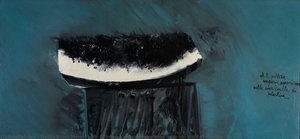
StatsAh! La povera anguria americana nella sua culla di plastica
 302.0 x 142.0 cm
 Ministero degli Affari Esteri e della Cooperazione Internazionale. Collezione Farnesina
 Read More
Giclée / Art Print
Museum-quality giclée or canvas print with fast production and flexible finish options. ( Buy Hand Made Painting Switch to Digital Image)
































Pick from our preset sizes that match the artwork's original proportions.

You may enter your own dimensions to fit a specific frame or space. If your selected size does not match the original image's proportions, we will either crop the artwork or extend the image with a mirrored or solid-fill edge. A digital mockup will be sent for your approval before production begins.
Please note that the on-screen preview does not reflect the actual cropping or extension. Only the mockup will accurately show the final composition.
While custom sizes are available, we recommend selecting a dimension from the predefined list to preserve the original proportions.
Worldwide Delivery () in 2 weeks instead of standard 4/5 weeks. (14 September)

Free Worldwide Express Shipping

High-Quality Linen Canvas

Full Shipping Insurance

Customs Tax Refund Guarantee

True Color Matching Guarantee

100-Day Return Policy (Defects Only)

100% Money-Back Guarantee

Bulk Discount Offer
 Glass option is only available in size under 110 CM

Ah! La povera anguria americana nella sua culla di plastica
Giclée / Art Print
Reproduction Size
-


Total Price
$ 63
Related Artworks








Artist Biography
A Legacy of Spontaneity: The Life and Spirit of Mattia Bruno Moreni
Born in the historic city of Pavia on November 12, 1920, Mattia Ercole Bruno Arduino Moreni entered a world that would soon be reshaped by the tremors of global conflict. His early life was marked by both personal and political resilience; born with a physical impairment to his right hand, he navigated a childhood shaped by discipline and seclusion, yet this very limitation perhaps fueled the profound expressive power found in his later works. As a young man, Moreni’s spirit was defined by an innate anticonformism. During the dark years of the fascist dictatorship, he sought refuge in the clandestine activities of the Communist Party, a choice that forced him into hiding and eventually led him to join the Italian Resistance. These formative experiences—the struggle for liberty, the tension of survival, and the raw reality of post-war reconstruction—would become the silent, pulsing heartbeat beneath his canvases and sculptures.
His artistic foundation was laid at the Accademia Albertina in Turin, where he studied under masters such as Cesare Maggi and Enrico Paulucci. In these early years, Moreni’s work moved through a fascinating evolution, beginning with naturalistic observations of landscapes and figures before gravitating toward a more introspective, expressionistic language. By the mid-1940s, his first solo exhibitions in Turin and Milan revealed an artist already breaking away from academic rigidity. His early paintings were characterized by a "visionary expressionism," where objects like fruit or animals were rendered with a destabilizing intensity, often appearing crowded and monumental within the frame. This period marked the departure from mere representation toward a style that sought to capture the psychological weight of the subject matter.
The Vanguard of Arte Informale
As the mid-20th century progressed, Moreni became a vital protagonist in the Arte Informale movement, an aesthetic revolution that rejected formal structure in favor of intuition, gesture, and the raw materiality of the medium. He was not merely a participant but a central figure within the influential Gruppo degli Otto, a collective of avant-garde thinkers including Afro Basaldene and Giulio Turcato. Through this group, Moreni helped foster a vibrant intellectual exchange that redefined Italian modernism. His work during this era embraced the fauve and expressionist traditions, moving toward an abstract language where the act of painting itself—the brushstroke, the texture, and the spontaneous movement of the hand—became the primary subject.
The significance of Moreni’s contribution lies in his ability to balance chaos with a profound sense of presence. His mastery extended beyond the canvas into the realm of sculpture, where he explored form and space with the same tactile urgency found in his paintings. His career reached significant heights through prestigious recognitions, including invitations to the XXIV Venice Biennale and participation in the National Quadrenniale in Rome. These stages allowed his voice to resonate far beyond Italy, earning him international acclaim that even caught the attention of critics at the New York Times.
Ultimately, the work of Mattia Bruno Moreni stands as a testament to the transformative power of art. He transformed personal adversity and political upheaval into a universal language of emotion. His legacy is defined by:
- The mastery of texture: Using the physical properties of paint and material to evoke tactile sensations.
- Emotional immediacy: A rejection of premeditated composition in favor of the spontaneous gesture.
- Historical resonance: Capturing the turbulent transition of Italy from the trauma of war to the creative liberation of the post-war era.
Through his dedication to the informal, Moreni ensured that art remained a living, breathing entity—one that does not merely reflect the world but actively feels its weight and its wonder.

mattia bruno moreni
1920 - 1999 , Italy
Quick Facts
- Artistic Movement Or Style: Arte Informale
- Artists Or Movements Influenced By This Artist:
- Afro Basaldella
- Renato Birolli
- Artists Who Influenced This Artist:
- Cesare Maggi
- Enrico Paulucci
- Date Of Birth: 1920
- Date Of Death: 1999
- Full Name: Mattia Bruno Moreni
- Nationality: Italian
- Notable Artworks:
- Untitled
- Ah La Povera Anguria Americana
- Place Of Birth: Pavia, Italy