 Preview
 Send
Send Share
Share
 Details

 Download
 Similars
 X-Ray
X-Ray Diaporama
Idyl


 Read More
Giclée / Art Print
Museum-quality giclée or canvas print with fast production and flexible finish options. ( Buy Hand Made Painting Buy Image)




































Pick from our preset sizes that match the artwork's original proportions.

You may enter your own dimensions to fit a specific frame or space. If your selected size does not match the original image's proportions, we will either crop the artwork or extend the image with a mirrored or solid-fill edge. A digital mockup will be sent for your approval before production begins.
Please note that the on-screen preview does not reflect the actual cropping or extension. Only the mockup will accurately show the final composition.
While custom sizes are available, we recommend selecting a dimension from the predefined list to preserve the original proportions.
Worldwide Delivery () in 2 weeks instead of standard 4/5 weeks. (16 August)

Free Worldwide Express Shipping

High-Quality Linen Canvas

Full Shipping Insurance

Customs Tax Refund Guarantee

True Color Matching Guarantee

60-Day Return Policy (Defects Only)

100% Money-Back Guarantee

Bulk Discount Offer
 Glass option is only available in size under 110 CM

Idyl
Giclée / Art Print
Reproduction Size
-


Total Price
$ 63
Collectible Description
A Celebration of Leisure and Light: Exploring Maurice Brazil Prendergast’s “Idyl”
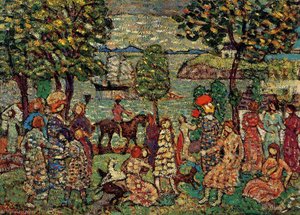
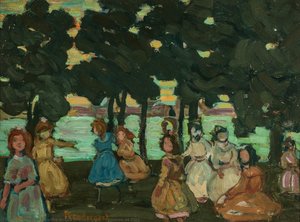
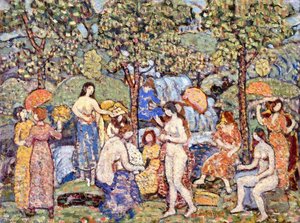
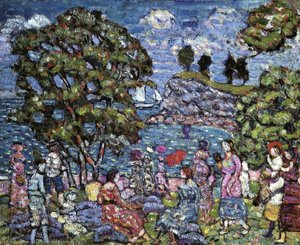
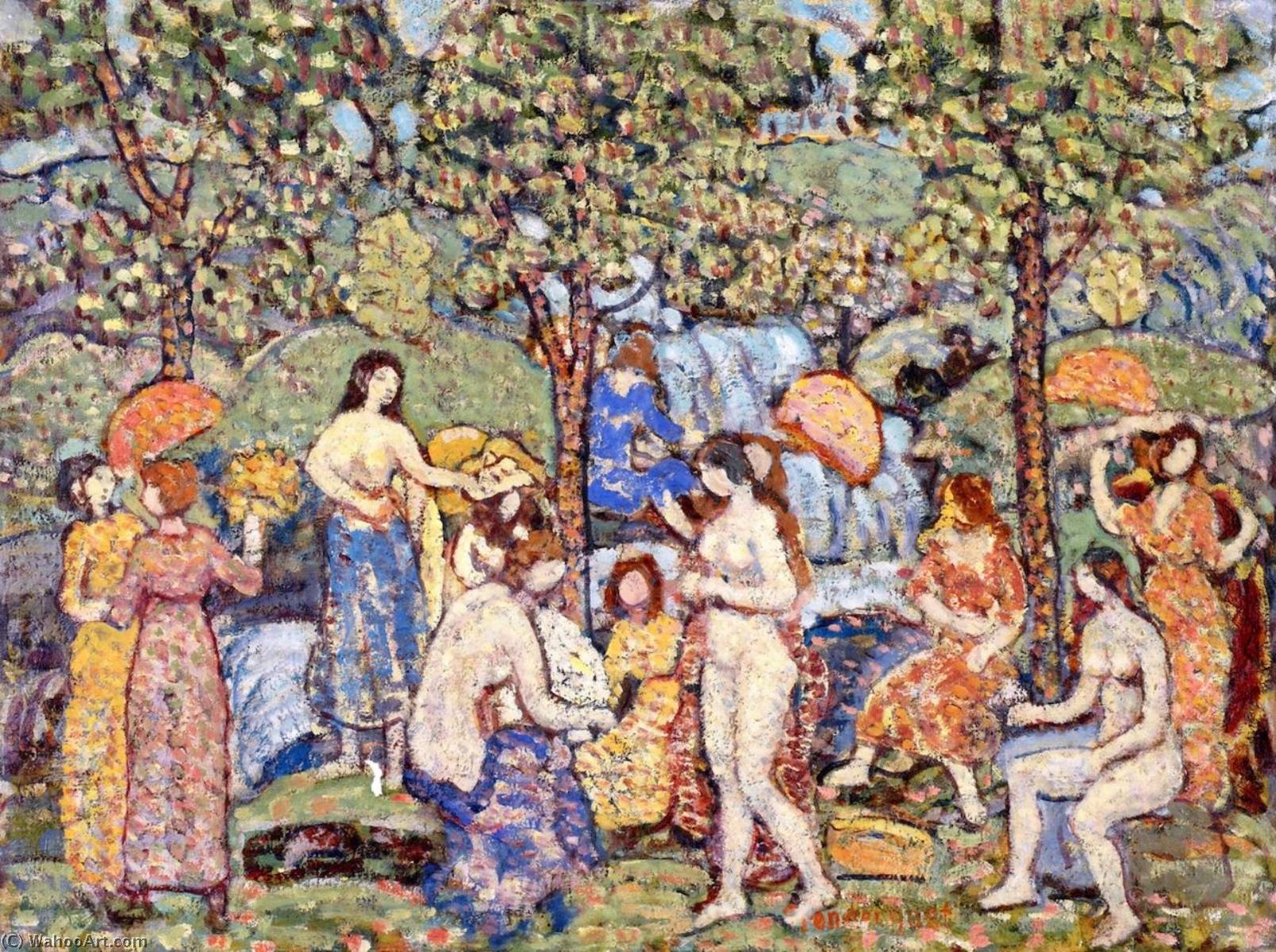
The painting "Idyl" by Maurice Brazil Prendergast stands as a testament to the burgeoning optimism of the early 20th century, capturing not merely a scene but an atmosphere—a palpable sense of joy and communion with nature. Completed in 1915 amidst the backdrop of European upheaval, this vibrant canvas offers a respite from the anxieties of its time, presenting instead a tableau of women enjoying a carefree afternoon outdoors. Located at The Barnes Foundation in Philadelphia, “Idyl” exemplifies Prendergast’s masterful embrace of Post-Impressionist principles, particularly the influence of Georges Seurat's Pointillist technique.- Style and Technique: Prendergast eschewed traditional realism, opting for a bold stylistic approach that prioritized capturing fleeting impressions rather than meticulous detail. His method—alla prima—involved applying paint directly onto the canvas in wet-on-wet layers, resulting in a textured surface brimming with visible brushstrokes. These strokes aren’t blended smoothly; instead, they are meticulously placed to create an illusion of color and luminosity, mirroring Seurat's groundbreaking use of dots of pigment.
- Color Palette: The painting’s dominant hues—warm yellows, oranges, and reds—speak volumes about the artist’s intention. These colors aren’t merely decorative; they convey a feeling of warmth, vibrancy, and vitality, mirroring the radiant sunlight filtering through the foliage surrounding the women.
- Composition: The composition is deliberately crowded, yet remarkably balanced. Figures are positioned strategically to create movement and dynamism, while overlapping shapes contribute to the overall visual density. This arrangement isn’t accidental; it reflects Prendergast's desire to convey a sense of immediacy and spontaneity.
Historical Context: A Moment of Reflected Calm
“Idyl” emerged during a period marked by significant political turbulence—the escalating tensions leading up to World War I. Yet, within this context of uncertainty, Prendergast’s painting offers an unexpected counterpoint: a celebration of beauty and tranquility. The scene depicts women engaged in leisurely activities – reclining on blankets, chatting animatedly, and admiring the flowers – representing a deliberate rejection of the grim realities confronting Europe at the time. It's as if Prendergast wished to encapsulate a moment of respite before the storm.Symbolism: Light, Femininity, and Connection
The painting’s symbolism is subtle yet profound. The dappled sunlight filtering through the trees symbolizes enlightenment and renewal, mirroring the optimistic spirit of the era. Furthermore, the nude figures—a deliberate stylistic choice—represent freedom and vulnerability, embodying ideals of beauty and grace. Perhaps most importantly, “Idyl” captures the essence of human connection – women sharing laughter and companionship in a harmonious relationship with their surroundings.Emotional Impact: An Invitation to Serenity
“Idyl” transcends mere visual representation; it evokes an emotional response. The painting’s luminous colors and energetic brushstrokes instill a feeling of warmth, joy, and contentment. It invites the viewer to step into this idyllic scene and experience the restorative power of nature alongside these graceful figures. More than just a depiction of a beautiful day, “Idyl” is a meditation on beauty, connection, and the enduring human desire for tranquility.For those seeking inspiration or considering acquiring a high-quality reproduction of Maurice Brazil Prendergast’s masterpiece, The Barnes Foundation offers exceptional resources. Explore "Idyl" in detail at The Barnes Foundation Website.
Related Artworks
Artist Biography
A Life Painted in Light: The World of Maurice Brazil Prendergast
Maurice Brazil Prendergast, a name perhaps less immediately recognizable than some of his contemporaries, nevertheless occupies a vital and luminous space within the narrative of American modernism. Born on October 10, 1858, amidst the rugged beauty of St. John’s, Newfoundland, his early life was shaped by an unusual upbringing – a family operating a subarctic trading post. This initial exposure to a stark, elemental landscape would subtly inform his later artistic vision, even as his world shifted dramatically with the family's relocation to Boston following the failure of their business venture. It was in Boston that young Maurice’s artistic inclinations began to blossom, nurtured by an apprenticeship with a commercial artist – a formative experience that instilled within him a sensitivity to color and pattern which would become hallmarks of his mature style. This early training wasn’t about grand academic tradition; it was about visual communication, about capturing attention, and this pragmatic foundation proved surprisingly potent as he evolved into a sophisticated Post-Impressionist painter.Parisian Influences and the Shaping of a Style
The true crucible for Prendergast's artistic development lay in Paris. From 1891 to 1895, he immersed himself in the vibrant art scene, studying at both the Académie Colarossi and the Académie Julian. These institutions provided him with technical grounding, but it was his encounters with the burgeoning avant-garde that truly ignited his imagination. He wasn’t simply absorbing techniques; he was witnessing a revolution in artistic thought. The influence of James McNeill Whistler, discovered through Canadian painter James Morrice, proved particularly significant, fostering an appreciation for aestheticism and harmonious color arrangements. Later exposure to artists like Édouard Vuillard and Pierre Bonnard cemented his path towards Post-Impressionism, while encounters with the works of Vincent van Gogh and Georges Seurat during retrospectives in Paris broadened his understanding of expressive form and color theory. He didn’t adopt any single style wholesale; instead, he synthesized these diverse influences into something uniquely his own – a mosaic-like approach to painting characterized by flattened forms, bold outlines, and jewel-toned hues.The Eight and Beyond: Finding His Place in American Art
Upon returning to Boston in 1895, Prendergast began to forge his distinctive artistic identity. He initially worked primarily in watercolor and monotype, mediums that allowed him to explore the delicate nuances of light and color with remarkable freedom. His subject matter often centered on scenes of modern life – leisurely moments in parks, bustling city streets, and vibrant waterfronts. These weren’t merely depictions of reality; they were carefully constructed compositions designed to evoke a sense of joy, vitality, and urban energy. His growing reputation led to inclusion among *The Eight*—a group of American artists including William Glackens, Robert Henri, and John French Sloan who sought to break away from academic conventions and depict the realities of modern American life. While Prendergast shared their desire for artistic independence, his aesthetic sensibilities differed significantly from the more socially conscious realism favored by many of his colleagues. He remained somewhat apart, a quiet observer whose work offered a different kind of commentary on modernity – one focused on beauty, harmony, and the fleeting pleasures of everyday existence. His participation in the landmark 1913 Armory Show further solidified his position within the American art world, showcasing his stylistic maturity to a wider audience.A Legacy of Light and Pattern
Despite facing health challenges throughout much of his career, Prendergast continued to exhibit and refine his artistic vision until his death in 1924. He remained a bachelor, finding companionship and support in his close relationship with his brother Charles, also an artist. His work, often overlooked during his lifetime, has since been recognized for its pioneering spirit and enduring beauty. Prendergast’s influence can be seen in the work of later American artists who embraced abstraction and explored the expressive potential of color and pattern. He was a master of capturing atmosphere and mood, transforming ordinary scenes into captivating visual experiences. His paintings are not simply representations of places; they are evocations of feelings – a sense of warmth, light, and the simple joys of being alive. He stands as a testament to the power of individual vision, an artist who dared to forge his own path and create a world painted in light and pattern, leaving behind a legacy that continues to inspire and delight audiences today.Exploring Prendergast’s World Today
Fortunately, experiencing Maurice Brazil Prendergast's artistry is readily accessible. His works are held in prominent collections such as the Smithsonian American Art Museum and the National Gallery of Art, offering opportunities for direct engagement with his vibrant canvases. Numerous online resources, including those provided by these institutions, allow art enthusiasts to delve deeper into his life and work. Furthermore, reproductions and scholarly analyses are available through platforms like ArtsDot, providing a comprehensive overview of his artistic journey and lasting impact on the landscape of American art. His paintings continue to resonate with contemporary viewers, reminding us of the enduring power of beauty, observation, and the transformative potential of color.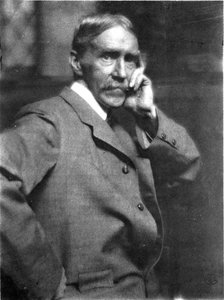
Maurice Brazil Prendergast
1858 - 1924 , Canada
Quick Facts
- Artistic Movement Or Style: Post-Impressionism
- Artists Or Movements Influenced By This Artist:
- The Eight
- American art
- Artists Who Influenced This Artist:
- Childe Hassam
- James McNeill Whistler
- Date Of Birth: October 10, 1858
- Date Of Death: February 1, 1924
- Full Name: Maurice Brazil Prendergast
- Nationality: Canadian-American
- Notable Artworks:
- Cove with Figures
- April Snow, Salem
- untitled (3207)
- Place Of Birth: St. John's, Canada
Related Articles
Beyond Light & Color: Impressionism vs. Post-Impressionism for the Discerning Collector
Explore the nuances of Impressionism & Post-Impressionism with . Expert insights for collectors on style, investment, and acquiring museum-quality reproductions.
Post-Impressionism's 10 Defining Masterpieces: Art for Your Home |
Journey through Post-Impressionism's 10 defining masterpieces – Van Gogh, Monet & more. Explore iconic paintings, art history & find museum-quality reproductions for your home at . Discover all masterpieces online!
Beyond Impressionism: Exploring the Emotional Depth of Post-Impressionist Painting
Explore the profound emotional depth & innovative techniques of Post-Impressionism with ArtsDot. Discover Cézanne, Van Gogh, Gauguin & more – and their lasting impact on modern art.
Beyond Impressionism: Exploring Emotional Depth & Formal Innovation in Post-Impressionist Art
Explore the profound emotional depth & formal innovations of Post-Impressionism with our expert guide. Discover Cézanne, Van Gogh, Gauguin & more. Learn about art history, collecting, and investing in this pivotal movement.

Impressionism's Masterpieces: 10 Paintings That Defined a Movement | ArtsDot
Journey through Impressionism's heart with 10 iconic paintings by Monet, Renoir & Degas. Explore light, color & the stories behind these masterpieces. Find museum-quality art reproductions and elevate your home decor on ArtsDot.com.