Preview
 Send
Send Share
Share
 Details

 Download
 Similars
 X-Ray
X-Ray Diaporama
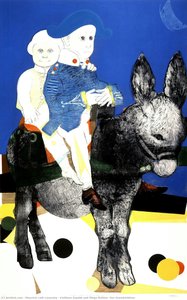
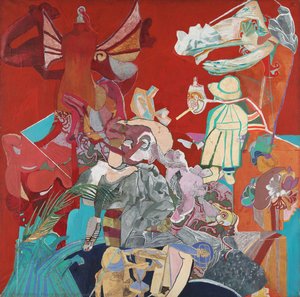
Emiliano Zapata and Diego Bolivar, Our Grandchildren


 Read More
Giclée / Art Print
Museum-quality giclée or canvas print with fast production and flexible finish options. ( Buy Hand Made Painting Buy Image)




































Pick from our preset sizes that match the artwork's original proportions.

You may enter your own dimensions to fit a specific frame or space. If your selected size does not match the original image's proportions, we will either crop the artwork or extend the image with a mirrored or solid-fill edge. A digital mockup will be sent for your approval before production begins.
Please note that the on-screen preview does not reflect the actual cropping or extension. Only the mockup will accurately show the final composition.
While custom sizes are available, we recommend selecting a dimension from the predefined list to preserve the original proportions.
Worldwide Delivery () in 2 weeks instead of standard 4/5 weeks. (6 September)

Free Worldwide Express Shipping

High-Quality Linen Canvas

Full Shipping Insurance

Customs Tax Refund Guarantee

True Color Matching Guarantee

100-Day Return Policy (Defects Only)

100% Money-Back Guarantee

Bulk Discount Offer
 Glass option is only available in size under 110 CM

Emiliano Zapata and Diego Bolivar, Our Grandchildren
Giclée / Art Print
Reproduction Size
-


Total Price
$ 63
Related Artworks






Artist Biography
The Architect of the Intaglio Renaissance
In the annals of twentieth-century graphic arts, few names command as much reverence for technical mastery and emotional depth as Mauricio Leib Lasansky. Born in 1914 to Eastern European Jewish immigrants in Buenos Aires, Argentina, Lasansky’s life was a profound journey across borders, both geographical and stylistic. The son of a Polish engraver, his very foundation was built upon the tactile language of ink and metal. From his earliest years, he displayed a precocious talent for sculpture and precision, earning accolades that hinted at the monumental force his later work would possess. His formative education in Argentina provided him with a classical rigor, yet it was his encounter with the literary giants of the era—Dostoyevsky, Lorca, and Cervantes—that infused his visual vocabulary with a deep, existential weight.
The trajectory of Lasansky’s career shifted irrevocably in 1943 when he was awarded a prestigious Guggenheim Fellowship. This opportunity propelled him from the vibrant cultural landscape of Argentina to the epicenter of the art world: New York City. It was here that his artistic metamorphosis truly began. Immersing himself in the vast, silent corridors of the Metropolitan Museum of Art, Lasansky engaged in a profound dialogue with history, studying over 100,000 prints from the masters. This period of intense study allowed him to synthesize the fragmented forms of Cubism and the haunting, psychological landscapes of Surrealism into a singular, powerful voice that would eventually define the American printmaking renaissance.
Mastery of the Plate and the Human Condition
Lasansky was far more than a mere technician; he was an explorer of the human psyche through the medium of intaglio. His mastery over complex processes—including etching, aquatint, softground, and burnishing—allowed him to manipulate light and shadow with unprecedented drama. He viewed the copper plate not just as a surface for reproduction, but as a site of physical struggle, where scraping, gouging, and acid-biting mirrored the internal conflicts of his subjects. His work often focused on the human figure, utilizing bold, fragmented forms to explore themes of war, suffering, and resilience.
Perhaps his most harrowing and historically significant contribution lies in The Nazi Drawings. Created between 1961 and 1966, this extraordinary series of monumental pencil drawings serves as a visceral confrontation with the atrocities of the Holocaust. Through these works, Lasansky moved beyond mere documentation, using raw, expressive lines to capture the profound agony and dehumanization of the era. This series, along with his celebrated engraving Dachau, solidified his reputation as an artist capable of translating historical trauma into universal symbols of human endurance.
A Legacy of Education and Innovation
Beyond the solitary labor of the print studio, Lasansky’s impact on the art world was institutional and transformative. Upon arriving at the University of Iowa, he did not merely teach; he built a legacy. He was instrumental in establishing the university's printmaking program, which became the first to offer a Master of Fine Arts degree in the field within the United States. As an educator, he mentored generations of artists, instilling in them the same reverence for craftsmanship and experimental courage that had guided his own hand. His influence was so pervasive that Time magazine famously dubbed him "the nation's most influential printmaker."
The significance of Mauricio Lasansky extends far beyond the borders of the classroom or the edges of a printed sheet. He remains a pivotal figure who bridged the gap between traditional European printmaking techniques and a modern, American aesthetic. His life’s work stands as a testament to the power of the graphic arts to confront the darkest chapters of history while celebrating the enduring complexity of the human spirit. Today, his contributions are preserved in the world's most esteemed institutions, including the National Gallery of Art and the Smithsonian American Art Museum, ensuring that his vision of strength and sorrow continues to resonate with new generations.

mauricio leib lasansky
1914 - 2012 , Argentina
Quick Facts
- Artistic Movement Or Style: Modern Printmaking
- Artists Or Movements Influenced By This Artist: ['American Modernism']
- Artists Who Influenced This Artist:
- Goya
- El Greco
- Modigliani
- Picasso
- Date Of Birth: October 12, 1914
- Date Of Death: April 2, 2012
- Full Name: Mauricio Leib Lasansky
- Nationality: Argentine-American
- Notable Artworks: ['Emiliano Zapata and Diego Bolivar, Our Grandchildren']
- Place Of Birth: Buenos Aires, Argentina