

 Preview
 Send
Send Share
Share
 Details

 Download
 Similars
 X-Ray
X-Ray Diaporama
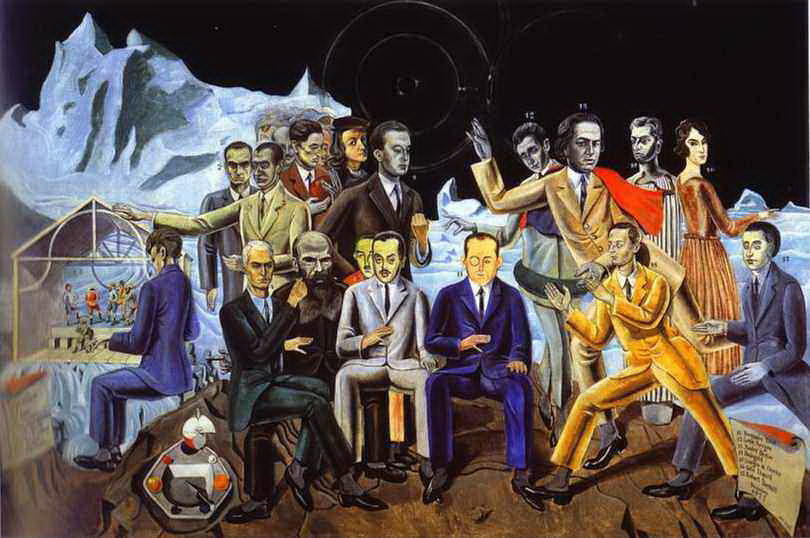
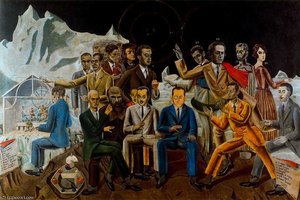
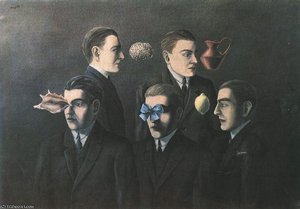
A Friends' Reunion
 Oil
Oil- WallArt
- Surrealism
 1922
1922 130.0 x 95.0 cm
 Read More
Purchase a high-resolution, enhanced digital image, far superior to the online preview.
Each file is meticulously prepared by our in-house specialists using advanced tools and expert manual retouching. We ensure every image has exceptional clarity, precise color accuracy, and fine detail.
The final file is delivered via email within 72 hours, optimized for immediate use in professional, editorial, and print environments. This is the same quality trusted by top-tier design studios, publishers, and galleries.
Digital Image
Download a high-resolution file for personal display, printing, and creative projects. ( Buy Print Buy Hand Made Painting)
Included in Every Digital Image Order
Expert Digital Delivery, Guaranteed
When you choose ArtsDot.com, you're not just getting an image - you're receiving a professionally enhanced digital artwork, crafted with precision and backed by a satisfaction guarantee. Here's everything that comes with your order, automatically:

Fast Email Delivery
Your high-resolution digital image file will be emailed to you within 72 hours of ordering - ready for immediate use.

AI-Enhanced Digital File
Your artwork is professionally optimized using advanced AI tools and manual editing, ensuring maximum detail, clarity, and color accuracy.

Free Lifetime Re-Delivery
Accidentally deleted or lost your file? No worries - we'll resend it to you anytime, free of charge.

No Import Fees - Ever
Enjoy your artwork instantly with zero customs, duties, or delivery fees - digital downloads are always tax-free.

Color Accuracy Guarantee
We ensure your digital image reflects the original colors as closely as possible using professional tools and color management.

60-Day Satisfaction Guarantee
If you're not satisfied with your digital image, we'll revise it or refund 100% within 60 days - no questions asked.

100% Money-Back Guarantee
Not satisfied? Get a full refund within 60 days of receiving your digital file - no questions asked.

Bulk Order Discounts
Buy 3 images, save 10% - Buy 5, save 15% - Buy 10+, save 20%. Great for creative projects, galleries, and agencies.
Collectible Description
The Enigmatic Gathering: Unpacking Max Ernst’s “A Friends’ Reunion”
Max Ernst’s 1922 painting, "A Friends’ Reunion," isn’t merely a depiction of a social gathering; it's an invitation into the subconscious, a carefully constructed dreamscape rendered in oil on canvas. Measuring a modest 130 x 95 cm, this work immediately captivates with its unsettling blend of realism and surrealism – a hallmark of Ernst’s distinctive style. The scene unfolds within a room brimming with figures, each engaged in seemingly random activities: seated, standing, reclining, lost in conversation or simply observing. Thirteen individuals populate the space, their attire ranging from formal to casual, their postures suggesting a complex interplay of relationships and unspoken narratives. The painting isn’t about capturing a specific moment; it's about evoking an atmosphere, a feeling of contained energy and subtle unease – a testament to Ernst’s ability to distill psychological depth into visual form.
The room itself is deceptively simple, furnished with a scattering of chairs and a prominent dining table positioned towards the left. However, it's the details that truly elevate the piece. A clock hangs prominently on the wall above the group, an insistent reminder of time’s passage and perhaps hinting at the anxieties inherent in social interaction. The muted color palette – dominated by browns, ochres, and greys – contributes to the painting’s dreamlike quality, lending it a timelessness that transcends its specific date. Ernst masterfully employs light and shadow to create depth and intrigue, drawing the viewer's eye across the crowded composition.
Surrealism in Action: Ernst’s Techniques and Influences
“A Friends’ Reunion” firmly establishes Max Ernst as a key figure within the burgeoning Surrealist movement. Emerging from the disillusionment of World War I, Surrealism sought to liberate art from the constraints of reason and logic, tapping into the realm of dreams, the unconscious, and irrationality. Ernst's approach was particularly innovative, incorporating techniques like *frottage* – a method of rubbing pencil over textured surfaces to create unexpected patterns – and *grattage*, where paint is scraped across canvas to reveal underlying layers and textures. These processes deliberately disrupted traditional artistic control, allowing for the emergence of spontaneous imagery.
The influence of Cubism is also evident in the painting’s fragmented forms and multiple perspectives. While not a direct imitation, Ernst utilizes Cubist principles – breaking down objects into geometric shapes and reassembling them from different viewpoints – to create a sense of disorientation and ambiguity. This juxtaposition of realistic elements with abstract distortions is central to Surrealist aesthetics, challenging viewers to interpret the scene on multiple levels.
Decoding the Symbolism: Faces in a Dream
The figures within “A Friends’ Reunion” are deliberately ambiguous, their identities obscured by gesture and posture. They aren't portraits in the traditional sense; instead, they represent archetypes of social interaction – the attentive listener, the engaged conversationalist, the solitary observer. The arrangement of these figures suggests a dynamic tension, a subtle power struggle beneath the surface of polite conversation. The clock, as mentioned earlier, serves as a potent symbol of time and mortality, reminding us that even in this seemingly idyllic gathering, the relentless march of time continues unabated.
Some art historians have suggested that Ernst’s use of birds – frequently appearing in his work – represents freedom and escape. The presence of these avian motifs within “A Friends’ Reunion” could be interpreted as a yearning for liberation from the constraints of social convention or perhaps a commentary on the fleeting nature of human connection. Ultimately, the painting's symbolism is open to interpretation, inviting viewers to project their own experiences and anxieties onto its enigmatic scene.
A Legacy of Innovation: Surrealism’s Enduring Impact
“A Friends’ Reunion” stands as a pivotal work in the development of modern art. Surrealism's exploration of the subconscious profoundly influenced subsequent movements, including Abstract Expressionism, Pop Art, and Conceptual Art. Ernst’s experimentation with technique and his willingness to challenge conventional artistic norms paved the way for artists to push boundaries and explore new forms of expression. His legacy continues to inspire contemporary artists who seek to disrupt established conventions and tap into the power of the imagination.
Artist Biography
A Life Immersed in the Surreal
Max Ernst, born Maximilian Maria Ernst on April 1st, 1891, in Brühl, Germany, was a restless spirit destined to become one of the most pivotal figures in 20th-century art. His journey wasn’t one of conventional artistic training; rather, it was a self-directed exploration fueled by philosophical inquiry, psychological fascination, and a profound disillusionment with societal norms. Ernst's father, a teacher of the deaf and an amateur painter, instilled in him both a sensitivity to the world and a rebellious streak against established authority. This early duality would become a defining characteristic of his artistic vision.
Ernst’s academic pursuits at the University of Bonn – encompassing philosophy, art history, literature, psychology, and psychiatry – were not merely diversions but foundational elements that deeply informed his later work. He wasn't simply interested in *how* to paint; he was grappling with *why*. This intellectual curiosity led him to encounter the groundbreaking works of Picasso, Van Gogh, and Gauguin at the Sonderbund exhibition in Cologne in 1912, a moment that irrevocably altered his artistic trajectory. The seeds of modernism had been sown.
Dada’s Disruption and the Birth of Surrealist Visions
The cataclysm of World War I proved to be a watershed moment for Ernst. His experiences as a soldier on both the Eastern and Western fronts left him profoundly shaken, fostering a deep skepticism towards established order and a yearning for new modes of expression. This disillusionment found fertile ground in the burgeoning Dada movement, which he embraced wholeheartedly after returning to Cologne in 1918. Alongside Hans Arp – a lifelong friend and collaborator – Ernst became a central figure in the Cologne Dada group, rejecting traditional artistic conventions and embracing absurdity, chance, and anti-rationality.
However, Dada was merely a stepping stone. In the early 1920s, Ernst migrated to Paris and joined the ranks of the Surrealists, led by André Breton. This marked a shift towards exploring the realm of dreams, the unconscious mind, and the irrational. Influenced by the psychoanalytic theories of Sigmund Freud, Ernst sought to unlock the hidden depths of human experience through his art. He wasn’t interested in depicting reality as it appeared but rather in revealing the underlying psychological forces that shaped it.
Pioneering Techniques: Frottage, Grattage, and Collage
Ernst's artistic innovation extended beyond subject matter; he was a relentless experimenter with technique. He didn’t simply adopt existing methods—he invented new ones. Perhaps his most famous contribution is frottage, a process of rubbing pencil or charcoal over textured surfaces to create unexpected and evocative images. This technique, born from a moment of boredom while observing wood grain, allowed Ernst to tap into the subconscious and generate forms that defied conscious control. Closely related was grattage, where paint is scraped across canvas revealing underlying layers.
He also masterfully employed collage, assembling disparate elements – images from magazines, scientific illustrations, photographs – into surreal compositions that challenged conventional notions of representation. These techniques weren’t merely stylistic choices; they were integral to his exploration of the unconscious and his desire to disrupt traditional artistic boundaries. His paintings often feature recurring symbolic imagery: birds (particularly his alter ego Loplop), desolate landscapes, unsettling juxtapositions, and a pervasive sense of mystery.
A Legacy of Innovation and Influence
The outbreak of World War II forced Ernst to flee Europe, finding refuge in the United States. He continued to paint and experiment with new techniques throughout his exile, eventually returning to France after the war where he remained active until his death on April 1st, 1976, in Paris. His influence on subsequent generations of artists is immeasurable.
Max Ernst’s contributions to Dada and Surrealism were nothing short of groundbreaking. He challenged artistic norms, delved into the depths of the subconscious mind, and invented innovative techniques that continue to inspire artists today. He wasn't merely a painter; he was an explorer, a provocateur, and a visionary who expanded the boundaries of art itself. His work remains a testament to the power of imagination, the allure of the irrational, and the enduring quest to understand the complexities of the human psyche.
- Major Works: The Entire City, Euclides, Of This Men Shall Know Nothing, Forest and Dove
- Influences: Pablo Picasso, Vincent van Gogh, Paul Gauguin, Sigmund Freud, Giorgio de Chirico
- Movements: Dada, Surrealism
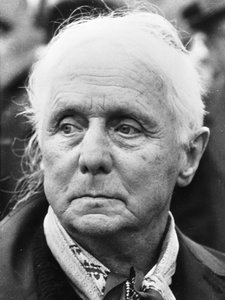
Max Ernst
1891 - 1976 , Germany
Quick Facts
- Artistic Movement Or Style: Dada, Surrealism
- Artists Or Movements Influenced By This Artist:
- Surrealism
- Dada
- Artists Who Influenced This Artist:
- Pablo Picasso
- Vincent van Gogh
- Paul Gauguin
- Giorgio de Chirico
- Date Of Birth: April 1, 1891
- Date Of Death: April 1, 1976
- Full Name: Max Ernst
- Nationality: German-American, French
- Notable Artworks:
- Ofrenda funeraria
- The Equivocal Woman
- L'Ange du foyer
- Place Of Birth: Brühl, Germany

