

 Preview
 Send
Send Share
Share
 Details

 Download
 Similars
 X-Ray
X-Ray Diaporama
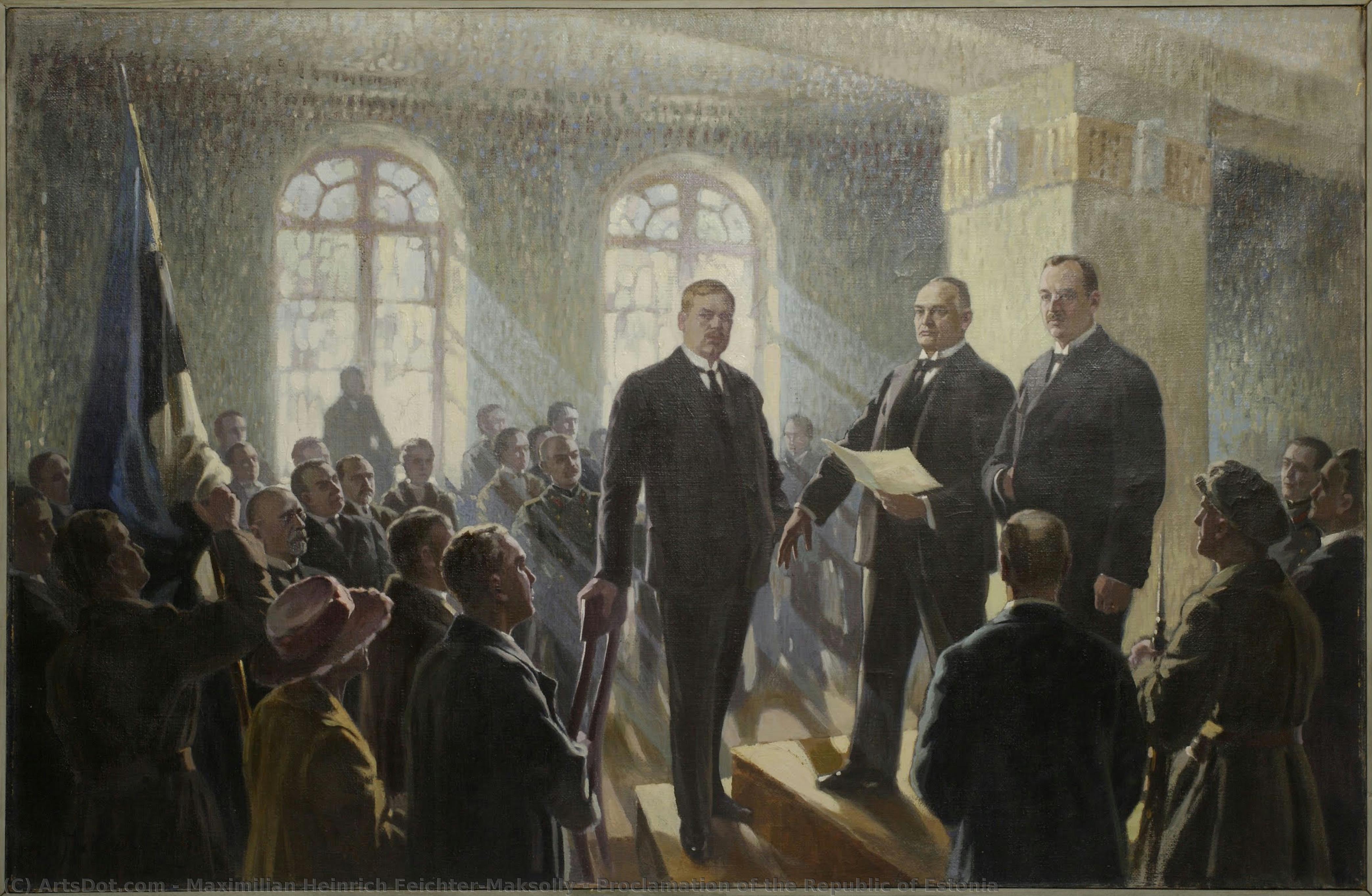
Proclamation of the Republic of Estonia


 Read More
Hand Made Oil Reproduction
Hand-painted oil on canvas in your size and frame, made to order by our artists. ( Buy Print Buy Image)




































Pick from our preset sizes that match the artwork's original proportions.

You may enter your own dimensions to fit a specific frame or space. If your selected size does not match the original image's proportions, we will either crop the artwork or extend the painting with additional hand-painted elements. A digital mockup will be sent for your approval before production begins.
Please note that the on-screen preview does not reflect the actual cropping or extension. Only the mockup will accurately show the final composition.
While custom sizes are available, we recommend selecting a dimension from the predefined list to preserve the original proportions.
After order, ArtsDot.com team will email client for instructions and provide a mockup preview
Worldwide Delivery () in 3/4 weeks instead of standard 5 weeks. (4 September). No compromise on quality.

Free Worldwide Express Shipping

High-Quality Linen Canvas

Full Shipping Insurance

Customs Tax Refund Guarantee

True Color Matching Guarantee

60-Day Return Policy (Defects Only)

100% Money-Back Guarantee

Bulk Discount Offer
 Glass option is only available in size under 110 CM

Proclamation of the Republic of Estonia
Reproduction Medium
Reproduction Size
-


Total Price
$ 263
Related Artworks








Artist Biography
A Voice of Estonian Resilience: The Life and Legacy of Maximilian Heinrich Feichter-Maksolly
In the grand tapestry of European art history, few figures embody the intersection of personal identity and national destiny as poignantly as Maximilian Heinrich Feichter-Maksolly. Born in 1880 in Tallinn, Estonia, to Hungarian parents, Maksolly’s life was a journey through the shifting borders and turbulent political landscapes of the early twentieth century. His artistic soul was forged within the prestigious halls of the Saint Petersburg Academy of Arts, where he immersed himself in the rich, burgeoning cultural currents of Imperial Russia. It was here that he mastered the delicate balance between meticulous observation and emotional expression, absorbing the luminous palettes of Impressionism and the profound, evocative depths of Symbolism. These early influences would later become the cornerstone of his ability to translate not just the physical world, but the very spirit of a nation in flux.
Maksolly’s professional maturation took place largely within the Russian Empire, where his technical prowess earned him significant commissions. He became a skilled restorer of churches and monasteries, a vocation that required an intimate understanding of sacred aesthetics and historical continuity. During this period, his portraiture flourished, as he sought to capture the nuanced personalities of the era's prominent figures with a sensitivity that transcended mere likeness. This era of his life was also marked by profound personal stability; his marriage to Klikeria Taigatsova in 1912 provided him with a lifelong partner and a steadfast muse, grounding his creative pursuits amidst a world on the brink of total transformation.
The Canvas of Conflict and Independence
The cataclysm of World War I acted as the great pivot in Maksolly’s life, redirecting his trajectory from the imperial centers of Russia back toward his Estonian roots. Traveling through Poland to reach Estonia, he arrived at a moment when the very concept of a sovereign nation was being forged in blood and fire. Driven by an urgent sense of artistic activism, Maksolly dedicated much of his subsequent career to documenting the Estonian War of Independence (1918-1920). He did not merely paint battles; he sought to immortalize the fervor of national aspiration and the heroic sacrifices made for liberty.
His works from this period are characterized by a remarkable emotional intensity, where the chaos of conflict meets the dignity of the human spirit. Notable masterpieces such as ‘Paju lahing 31. jaanuaril 1919. a.’ (Battle of Pajula Hill) and ‘Need, kes vabastasid isamaa’ (Those Who Liberated Fatherland) serve as powerful visual chronicles of the struggle for autonomy. Through his expressive brushstrokes and atmospheric use of light, he captured the grit and glory of the battlefield, ensuring that the struggles of the Estonian people were etched into the permanent record of art.
Historical Significance and Enduring Memory
Beyond the battlefield, Maksolly’s contribution to Estonian identity is perhaps most profoundly felt in his ability to idealize and commemorate the foundational moments of the Republic. His painting 'Proclamation of the Republic of Estonia' stands as a vital historical document, offering an idealized depiction of the 1924 ceremony in Tallinn. While art historians may debate its stylistic merits, its value as a record of figures like Jüri Vilms and Konstantin Päts is immeasurable. Remarkably, much of this visual heritage survived the dark era of Soviet occupation because works like these were carefully hidden within the archives of the Tallinn City Museum, escaping the systematic destruction of national memory.
The legacy of Maximilian Heinrich Feichter-Maksolly is one of profound endurance. He remains a pivotal figure whose oeuvre bridges the gap between the classical traditions of the Saint Petersburg Academy and the modern necessity of national storytelling. His life’s work serves as both a window into the aesthetic movements of his time and a mirror reflecting the resilience of the Estonian spirit, making him an indispensable chronicler of a nation's birth.
maximilian heinrich feichter-maksolly
1880 - 1968 , Estonia
Quick Facts
- Artistic Movement Or Style: Russian Art
- Date Of Birth: 1880 Tallinn Estonia
- Date Of Death: 1968 Rio de Janeiro Brazil
- Full Name: Maximilian Heinrich Feichter-Maksolly
- Nationality: Estonian
- Notable Artworks:
- Paju lahing 31. jaanuaril 1919. a.
- Need, kes vabastasid isamaa
- Place Of Birth: Tallinn Estonia

