Preview
 Send
Send Share
Share
 Details

 Download
 Similars
 X-Ray
X-Ray Diaporama
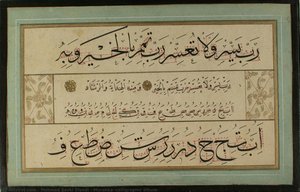
Murakka (calligraphic album)
 1863
1863 25.0 x 16.0 cm
 Sakıp Sabancı Museum
 Read More
Hand Made Oil Reproduction
Hand-painted oil on canvas in your size and frame, made to order by our artists. ( Buy Print Buy Image)




































Pick from our preset sizes that match the artwork's original proportions.

You may enter your own dimensions to fit a specific frame or space. If your selected size does not match the original image's proportions, we will either crop the artwork or extend the painting with additional hand-painted elements. A digital mockup will be sent for your approval before production begins.
Please note that the on-screen preview does not reflect the actual cropping or extension. Only the mockup will accurately show the final composition.
While custom sizes are available, we recommend selecting a dimension from the predefined list to preserve the original proportions.
After order, ArtsDot.com team will email client for instructions and provide a mockup preview
Worldwide Delivery () in 3/4 weeks instead of standard 5 weeks. (26 August). No compromise on quality.

Free Worldwide Express Shipping

High-Quality Linen Canvas

Full Shipping Insurance

Customs Tax Refund Guarantee

True Color Matching Guarantee

60-Day Return Policy (Defects Only)

100% Money-Back Guarantee

Bulk Discount Offer
 Glass option is only available in size under 110 CM

Murakka (calligraphic album)
Reproduction Medium
Reproduction Size
-


Total Price
$ 263
Related Artworks








Artist Biography
A Legacy Etched in Gold: The Life and Art of Mehmed Şevki Efendi
Born in Kastamonu, a town nestled near the Black Sea in 1829, Mehmed Şevki Efendi emerged as one of the most celebrated calligraphers of the Ottoman Empire. His journey began not within the grand schools of Istanbul, but with the quiet dedication fostered by his family and uncle, Ahmed Agha and Mehmed Hulûsi Efendi respectively. Sent to the imperial capital at a young age, Şevki’s early education was steeped in traditional Islamic learning, laying the foundation for a life devoted to the exquisite art of calligraphy. While initially encouraged to seek tutelage under the renowned Kazasker Mustafa Izzet Efendi, Şevki possessed an independent spirit and chose instead to refine his skills alongside his uncle, forging a unique path that would ultimately define his own distinctive style – the *Şevki Mektebi* school. This decision proved pivotal, allowing him the freedom to absorb influences from masters like Hâfiz Osman while simultaneously cultivating a personal aesthetic that resonated with unparalleled grace and precision.The Flourishing of a Unique Style
Şevki Efendi’s mastery lay primarily in the *thuluth* and *naskh* scripts, two cornerstones of Islamic calligraphy revered for their elegance and complexity. He didn't merely replicate these forms; he elevated them to new heights of perfection. His work is characterized by a harmonious balance between boldness and delicacy, achieved through meticulous attention to detail and an innate understanding of the rhythmic flow of the pen. He was known for his unwavering commitment to tradition, yet possessed an innovative spirit that allowed him to subtly push boundaries within established conventions. This dedication resulted in a style so refined it became a benchmark for subsequent generations of calligraphers. He achieved what many consider “a height of perfection never attained previously, nor surpassed since.” His compositions weren’t simply beautiful arrangements of letters; they were spiritual expressions rendered visible through the artful manipulation of ink and gold leaf.A Life Dedicated to Teaching and Imperial Service
Beyond his personal artistic pursuits, Şevki Efendi dedicated a significant portion of his life to education. He served as a calligraphy teacher within the Ministry of War, imparting his knowledge to military scribes who were responsible for producing official documents and correspondence. This role underscored the importance of calligraphy in Ottoman society – it wasn’t merely an aesthetic practice but a vital skill essential for maintaining administrative functions. Furthermore, he was entrusted with the prestigious task of teaching penmanship to the sons of Sultan Abdulhamid II, solidifying his position as a leading figure within the imperial court. His influence extended far beyond the confines of the classroom and palace walls; through his students, Şevki’s style permeated various facets of Ottoman artistic life.Major Achievements and Enduring Legacy
Throughout his career, Mehmed Şevki Efendi produced an astonishing body of work, including twenty-five complete copies of the Quran – each a testament to his unwavering devotion and exceptional skill. He also created numerous personal prayer books, adorned with intricate calligraphic compositions bearing his signature, “Muhammed Shawki.” His most significant contribution, however, lies in the establishment of the *Şevki Mektebi* school, which continues to inspire contemporary calligraphers today. The principles he espoused – a reverence for tradition combined with an innovative spirit and meticulous attention to detail – remain central to the practice of Ottoman calligraphy. His work, including his treatise on *Thuluth & Naskh Mashqs*, serves as a valuable resource for students and scholars alike, ensuring that his legacy endures.Historical Significance: The Last of a Great Lineage
Mehmed Şevki Efendi occupies a unique position in the history of Islamic calligraphy. He is often regarded as the last in a long and illustrious lineage stretching back to Sheikh Hamdullah, the 15th-century master who revolutionized the *sülüs* and *naskh* scripts. He not only preserved the traditions of his predecessors but also refined them, pushing the boundaries of artistic expression while remaining deeply rooted in Islamic aesthetics. His work reflects the cultural richness and spiritual depth of the Ottoman Empire during a period of significant change. The exquisite beauty and technical mastery of his calligraphy continue to captivate audiences today, serving as a powerful reminder of a golden age of Islamic art and a testament to the enduring power of human creativity. He passed away in 1887 following a stroke, leaving behind a legacy etched not just in ink and gold, but in the hearts and minds of generations of calligraphers who continue to draw inspiration from his unparalleled artistry.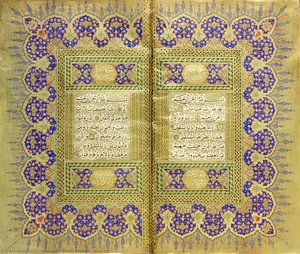
Quick Facts
- Artistic Movement Or Style: Thuluth-Naskh calligraphy
- Artists Or Movements Influenced By This Artist:
- Mohammad Hosni
- Şevki Mektebi school
- Artists Who Influenced This Artist: ['Hâfiz Osman']
- Date Of Birth: 1829
- Date Of Death: 1887
- Full Name: Mehmed Şevki Efendi
- Nationality: Ottoman
- Notable Artworks:
- Qur’an (1862)
- Murakka album
- Place Of Birth: Kastamonu, Turkey