 Preview
 Send
Send Share
Share
 Details

 Download
 Similars
 X-Ray
X-Ray Diaporama
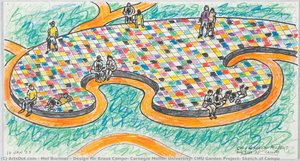
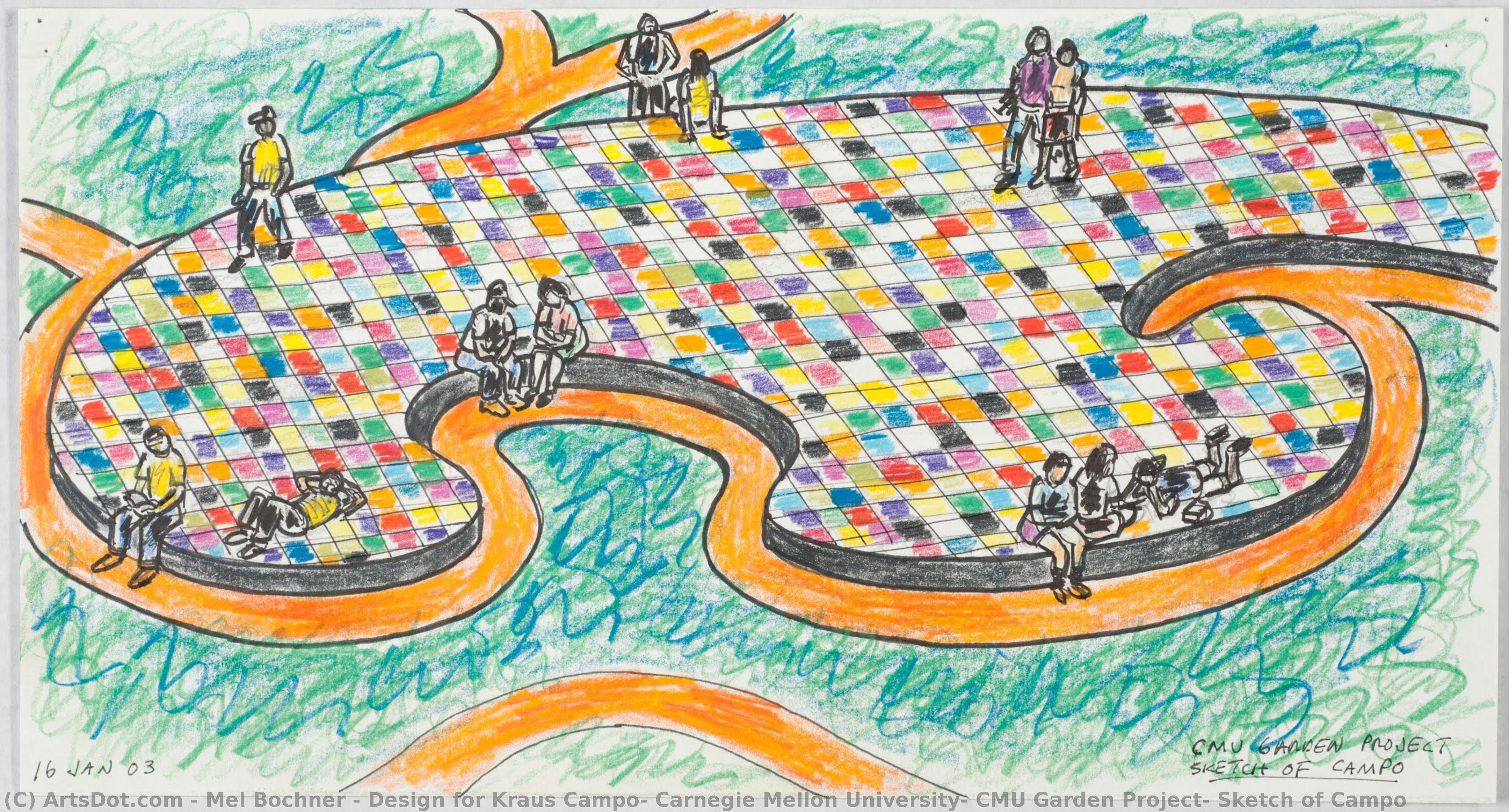
Design for Kraus Campo, Carnegie Mellon University: CMU Garden Project, Sketch of Campo

 Read More
Hand Made Oil Reproduction
Hand-painted oil on canvas in your size and frame, made to order by our artists. ( Buy Print Buy Image)




































Pick from our preset sizes that match the artwork's original proportions.

You may enter your own dimensions to fit a specific frame or space. If your selected size does not match the original image's proportions, we will either crop the artwork or extend the painting with additional hand-painted elements. A digital mockup will be sent for your approval before production begins.
Please note that the on-screen preview does not reflect the actual cropping or extension. Only the mockup will accurately show the final composition.
While custom sizes are available, we recommend selecting a dimension from the predefined list to preserve the original proportions.
After order, ArtsDot.com team will email client for instructions and provide a mockup preview
Worldwide Delivery () in 3/4 weeks instead of standard 5 weeks. (22 August). No compromise on quality.

Free Worldwide Express Shipping

High-Quality Linen Canvas

Full Shipping Insurance

Customs Tax Refund Guarantee

True Color Matching Guarantee

60-Day Return Policy (Defects Only)

100% Money-Back Guarantee

Bulk Discount Offer
 Glass option is only available in size under 110 CM

Design for Kraus Campo, Carnegie Mellon University: CMU Garden Project, Sketch of Campo
Reproduction Medium
Reproduction Size
-


Total Price
$ 263
Related Artworks


Artist Biography
The Linguistic Turn: Mel Bochner's Conceptual Exploration
Mel Bochner, born in 1940 in Pittsburgh, Pennsylvania, emerged as a pivotal figure within the conceptual art movement of the late 1960s and early 70s. His work isn’t defined by objects so much as by ideas – specifically, those concerning language, perception, and the very nature of representation itself. Unlike many artists who turned to minimalism's formal purity, Bochner saw limitations in its self-referentiality. He believed that art needed to engage with the world beyond its own boundaries, and for him, that engagement began with the recognition that all experience is mediated through language. His early life wasn’t steeped in a traditional artistic environment; he initially pursued an academic path, earning a B.A. from Carnegie Mellon University in 1962 and later a Ph.D. in philosophy from Northwestern University in 1966. This philosophical grounding profoundly shaped his artistic trajectory, providing him with the tools to dissect the assumptions underlying visual experience and the systems we use to understand it. He wasn’t interested in *what* art looked like, but rather *how* we know what it looks like – a question that led him directly into the realm of linguistic investigation.From Measurement to Meaning: Early Works & Conceptual Strategies
Bochner's early works, often described as “measurement” pieces, were deceptively simple. He created grids and charts documenting seemingly mundane aspects of his studio environment—the number of books on a shelf, the dimensions of walls, or the frequency of certain colors in paintings he encountered. These weren’t attempts at objective recording; they were deliberate disruptions of traditional artistic processes. By focusing on the act of measurement itself, Bochner highlighted the inherent subjectivity involved in even the most seemingly neutral observations. He challenged the notion that art could be divorced from its context or the artist's own perspective. This period saw a shift away from tangible artworks towards instructions and proposals – works existing primarily as ideas documented through text and photographs. His famous “Working Drawings” series (1966-70) exemplified this strategy, presenting mathematical formulas and linguistic statements as art in their own right. These weren’t blueprints for sculptures or paintings; they *were* the artwork, emphasizing the conceptual framework over physical manifestation. He deliberately eschewed traditional artistic skill, arguing that the idea was paramount, and its execution secondary. This radical approach aligned him with other key conceptual artists like Sol LeWitt and Joseph Kosuth, who were similarly questioning the definition of art itself.The Rise of Text & The Exploration of Linguistic Conventions
By the early 1970s, Bochner’s work became increasingly focused on language as its primary medium. He began creating large-scale wall paintings featuring phrases and statements that directly addressed the viewer's perception and understanding of space and meaning. Works like “Inside Out” (1972) and “For Unseen Forces” (1973) employed bold, declarative sentences painted directly onto gallery walls, forcing viewers to confront the relationship between language, thought, and visual experience. These weren’t simply words *about* art; they were attempts to embody linguistic structures within a visual field. He explored the inherent ambiguities of language, highlighting how meaning is always contingent on context and interpretation. Bochner wasn't interested in using language poetically or metaphorically; he sought to expose its underlying logic and conventions. His use of repetition, fragmentation, and unconventional syntax further emphasized the instability of linguistic systems.- Influence of Wittgenstein: The philosopher Ludwig Wittgenstein’s theories on language games and the limits of representation were a crucial influence on Bochner's work.
- Semiotics & Structuralism: He engaged with emerging fields like semiotics and structuralism, exploring how signs and symbols function within broader cultural contexts.
Later Developments & Enduring Legacy
Throughout the 1980s and beyond, Bochner continued to refine his linguistic explorations, incorporating new materials and techniques. He began using photographs and digital imagery alongside text, creating complex works that layered different modes of representation. His “Incidents” series (1991-2003) combined photographic documentation with handwritten annotations, blurring the boundaries between observation, memory, and language. His work consistently challenges viewers to question their own assumptions about perception and meaning. Bochner’s influence on contemporary art is profound. He paved the way for a generation of artists who embraced conceptual strategies and explored the relationship between language, image, and power. His rigorous intellectual approach and his commitment to demystifying artistic processes continue to resonate with artists today. He demonstrated that art doesn't need to be beautiful or visually striking to be powerful; it can be intellectually challenging, conceptually provocative, and deeply engaging. Bochner’s enduring legacy lies in his ability to transform the very language of art itself, forcing us to reconsider how we see, think, and understand the world around us. He remains a vital voice in contemporary art, continually pushing the boundaries of artistic expression and prompting critical reflection on the nature of representation.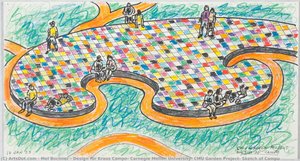
Quick Facts
- Artistic Movement Or Style: Conceptual Art, Text-based art
- Current Meta Description: Explore his influential contributions to modern art.
- Current Meta Keywords: mel bochner, Conceptual art
- Full Name: Mel Bochner
- Notable Artworks:
- Measurements
- Counting
- In Numbers