 Preview
 Send
Send Share
Share
 Details

 Download
 Similars
 X-Ray
X-Ray Diaporama
La señora
 Painting
- Contemporary Realism
 2000
2000- Contemporary
 38.0 x 30.0 cm
 Fundación Universidad de las Américas Puebla
 Read More
Hand Made Oil Reproduction
Hand-painted oil on canvas in your size and frame, made to order by our artists. ( Buy Print Buy Image)




P118B $10

P118H $10

P118W $10

P438Z $10

P508JH $12

P508YH $12

P805H $10

P805Z $10

P919BZ $10

P919G $10

P919XJ $10

P959ZH $10

P968JZ $12

W106C $8

W218G $10

W218JH $8

W218Y $10

W307PJ $10

W316G $10

W316PJ $8

W316Y $10

W398PJ $8

W4111J $10

W500HY $15

W500JH $15

W692G $12

W849H $8

W940BG $15

W953PJ $8




Pick from our preset sizes that match the artwork's original proportions.

You may enter your own dimensions to fit a specific frame or space. If your selected size does not match the original image's proportions, we will either crop the artwork or extend the painting with additional hand-painted elements. A digital mockup will be sent for your approval before production begins.
Please note that the on-screen preview does not reflect the actual cropping or extension. Only the mockup will accurately show the final composition.
While custom sizes are available, we recommend selecting a dimension from the predefined list to preserve the original proportions.
After order, ArtsDot.com team will email client for instructions and provide a mockup preview
Worldwide Delivery () in 3/4 weeks instead of standard 5 weeks. (24 August). No compromise on quality.

Free Worldwide Express Shipping

High-Quality Linen Canvas

Full Shipping Insurance

Customs Tax Refund Guarantee

True Color Matching Guarantee

60-Day Return Policy (Defects Only)

100% Money-Back Guarantee

Bulk Discount Offer
 Glass option is only available in size under 110 CM

La señora
Reproduction Medium
Reproduction Size
-


Total Price
$ 263
Artwork Description
A Dreamscape of Memory and Presence
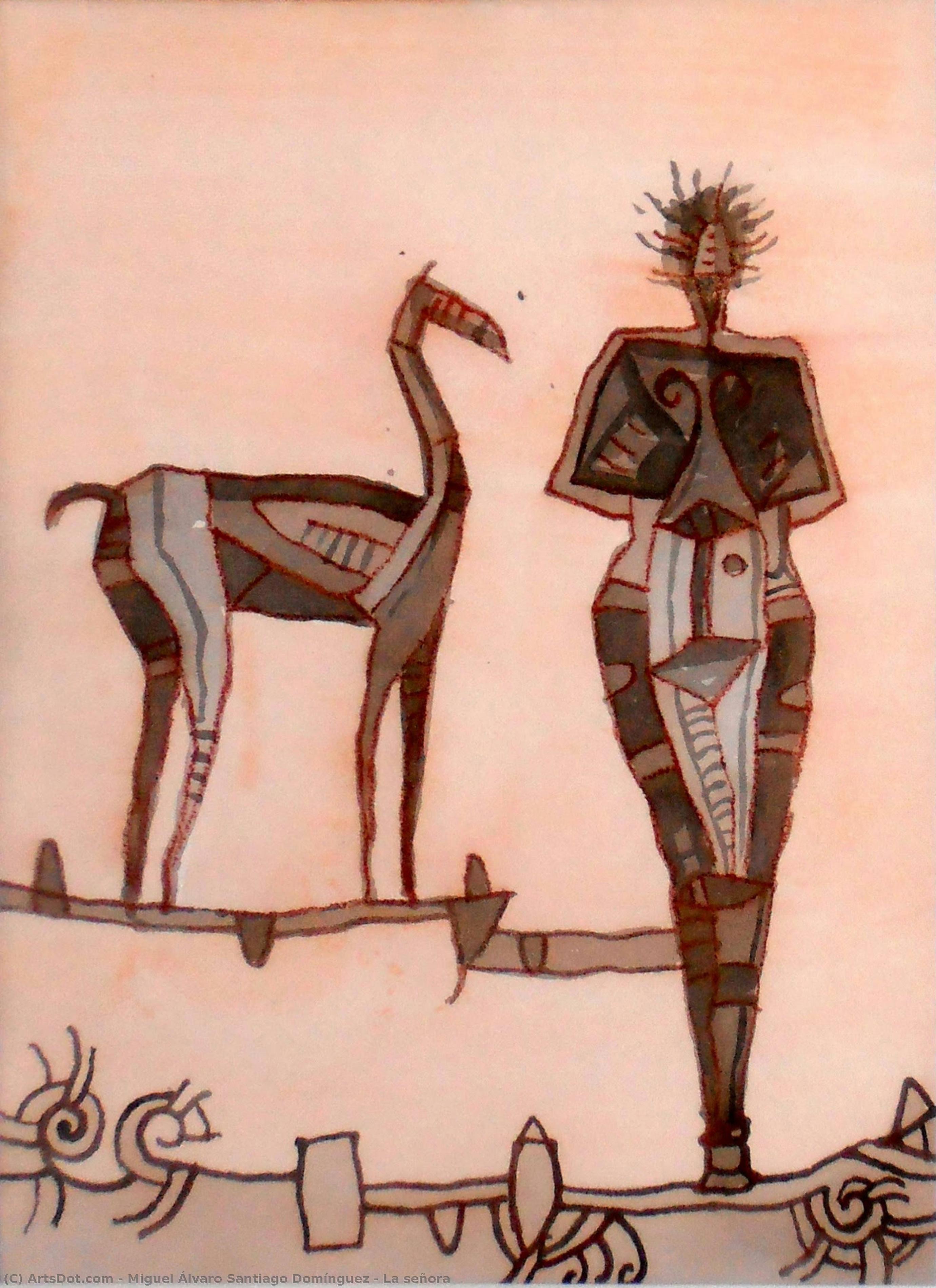
In the evocative realm of Álvaro Santiago, reality often dissolves into what critics have termed "Kaleidoscope Dreams," and nowhere is this more palpable than in his poignant work, La señora. Created in the year 2000, this intimate painting serves as a window into a world where the boundaries between the human spirit and the natural environment are beautifully blurred. The composition presents us with a profound moment of stillness: a woman and a man standing side by side, their presence anchored against a textured wall that feels both solid and ephemeral. The inclusion of a bird perched delicately upon the woman's shoulder introduces an element of fragile companionship, suggesting a deep, symbiotic connection between humanity and the wilder, more instinctual parts of our existence.
The scene is far from solitary; it is populated by a subtle choreography of life. Scattered throughout the canvas, birds drift through the space like fragments of a wandering thought, while the unexpected presence of a horse to the left adds a layer of mythic weight to the composition. This juxtaposition of domesticity and the untamed creates a narrative tension that invites the viewer to linger. Is this a captured moment from a shared memory, or a surrealist vision of a dreamscape? Santiago’s ability to weave these disparate elements—the human, the avian, and the equine—into a singular, cohesive atmosphere is a testament to his mastery over symbolic storytelling.
Technique and the Texture of Emotion
The technique employed in La señora reflects the artist's unique position between abstraction and surrealism. Through a careful application of pigment, Santiago creates a surface that feels alive with movement and depth. The brushwork does not merely define shapes; it breathes life into the textures of the wall, the feathers of the birds, and the heavy fabric of the man's hat. There is a palpable sense of weight and shadow that lends the piece a sculptural quality, making the subjects feel as though they are emerging from the very canvas itself.
For the discerning collector or interior designer, this piece offers an unparalleled emotional resonance. The color palette and the layered composition provide a sophisticated focal point that can anchor a room, offering both a sense of quiet contemplation and a conversation-starting complexity. Whether placed in a contemporary gallery setting or a classic study, La señora brings with it an aura of mystery and timelessness. It is not merely a painting of figures; it is an invitation to explore the fragmented nature of our own identities and the beautiful, often enigmatic, connections that bind us to the world around us.
Related Artworks




Artist Biography
The Enigmatic Vision of Miguel Álvaro Santiago Domínguez – “Álvaro Santiago”
Miguel Álvaro Santiago Domínguez, more commonly known as “Álvaro Santiago,” is a figure shrouded in intriguing layers of artistic and footballing history. Born on February 23rd, 1949, in Spain, his life has been marked by both a passionate dedication to the beautiful game and an equally compelling journey into the realm of visual art – specifically, large-scale, intensely evocative paintings often referred to as “Kaleidoscope Dreams.” While his football career provided a foundation, it’s Santiago's artistic output that truly defines his legacy, revealing a mind grappling with themes of memory, identity, and the fragmented nature of experience. His work isn’t easily categorized; it exists in a space between surrealism, abstraction, and a deeply personal exploration of the subconscious.Early Life and Transition to Art
Santiago's early life was rooted in Spain, specifically within the context of professional football. He began his career as a defender with CF Valdepeñas before joining CE Sabadell FC in 1973, playing until the end of the 1980-81 season. This period provided him with a disciplined mind and an understanding of spatial awareness – qualities that would later translate surprisingly well to his artistic practice. However, around the mid-1980s, Santiago made a pivotal shift, abandoning football for painting. The exact reasons behind this transition remain somewhat elusive, fueled by speculation about disillusionment within the sport and a burgeoning desire to express himself through a different medium. He began experimenting with large canvases, often employing a unique technique involving layers of acrylic paint applied with palette knives and sponges, creating textures that resemble both landscapes and abstract patterns.The “Kaleidoscope Dream” Technique
Santiago’s distinctive style is immediately recognizable as the "Kaleidoscope Dreams." This method involves meticulously building up multiple layers of color – predominantly blues, greens, yellows, and reds – onto vast canvases, sometimes reaching dimensions of over 6 by 8 feet. The process isn't about creating representational images; instead, it’s a deliberate attempt to capture fleeting memories, emotional states, and the feeling of disorientation that can accompany recollection. He describes his work as “a visual diary,” documenting moments of intense emotion or sensory overload. Santiago often speaks of accessing subconscious imagery through this layering process, allowing colors and textures to coalesce into evocative forms that suggest both familiarity and strangeness. The technique is incredibly labor-intensive, requiring months – sometimes years – to complete a single piece.Influences and Artistic Connections
Santiago’s artistic development has been shaped by a diverse range of influences. He cites the works of Joan Miró and Max Ernst as key inspirations, particularly their exploration of subconscious imagery and dreamlike landscapes. The influence of surrealism is undeniable in his use of unexpected juxtapositions and symbolic elements. However, Santiago's work also possesses a distinctly Spanish sensibility, reflecting the country’s rich artistic heritage and its complex relationship with memory and identity. Furthermore, his connection to the art world extends beyond purely theoretical influences; he has collaborated with various galleries and institutions, including ArtsDot.com, showcasing his work internationally. His association with Cintas Foundation further highlights his recognition as a significant contemporary artist.Themes of Memory, Identity, and Fragmentation
At the heart of Santiago’s art lies an exploration of memory – not as a linear narrative, but as a fragmented, subjective experience. He frequently references childhood memories, personal relationships, and moments of intense emotion, translating these intangible feelings into tangible visual forms. The “Kaleidoscope Dreams” themselves can be interpreted as representations of this fractured process of recollection, with their swirling colors and ambiguous shapes mirroring the way memories surface and shift over time. His work also grapples with themes of identity – particularly the sense of displacement and alienation that can arise from navigating multiple cultural contexts. Santiago’s Spanish heritage is interwoven throughout his art, yet he often portrays a feeling of being both rooted in tradition and adrift in a rapidly changing world. The recurring motifs—often resembling architectural fragments or distorted landscapes—suggest a yearning for stability amidst chaos, a search for meaning within the fragmented realities of modern life. His work invites viewers to contemplate their own subjective experiences of memory and identity, prompting a dialogue about the nature of perception and the elusive quality of truth.
miguel álvaro santiago domínguez
1949 - , Spain
Quick Facts
- Artistic Movement Or Style: Footballer
- Artists Or Movements Influenced By This Artist: ['None specified']
- Artists Who Influenced This Artist: ['None specified']
- Date Of Birth: February 23, 1949
- Full Name: Miguel Álvaro Santiago Domínguez
- Nationality: Spanish
- Notable Artworks: ['La señora']
- Place Of Birth: Spain (Valdepeñas)
Related Articles
Feathered Visions: A Historical & Artistic Exploration of Birds in Painting
Explore the rich history of birds in painting! Discover symbolism, artistic movements & master artists like Audubon. High-quality reproductions available at ArtsDot.

Charles Bird King: Capturing Native American Dignity Through Portraiture & Cultural Exchange
Explore the captivating portraits of Charles Bird King, renowned for his depictions of Native American leaders. Discover the historical context, artistic techniques, and collecting value of these significant 19th-century artworks.

Henri Matisse's Masterpieces: Explore 25 Iconic Paintings & Art Decor Ideas
Journey through Henri Matisse's 25 most iconic paintings! Explore Fauvism, vibrant colors & the stories behind masterpieces like 'The Dance'. Find museum-quality art reproductions and curated decor ideas to elevate your space. Discover all masterpieces on ArtsDot.com.

John James Audubon: A Life Immersed in Ornithological Art & the American Wilderness
Explore the life & art of John James Audubon, pioneer of ornithological illustration! Discover his stunning 'Birds of America' watercolors and complex legacy. Hand-painted reproductions available at ArtsDot.
Cubist Portraits: 10 Masterpieces That Revolutionized Art | ArtsDot
Explore 10 revolutionary Cubist portraits by Picasso, Braque & more! Discover the stories behind these iconic paintings and how they shaped modern art. Find museum-quality reproductions to elevate your home decor on ArtsDot.com.