 Preview
 Send
Send Share
Share
 Details

 Download
 Similars
 X-Ray
X-Ray Diaporama
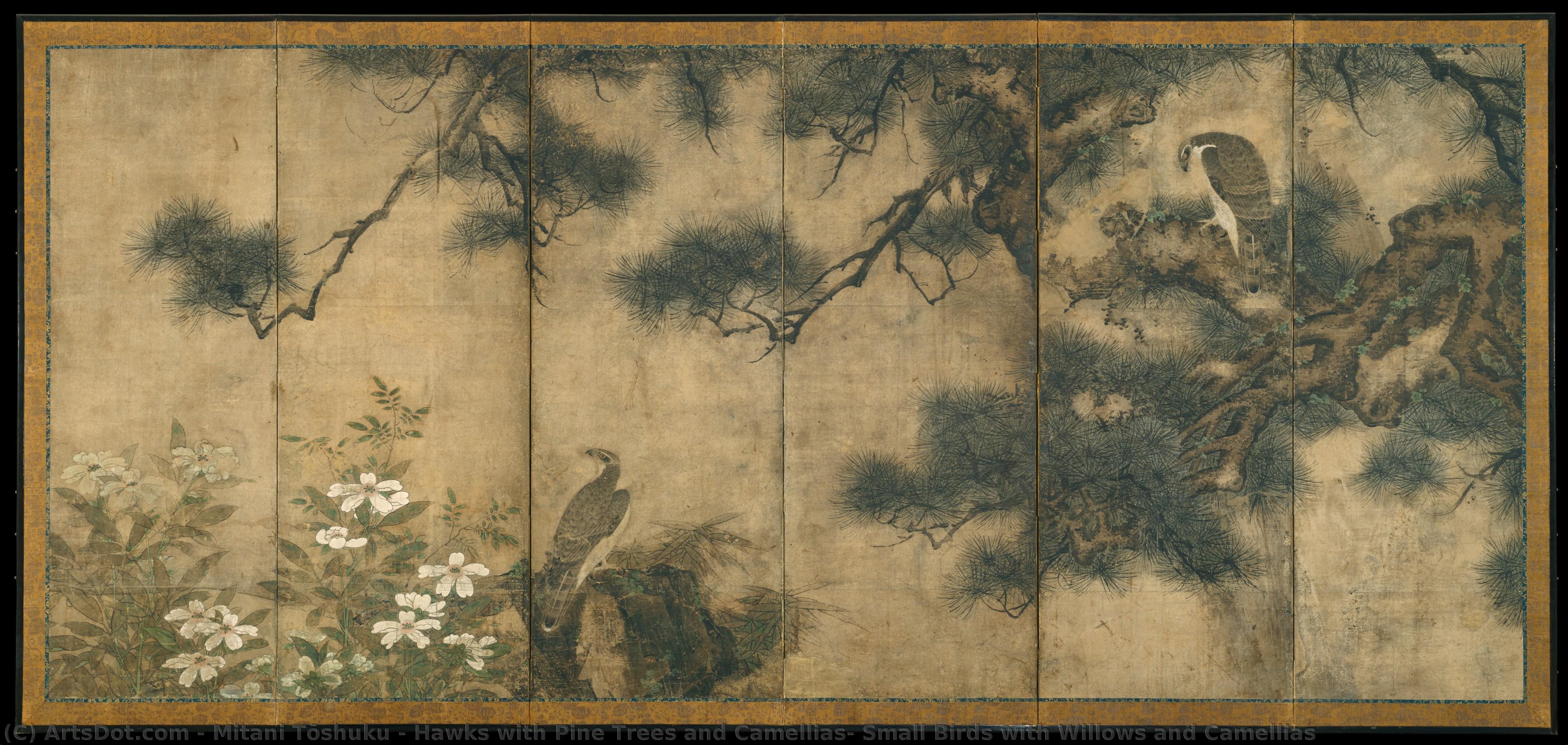
Hawks with Pine Trees and Camellias; Small Birds with Willows and Camellias
 601
601 148.0cm x 327.0cm
 Read More
Hand Made Oil Reproduction
Hand-painted oil on canvas in your size and frame, made to order by our artists. ( Buy Print Buy Image)




































Pick from our preset sizes that match the artwork's original proportions.

You may enter your own dimensions to fit a specific frame or space. If your selected size does not match the original image's proportions, we will either crop the artwork or extend the painting with additional hand-painted elements. A digital mockup will be sent for your approval before production begins.
Please note that the on-screen preview does not reflect the actual cropping or extension. Only the mockup will accurately show the final composition.
While custom sizes are available, we recommend selecting a dimension from the predefined list to preserve the original proportions.
After order, ArtsDot.com team will email client for instructions and provide a mockup preview
Worldwide Delivery () in 3/4 weeks instead of standard 5 weeks. (27 August). No compromise on quality.

Free Worldwide Express Shipping

High-Quality Linen Canvas

Full Shipping Insurance

Customs Tax Refund Guarantee

True Color Matching Guarantee

60-Day Return Policy (Defects Only)

100% Money-Back Guarantee

Bulk Discount Offer
 Glass option is only available in size under 110 CM

Hawks with Pine Trees and Camellias; Small Birds with Willows and Camellias
Reproduction Medium
Reproduction Size
-


Total Price
$ 263
Artwork Description
Introduction
Mitani Tōshuku, a prominent member of the Unkoku school, was a Japanese painter of the Edo period (1603-1868). He is known for his depictions of birds and flowers, painted in a manner very similar to his master, Unkoku Togan. One of his most famous works is 'Hawks with Pine Trees and Camellias; Small Birds with Willows and Camellias' (Mitani Toshuku: Hawks with Pine Trees and Camellias; Small Birds with Willows and Camellias).Style
Mitani Tōshuku painted in a style that was heavily influenced by Chinese painting, particularly the Ming dynasty. He used ink and color on paper or silk to create delicate and intricate compositions. His brushwork is fluid and expressive, with a strong emphasis on calligraphic lines. The use of empty space, or 'ma', in his paintings creates a sense of balance and harmony.Symbolism
In Japanese culture, birds and flowers are often used as symbols of the changing seasons. In this painting, hawks represent strength and courage, while camellias symbolize love and devotion. The willows and pine trees are traditional symbols of longevity and resilience. By combining these elements, Mitani Tōshuku created a visual representation of the beauty and transience of life.Historical Context
The Unkoku school was founded by Unkoku Togan in 1600, at the beginning of the Edo period. This was a time of peace and prosperity in Japan, which allowed for the development of new artistic styles and techniques. The Unkoku school was known for its innovative approach to ink painting, which emphasized individual expression and creativity. Mitani Tōshuku was one of the most talented painters of this school, and his work reflects the cultural and artistic values of his time.Conclusion
Mitani Tōshuku's 'Hawks with Pine Trees and Camellias; Small Birds with Willows and Camellias' is a masterpiece of Japanese painting, which showcases the artist's skillful use of ink and color, as well as his deep understanding of symbolism and historical context. At https://ArtsDot.com, we are proud to offer high-quality reproductions of this painting, handmade by our skilled artisans using traditional techniques. Whether you are an art collector or a lover of Japanese culture, our reproductions are a perfect addition to any home or office decor.Related Paintings
Note: All paintings are available for purchase at https://ArtsDot.com.Related Artworks









Artist Biography
The Quiet Legacy of Mitani Toshuku: A Master of the Unkoku School
Mitani Toshuku, born in Yamaguchi, Japan in 1577 and passing away in 1654, occupies a fascinating yet often understated position within the landscape of Edo period Japanese painting. He wasn’t a revolutionary figure shattering conventions, but rather a devoted custodian and subtle extender of a powerful artistic lineage – that of the Unkoku school. To understand Toshuku is to appreciate the profound impact of his teacher, Unkoku Tōgan, and the delicate balance between emulation and individual expression within a highly formalized tradition. The Momoyama period had witnessed the flourishing of bold, dynamic styles, often associated with warrior patronage and grand decorative schemes. Tōgan, emerging from this milieu, distilled these energies into a uniquely refined aesthetic characterized by powerful brushwork, striking compositions, and a restrained palette, frequently focusing on themes drawn from nature – particularly birds and flowers. Toshuku inherited not just Tōgan’s techniques but also his spirit; he became the most important follower of Unkoku, ensuring the school's continued vitality well into the Edo period.A Life Dedicated to Brush and Ink
Details surrounding Mitani Toshuku’s life remain somewhat sparse, a common characteristic for artists operating within established schools who prioritized stylistic continuity over individual notoriety. He was born into a regional samurai family, which likely afforded him access to education and the resources necessary to pursue artistic training. His dedication to Tōgan's style suggests a deep personal resonance with its philosophical underpinnings – a reverence for nature, an appreciation of simplicity, and a commitment to technical mastery. Unlike some artists who travelled extensively or sought patronage from diverse sources, Toshuku appears to have remained largely within the orbit of his master’s influence, focusing on perfecting the Unkoku aesthetic rather than forging entirely new paths. This isn't to say he was merely a copyist; instead, he embodied a profound understanding of Tōgan’s principles, allowing him to create works that were both faithful and subtly nuanced. He did not adopt the *Unkoku* name for himself, which speaks volumes about his humility and respect for his teacher's legacy.The Essence of Unkoku: Birds, Flowers, and Subtlety
Toshuku’s paintings are immediately recognizable as belonging to the Unkoku school. He excelled in depicting birds and flowers with a remarkable economy of line and a masterful control of ink wash techniques. His compositions often feature solitary birds perched on branches laden with blossoms, rendered against minimalist backgrounds. The power lies not in elaborate detail but in the expressive quality of the brushwork – the way a single stroke can convey both the physical form and the inner vitality of the subject. His use of *sumi* ink is particularly noteworthy, ranging from delicate washes to bold, decisive strokes that define the contours and textures of his subjects. The symbolism inherent in these motifs is also crucial. Birds often represent freedom, longevity, or good fortune, while flowers are associated with beauty, transience, and the cyclical nature of life. Toshuku’s works aren't simply beautiful depictions of nature; they are carefully constructed visual poems imbued with layers of meaning. He favored a restrained color palette, often employing subtle washes of green, brown, and ochre to complement the monochrome ink work.Maintaining a Tradition: Toshuku’s Historical Significance
Mitani Toshuku's primary achievement lies in his successful preservation and propagation of the Unkoku school style during a period of significant artistic change. As the Edo period progressed, new schools and techniques emerged, challenging the dominance of earlier traditions. Toshuku’s unwavering commitment to Tōgan’s aesthetic ensured that the Unkoku principles continued to be valued and practiced. He trained numerous students, passing on his knowledge and skills, and his works served as models for generations of artists. While he may not have achieved the same level of widespread fame as some of his contemporaries, his influence within certain artistic circles was profound.- He bridged the gap between the Momoyama and Edo periods.
- His paintings embody a refined aesthetic sensibility that continues to resonate with contemporary viewers.
- Toshuku’s dedication to preserving tradition highlights the importance of artistic lineage in Japanese culture.
A Lasting Impression: The Enduring Appeal of Toshuku's Art
Today, Mitani Toshuku’s paintings are prized for their quiet elegance and technical virtuosity. They offer a glimpse into a world where artistic mastery was valued above all else, and where the pursuit of beauty was seen as a path to spiritual enlightenment. His works remind us that true artistry lies not in innovation alone but also in the ability to deeply understand and faithfully interpret the traditions of the past. The serene atmosphere and subtle symbolism found within his paintings continue to captivate audiences, offering a moment of tranquility and reflection in an increasingly chaotic world. His legacy is one of dedication, refinement, and a profound reverence for the power of brush and ink – a testament to the enduring appeal of Japanese art and the timeless beauty of nature.
mitani toshuku
1577 - 1654 , Japan
Quick Facts
- Artistic Movement Or Style: Unkoku School
- Artists Who Influenced This Artist: ['Unkoku Togan']
- Date Of Birth: 1577
- Date Of Death: 1654
- Full Name: Mitani Toshuku
- Nationality: Japanese
- Place Of Birth: Yamaguchi, Japan