 Preview
 Send
Send Share
Share
 Details

 Download
 Similars
 X-Ray
X-Ray Diaporama
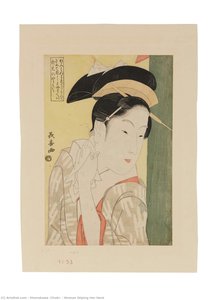
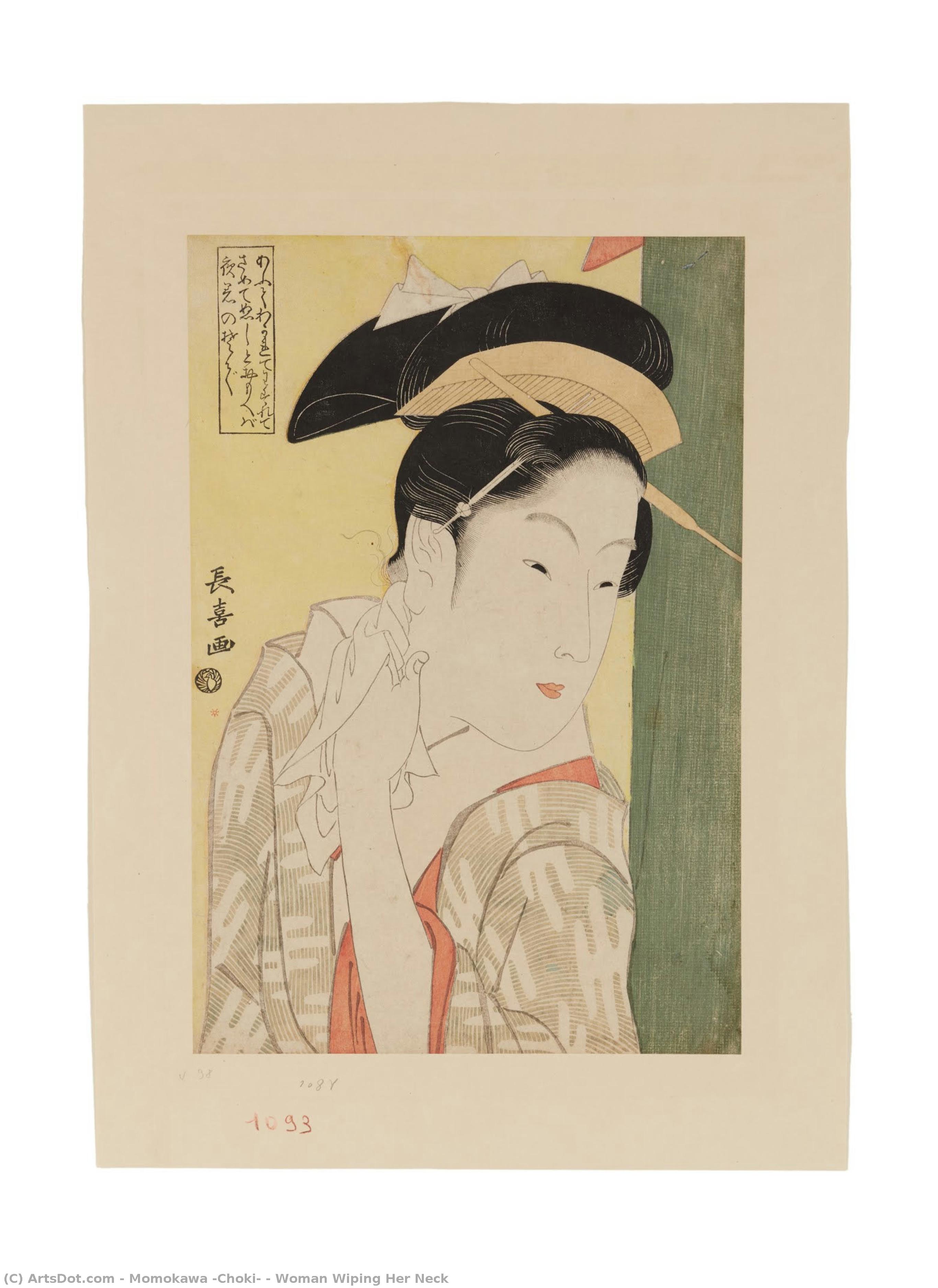
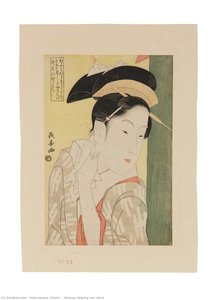
Woman Wiping Her Neck

 Read More
Giclée / Art Print
Museum-quality giclée or canvas print with fast production and flexible finish options. ( Buy Hand Made Painting Buy Image)




































Pick from our preset sizes that match the artwork's original proportions.

You may enter your own dimensions to fit a specific frame or space. If your selected size does not match the original image's proportions, we will either crop the artwork or extend the image with a mirrored or solid-fill edge. A digital mockup will be sent for your approval before production begins.
Please note that the on-screen preview does not reflect the actual cropping or extension. Only the mockup will accurately show the final composition.
While custom sizes are available, we recommend selecting a dimension from the predefined list to preserve the original proportions.
Worldwide Delivery () in 2 weeks instead of standard 4/5 weeks. (24 August)

Free Worldwide Express Shipping

High-Quality Linen Canvas

Full Shipping Insurance

Customs Tax Refund Guarantee

True Color Matching Guarantee

60-Day Return Policy (Defects Only)

100% Money-Back Guarantee

Bulk Discount Offer
 Glass option is only available in size under 110 CM

Woman Wiping Her Neck
Giclée / Art Print
Reproduction Size
-


Total Price
$ 63
Related Artworks









Artist Biography
The Ethereal Grace of Eishōsai Chōki
In the vibrant, bustling landscape of the Edo period, few artists captured the quietude of beauty as delicately as Eishōsai Chōki, also known by his name Momokawa Chōki. Active primarily between 1786 and 1808, Chōki emerged during a golden age of Japanese woodblock printing, carving out a niche that balanced the popular allure of bijin-ga—portraits of beautiful women—with an unprecedented atmospheric depth. While much of his personal history remains veiled in the mists of time, his artistic presence is unmistakable. He was a master of nuance, an artist who did not merely depict figures but sought to evoke the very air they breathed, creating works that felt less like static images and alone like fleeting moments captured in silk and paper.
The foundations of Chōki’s mastery were laid under the tutelage of the renowned Toriyama Sekien, a polymath whose expertise in botany and illustration instilled in his pupil a profound respect for the natural world. This lineage is vital to understanding Chōki's aesthetic; from Sekien, he inherited a keen eye for scientific detail and the ability to weave organic elements into narrative compositions. It is believed that Chōki may have even been an adopted son of Sekien, a relationship that likely provided him with access to the prestigious publishing circles of the era, including the influential house of Tsutaya Jūzaburō. This connection allowed his work to reach the widest possible audience, placing him in the same creative orbit as legends like Utamaro.
A Symphony of Style and Technique
What distinguishes Chōki from his contemporaries was his remarkable stylistic versatility, often signaled by the very signatures he used on his prints. When working under the name Chōki, his compositions mirrored the elegant, elongated grace of Kiyonaga; however, when signing as Shikō, he embraced a more emotive and bold approach reminiscent of Utamaro. This duality allowed him to navigate different aesthetic demands, moving between the serene and the striking with effortless ease. His technique was characterized by a sophisticated use of atmospheric perspective, a method that utilized misty backgrounds and diffused light to create a sense of infinite space, effectively immersing his subjects in idealized, dreamlike environments.
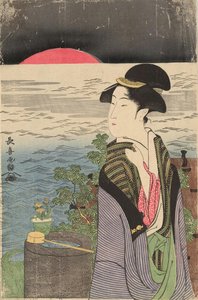
His technical prowess extended into the realm of luxury printing. Chōki frequently employed blown mica to add a shimmering, iridescent quality to his works, particularly in his most celebrated series. One might look upon a masterpiece like Sunrise on New Year and witness the breathtaking interplay of light: the black sky emitting a subtle mica-sheen that mimics the cold, crisp air of dawn, contrasted against the brilliant red of a rising sun. Such details—the way a woman’s hand is tucked into her robes for warmth or the precise placement of a seasonal plant like the pheasant’s eye—transformed his prints from mere illustrations into profound meditations on the changing seasons and the ephemeral nature of life.
Legacy and Artistic Significance
Beyond the celebrated portraits of slender, graceful women, Chōki’s repertoire was impressively diverse, showcasing an artist who could master any subject matter set before him. His contributions to the ukiyo-e genre include:
- Hashira-e: Striking pillar prints designed for the narrow vertical spaces of Japanese architecture.
- Kachō-e: Exquisite bird and flower prints that showcased his botanical precision.
- Narrative Series: Compelling landscape and historical series, such as the Eight Views of Lake Ōmi and the Eight Views of the Treasury of Loyal Retainers.
- Book Illustration: Detailed work for literary publications, including his final known contribution to the book Nakoso Gate in 1809.
The historical significance of Eishōsai Chōki lies in his ability to bridge the gap between the decorative and the contemplative. While many artists of the Edo period focused on the flamboyant or the scandalous, Chōki sought a sense of quiet dignity. He captured the essence of beauty—not just the outward form, but the mood, the temperature, and the soul of the moment. Today, his work remains a vital window into the refined sensibilities of late 18th-century Japan, reminding us that true elegance often resides in the softest shadows and the most subtle transitions of light.
momokawa chōki
Japan
Quick Facts
- Artistic Movement Or Style: Ukiyo-e
- Artists Or Movements Influenced By This Artist: ['Kiyonaga']
- Artists Who Influenced This Artist:
- Toriyama Sekien
- Utamaro
- Full Name: Eishōsai Choki
- Nationality: Japanese
- Notable Artworks:
- Sunrise on New Year
- Woman Wiping Her Neck
- The Courtesan Hinazuru of the Chojiya and her Attendants
- Place Of Birth: Japanese, Japan