 Preview
 Send
Send Share
Share
 Details

 Download
 Similars
 X-Ray
X-Ray Diaporama
Book of Italian Costumes
 Tempera
 1588
1588- Early Modern
 14.0 x 9.0 cm
 The Walters Art Museum
 Read More
Giclée / Art Print
Museum-quality giclée or canvas print with fast production and flexible finish options. ( Buy Hand Made Painting Buy Image)




P118B $10

P118H $10

P118W $10

P438Z $10

P508JH $12

P508YH $12

P805H $10

P805Z $10

P919BZ $10

P919G $10

P919XJ $10

P959ZH $10

P968JZ $12

W106C $8

W218G $10

W218JH $8

W218Y $10

W307PJ $10

W316G $10

W316PJ $8

W316Y $10

W398PJ $8

W4111J $10

W500HY $15

W500JH $15

W692G $12

W849H $8

W940BG $15

W953PJ $8




Pick from our preset sizes that match the artwork's original proportions.

You may enter your own dimensions to fit a specific frame or space. If your selected size does not match the original image's proportions, we will either crop the artwork or extend the image with a mirrored or solid-fill edge. A digital mockup will be sent for your approval before production begins.
Please note that the on-screen preview does not reflect the actual cropping or extension. Only the mockup will accurately show the final composition.
While custom sizes are available, we recommend selecting a dimension from the predefined list to preserve the original proportions.
Worldwide Delivery () in 2 weeks instead of standard 4/5 weeks. (3 September)

Free Worldwide Express Shipping

High-Quality Linen Canvas

Full Shipping Insurance

Customs Tax Refund Guarantee

True Color Matching Guarantee

60-Day Return Policy (Defects Only)

100% Money-Back Guarantee

Bulk Discount Offer
 Glass option is only available in size under 110 CM

Book of Italian Costumes
Giclée / Art Print
Reproduction Size
-


Total Price
$ 63
A Window into the Renaissance: The Elegance of Italian Costume
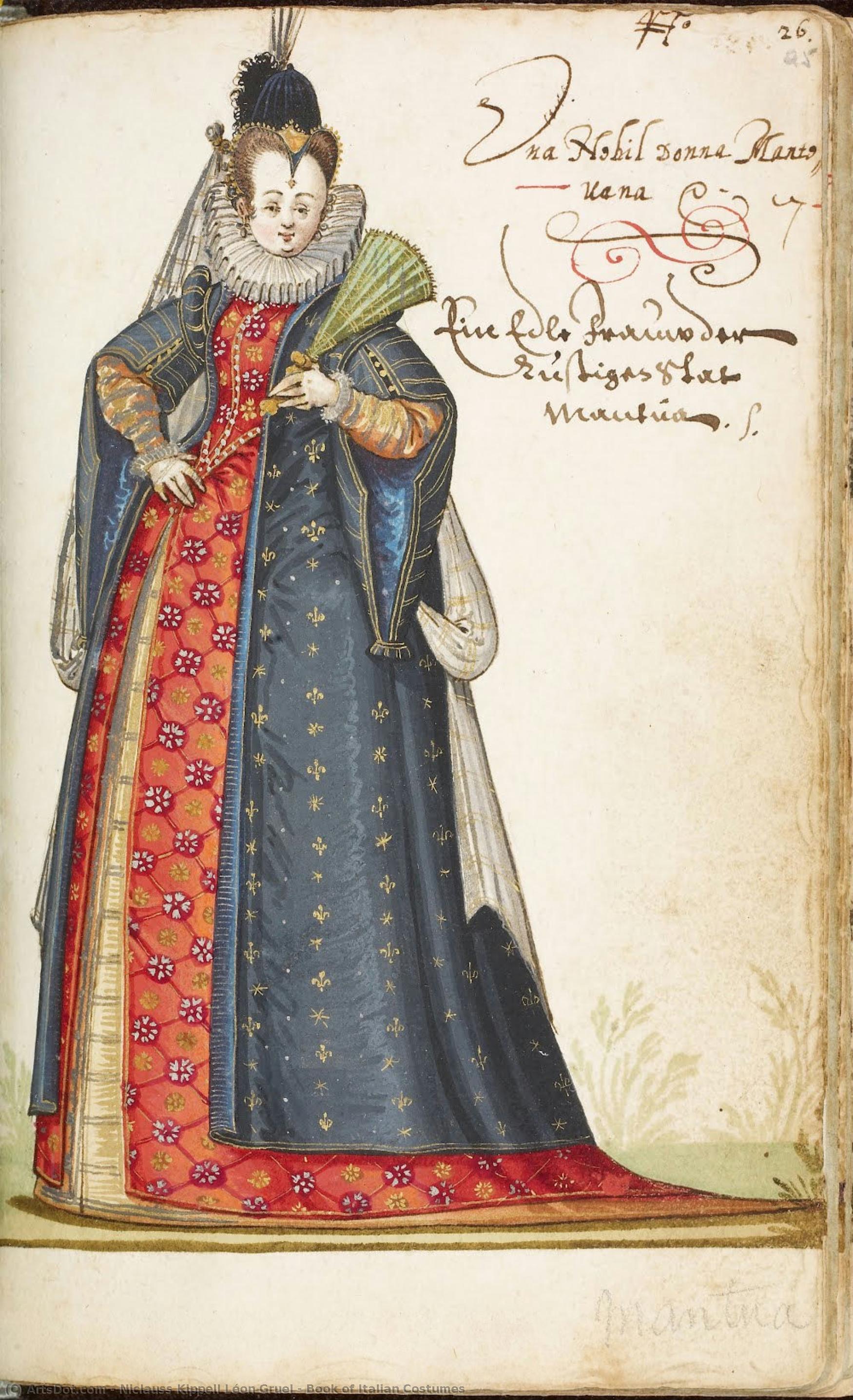
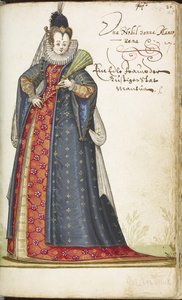
In the delicate, intimate scale of "Book of Italian Costumes," we are invited to step through a portal into the late sixteenth century. Created in 1588 by the master of decorative artistry, Niclauss Kippell Léon Gruel, this exquisite tempera painting serves as more than just a visual record; it is a vibrant celebration of fashion, status, and the enduring allure of the Italian Renaissance. The subject—a woman poised with an air of quiet confidence—is draped in a magnificent blue gown, accented by striking red details that command the viewer's attention. Her ruffled collar, rendered with meticulous precision, frames her face, while her hands resting on her hips suggest a spirited character, bridging the gap between historical documentation and living portraiture.
The technique employed here is a testament to the disciplined beauty of tempera paint. This medium, known for its quick-drying nature and luminous clarity, allows Gruel to achieve a level of detail that feels both crisp and ethereal. Every fold of the heavy fabric and every subtle shadow within the ruffles is captured with a precision that honors the original's historical intent. For the discerning collector or interior designer, this piece offers a sophisticated focal point. Its small, intimate dimensions—measuring just 14 x 9 cm in its original form—suggest a work meant for close contemplation, making it an ideal addition to a curated gallery wall or a refined study where fine details can be truly appreciated.
The Art of the Relieur: A Legacy of Craftsmanship
To understand the soul of this artwork, one must look toward the hands of its creator. Niclauss Kippell Léon Gruel was not merely a painter but a relieur d'art—a master bookbinder whose life was dedicated to the preservation and beautification of literary treasures. Born in the vibrant artistic atmosphere of Paris, Gruel brought the meticulousness of gold tooling and intricate marbling to the canvas. This background in decorative arts is evident in the way he treats the subject matter; there is a structural harmony and a decorative richness to the composition that mirrors the exquisite bindings of the Belle Époque. He approaches the human form with the same reverence one might accord a precious manuscript, treating color and line as elements of a grander, ornamental design.
The historical context of 1588 provides a backdrop of profound cultural transition, and Gruel captures this essence through the lens of costume. The painting acts as a miniature archive, preserving the textures and silhouettes that defined an era of grandeur. For those seeking to infuse their living spaces with a sense of history and timelessness, a reproduction of this work offers a unique opportunity. It brings the scholarly elegance of the Walters Art Museum into the modern home, providing a conversation piece that speaks of old-world charm, the meticulous labor of French craftsmanship, and the eternal beauty of the Italian spirit.
Related Artworks
Artist Biography
A Legacy of Leather and Gold: The Artistry of Léon Gruel
In the heart of nineteenth-century Paris, amidst the intellectual fervor of the Belle Époque, a unique form of artistry was flourishing—one that sought to ennoble the written word through the tactile beauty of the bookbinding craft. Niclauss Kippell Léon Gruel (1841–1923) stood at the forefront of this movement, transforming the humble act of binding pages into a profound expression of relieur d'art. Born into a lineage where the scent of leather and the shimmer of gold leaf were part of the family fabric, Gruel was destined to become a master of decorative bookbinding. His life was not merely a career in craft, but a lifelong devotion to preserving literary treasures by turning them into exquisite objects of visual splendor.
The foundations of Gruel’s mastery were laid long before he achieved international renown. Raised within a dynasty of binders, his early training was an immersive apprenticeship under the watchful eyes of his father, Pierre-Paul Gruel, and other esteemed masters of the trade. This rigorous upbringing instilled in him a deep reverence for the technical precision required to manipulate fine materials. By 1872, he had ascended to lead the family enterprise, Gruel and Engelmann, a firm that would eventually become synonymous with unparalleled elegance. His work was never about mere assembly; it was an expressive endeavor where technical expertise met an imaginative spirit, allowing him to elevate the book from a vessel of information to a captivating spectacle of texture and color.
The Renaissance of the Medieval and Gothic Spirit
As his career matured, Gruel became much more than a craftsman; he became a scholar of historical aesthetics. He possessed a profound passion for the medieval era, which catalyzed a magnificent resurgence of Gothic binding styles adapted for the sophisticated tastes of his contemporary collectors. This was not a simple imitation of the past, but a brilliant bridge between eras. Through the meticulous study of ancient bindings and the accumulation of rare volumes, Gruel learned to recreate historical construction techniques with breathtaking accuracy while infusing them with modern decorative flair.
His artistic signature was defined by an unwavering commitment to intricate detail and a luxurious palette. A viewer encountering a Gruel binding is immediately struck by the harmonious interplay of several key elements:
- Intricate Gold Tooling: The use of precious metal leaf to create delicate, raised patterns that catch the light with every movement.
- Exquisite Marbling: The creation of vibrant, swirling patterns on endpapers that provided a dynamic contrast to the structured leather covers.
- Classical and Gothic Motifs: A design language that drew heavily from historical ornamentation, lending each volume an air of timeless authority.
- Material Mastery: An expert command over pigments, leathers, and textures that breathed life into the surfaces of his creations.
Historical Significance and Lasting Influence
The impact of Léon Gruel extended far beyond the walls of his Parisian atelier on Rue Saint-Honoré. As a leader in his field, he served as the president of the syndicate for bookbinding, gilding, and brochure making from 1889 to 1900, demonstrating his commitment to elevating the professional standards of the entire craft. His influence was also felt through the students he mentored, such as Antoine Joly, ensuring that the meticulous traditions of French bookbinding would endure into the next generation. Even as he transitioned away from active binding due to health reasons in 1901, his scholarly contributions—including his historical and bibliographic manuals—remained vital resources for bibliophiles and collectors worldwide.
Today, the works of Léon Gruel are cherished not just as book covers, but as standalone masterpieces of the decorative arts. His ability to marry the scholarly weight of history with the ephemeral beauty of fine design ensures his place in the annals of art history. He remains a symbol of an era when even the most functional objects were treated with the utmost dignity and artistic intention, leaving behind a legacy of gold-tooled elegance that continues to inspire awe in museums and private collections alike.
niclauss kippell léon gruel
1841 - 1923 , France
Quick Facts
- Artistic Movement Or Style: Bookbinding & Decorative Arts
- Artists Or Movements Influenced By This Artist: ['Renaissance']
- Artists Who Influenced This Artist: ['Claude Monet']
- Date Of Birth: Paris, France (1841)
- Date Of Death: 1923
- Full Name: Niclauss Kippell Léon Gruel
- Nationality: French
- Notable Artworks: ['Gondola Ride']
- Place Of Birth: Paris
Related Articles

Slate Blue Masterpieces: 10 Iconic Paintings & Timeless Home Decor Ideas
Immerse yourself in the captivating world of slate blue! Explore 10 iconic paintings by Monet, Van Gogh & Renoir. Discover their stories, techniques & find museum-quality art reproductions for your home at .
The Allure of Azure: Exploring the Symbolic & Aesthetic Depths of Blue in Art History
Explore the rich history of blue in art! Discover its symbolism, from ancient pigments to modern masterpieces by Kandinsky & Seurat. Uncover the psychological impact and cultural meanings behind this captivating hue.

Crimson Threads of Narrative: Exploring Symbolism & Representation in Artworks Featuring the Red Dress
Explore the rich symbolism of the red dress in art history! From ancient power displays to iconic portraits like Cézanne’s 'Madame Cezanne', discover the cultural and artistic significance behind this captivating color. Expert analysis & insights.
Azure Visions: Exploring Representations of the Blue Dress in Western Art History
Explore the rich history of the blue dress in Western art! Discover its symbolism, from Renaissance masterpieces to modern interpretations by artists like Martin & Schiele. Uncover cultural meanings and artistic techniques.
Henri Matisse's Masterpieces: Explore 25 Iconic Paintings & Art Decor Ideas
Journey through Henri Matisse's 25 most iconic paintings! Explore Fauvism, vibrant colors & the stories behind masterpieces like 'The Dance'. Find museum-quality art reproductions and curated decor ideas to elevate your space. Discover all masterpieces on ArtsDot.com.