

 Preview
 Buy Print
 Send
Send Share
Share


 Download
 Similars
 X-Ray
X-Ray Diaporama
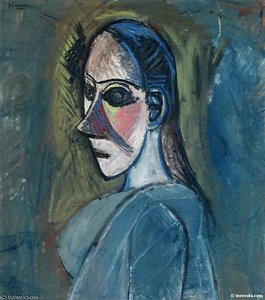
Buste de femme

Pablo Picasso (1881 – 1973)
Pablo Picasso (1881-1973) was a revolutionary Spanish painter and sculptor, co-founder of Cubism, and master of diverse styles. Known for iconic works like Guernica & Les Demoiselles d'Avignon, his legacy continues to inspire.
The Enigmatic Gaze: Unpacking Picasso’s ‘Buste de Femme’
Pablo Picasso's “Buste de Femme,” a captivating portrait rendered in shades of blue, is more than just a depiction of a woman’s face; it’s a distilled expression of emotional turmoil and a pivotal example of the artist’s evolving Cubist style. Painted around 1907-1908, during a period of intense experimentation and stylistic shifts, this work embodies Picasso's exploration of form, perspective, and the very nature of representation. The painting immediately draws the viewer in with its subject’s direct gaze – an expression that oscillates between defiance and profound vulnerability. The woman, seemingly caught mid-thought or perhaps on the verge of a sharp retort, holds our attention captive, inviting us to decipher the complex emotions simmering beneath her surface.
Cubism and the Fragmentation of Reality
“Buste de Femme” is a cornerstone of Picasso’s early Cubist explorations, a movement he co-founded with Georges Braque. Rather than striving for realistic depiction, Cubism sought to represent objects from multiple viewpoints simultaneously, fracturing them into geometric shapes and reassembling them on the canvas. Here, we see this principle vividly applied to the female face. The features – the nose, mouth, and eyes – are not rendered in a single, unified form but are broken down into angular planes and overlapping forms, creating an unsettling yet undeniably compelling effect. The background, a uniform blue, further emphasizes the fragmented nature of the subject, isolating her within a space devoid of traditional perspective.
- Geometric Forms: The dominant shapes – triangles, rectangles, and circles – create a sense of dynamism and instability.
- Multiple Perspectives: The simultaneous presentation of different viewpoints challenges our conventional understanding of the face as a static object.
- Monochromatic Palette: The limited use of blue contributes to the painting’s somber mood and reinforces its Cubist aesthetic.
Symbolism and Emotional Resonance
While Picasso himself rarely offered explicit interpretations of his work, art historians have identified several symbolic elements within “Buste de Femme.” The circles near the center and left side of her face are often interpreted as representations of her nose and mouth respectively. However, their stylized form suggests a deliberate abstraction, moving beyond mere anatomical accuracy. The woman’s intense gaze is particularly significant; it conveys a sense of suspicion, perhaps even anger or disappointment. Some scholars connect this expression to the turbulent personal life of Picasso during this period, marked by both creative breakthroughs and emotional struggles. The blue background itself can be seen as symbolic of melancholy and introspection – a color frequently associated with sadness and contemplation in Picasso’s work.
A Legacy of Innovation
“Buste de Femme” stands as a testament to Pablo Picasso's revolutionary approach to art, forever altering the course of 20th-century painting. It exemplifies his willingness to dismantle traditional artistic conventions and embrace new ways of seeing and representing the world. This work’s influence can be traced through countless subsequent artists who have drawn inspiration from its innovative use of form, perspective, and symbolism. Today, reproductions of “Buste de Femme” continue to captivate audiences with their raw emotional power and enduring aesthetic appeal. ArtsDot offers meticulously crafted hand-painted reproductions that faithfully capture the essence of this iconic masterpiece, allowing you to bring a touch of Picasso’s genius into your home or office.
About this artwork
- Title: Buste de femme
- Artist: Pablo Picasso
- Format: Portrait
- Copyright status: Under copyright
- Medium type: WallArt
- Corpus context: picasso’s political stance , anti-war
- Keywords: blue , portrait , modern art
- Color intensity: Monochromatic
- Perceived brightness: shadow
- Topics: blue background , woman , anger
Quick Facts
- Notable elements: Geometric shapes
- Title: Buste de femme
- Artistic style: Fragmented, Expressive
- Influences: Picasso's work
- Subject or theme: Portrait of a woman
QR Code


