

 Preview
 Buy Print
 Send
Send Share
Share


 Download
 Similars
 X-Ray
X-Ray Diaporama
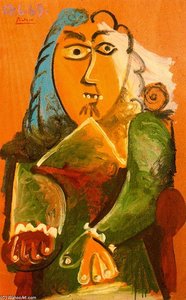
Hombre en un sillón

Pablo Picasso (1881 – 1973)
Pablo Picasso (1881-1973) was a revolutionary Spanish painter and sculptor, co-founder of Cubism, and master of diverse styles. Known for iconic works like Guernica & Les Demoiselles d'Avignon, his legacy continues to inspire.
The Enigmatic Figure: Hombre en un Sillón
Pablo Picasso’s “Hombre en un Sillón” (Man in a Chair) is not merely a portrait; it's an arresting distillation of the artist’s evolving Cubist sensibilities, imbued with a palpable sense of melancholy and introspection. Painted around 1916-1917, during a pivotal period in his artistic development, this work offers a glimpse into Picasso’s exploration of form, space, and the fragmented nature of human experience. The painting immediately commands attention through its stark color palette – a predominantly cool green shirt juxtaposed against an orange background – creating a visual tension that mirrors the psychological state of the subject. The figure itself is rendered with a deliberate distortion, his features broken down into geometric shapes, reflecting the Cubist desire to represent multiple viewpoints simultaneously.
Cubism and the Fragmentation of Reality
Picasso’s embrace of Cubism, alongside Georges Braque, marked a radical departure from traditional Western art. Rather than striving for realistic representation, Cubist artists sought to depict objects as they are perceived – simultaneously – by the eye. “Hombre en un Sillón” exemplifies this approach. The figure's body is deconstructed into angular planes and overlapping forms, challenging our conventional understanding of perspective and spatial relationships. The chair itself becomes a series of interlocking geometric shapes, contributing to the overall sense of disorientation and instability. This fragmentation isn’t arbitrary; it reflects Picasso’s interest in exploring the subjective nature of reality and the limitations of visual perception.
- Analytical Cubism (1909-1912): Characterized by monochromatic palettes and a focus on breaking down objects into their basic geometric components.
- Synthetic Cubism (1912-1919): Introduced brighter colors, collage elements, and a more simplified approach to form.
Symbolic Layers: Color, Gesture, and Emotion
Beyond the purely formal aspects of the painting, “Hombre en un Sillón” is rich in symbolic meaning. The green shirt, often associated with envy or introspection, suggests a contemplative mood for the subject. The blue face, a recurring motif in Picasso’s work during this period, can be interpreted as representing sadness, loneliness, or even a sense of detachment from reality. Notice the open mouth – a gesture that invites interpretation; is it an expression of pain, boredom, or simply a moment of quiet observation? The held wine glass and cup hint at a solitary ritual, perhaps suggesting a yearning for connection or a reflection on past experiences. The background’s orange hue adds to the painting's dramatic effect, creating a sense of unease and highlighting the figure’s isolation.
A Legacy of Emotional Depth
“Hombre en un Sillón” stands as a testament to Picasso’s genius – a work that transcends mere representation to convey profound emotional depth. It's a powerful exploration of human psychology, rendered with remarkable technical skill and imbued with the artist’s signature stylistic innovations. Reproductions of this iconic painting offer an exceptional opportunity to bring this evocative image into your home or office, allowing you to contemplate its complexities and appreciate the enduring legacy of one of art history’s most influential figures. ArtsDot offers meticulously crafted hand-painted reproductions that faithfully capture the essence of Picasso's vision, ensuring a timeless addition to any collection.
About this artwork
- Title: Hombre en un sillón
- Artist: Pablo Picasso
- Format: Tall
- Copyright status: Under copyright
- Medium: Acrylic On Canvas
- Corpus context: iconic picasso masterpiece” , influenced by african art
- Color palette: Dark
- Purpose: Statement
- Keywords: cubism , chaos , woman
- Color intensity: Vivid
Quick Facts
- Artistic style: Cubist
- Movement: Cubism
- Influences: Picasso
- Notable elements: Blue shirt, wine glass
- Artist: Pablo Picasso
- Medium: Oil painting
QR Code


