

 Preview
 Send
Send Share
Share
 Details

 Download
 Similars
 X-Ray
X-Ray Diaporama
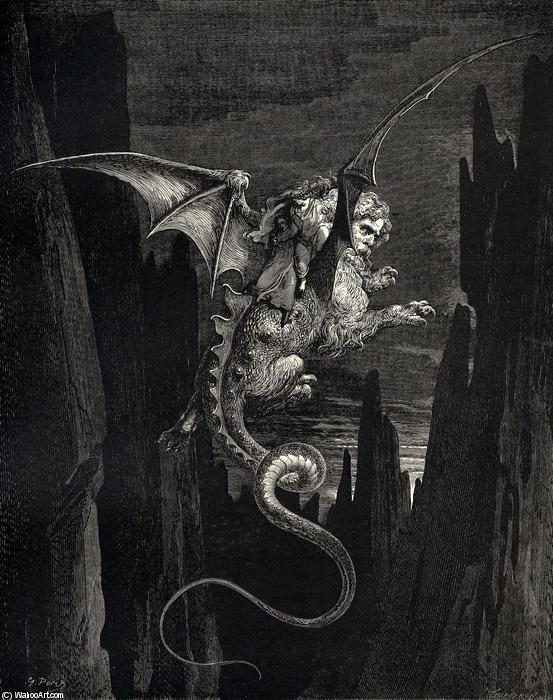
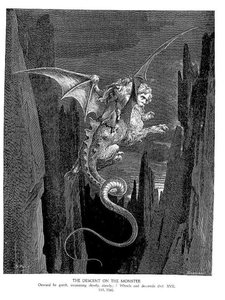
The Inferno, Canto 17, line 117. New terror I conceiv’d at the steep plunge

 Read More
Purchase a high-resolution, enhanced digital image, far superior to the online preview.
Each file is meticulously prepared by our in-house specialists using advanced tools and expert manual retouching. We ensure every image has exceptional clarity, precise color accuracy, and fine detail.
The final file is delivered via email within 72 hours, optimized for immediate use in professional, editorial, and print environments. This is the same quality trusted by top-tier design studios, publishers, and galleries.
Digital Image
Download a high-resolution file for personal display, printing, and creative projects. ( Buy Print Buy Hand Made Painting)
Included in Every Digital Image Order
Expert Digital Delivery, Guaranteed
When you choose ArtsDot.com, you're not just getting an image - you're receiving a professionally enhanced digital artwork, crafted with precision and backed by a satisfaction guarantee. Here's everything that comes with your order, automatically:

Fast Email Delivery
Your high-resolution digital image file will be emailed to you within 72 hours of ordering - ready for immediate use.

AI-Enhanced Digital File
Your artwork is professionally optimized using advanced AI tools and manual editing, ensuring maximum detail, clarity, and color accuracy.

Free Lifetime Re-Delivery
Accidentally deleted or lost your file? No worries - we'll resend it to you anytime, free of charge.

No Import Fees - Ever
Enjoy your artwork instantly with zero customs, duties, or delivery fees - digital downloads are always tax-free.

Color Accuracy Guarantee
We ensure your digital image reflects the original colors as closely as possible using professional tools and color management.

60-Day Satisfaction Guarantee
If you're not satisfied with your digital image, we'll revise it or refund 100% within 60 days - no questions asked.

100% Money-Back Guarantee
Not satisfied? Get a full refund within 60 days of receiving your digital file - no questions asked.

Bulk Order Discounts
Buy 3 images, save 10% - Buy 5, save 15% - Buy 10+, save 20%. Great for creative projects, galleries, and agencies.
Collectible Description
A Descent into Shadow: Gustave Doré's "The Inferno, Canto 17"
Paul Gustave Doré’s engraving of “The Inferno, Canto 17, line 117. New terror I conceiv’d at the steep plunge” is more than just an illustration; it’s a visceral embodiment of Dante Alighieri's harrowing journey through Hell. Created in the mid-19th century, this black and white masterpiece captures a moment of profound dread from Dante’s *Divine Comedy*, transporting the viewer directly into the heart of infernal torment. The scene depicts a monstrous creature—a hybrid of griffin and dragon—carrying two figures plummeting down a precipitous chasm, surrounded by jagged cliffs shrouded in swirling mists. Doré doesn't merely depict the event; he orchestrates an experience, drawing us into the very vortex of Dante’s despair.
The Art of Engraving: A Technique of Light and Darkness
Doré was a master of engraving, a technique demanding incredible precision and skill. Unlike painting, where color can soften edges and obscure detail, engraving relies on stark contrasts of light and shadow created through meticulously etched lines. The artist would first draw his design onto a copper or steel plate, then use specialized tools to incise these lines, creating grooves that would hold ink. When the plate was inked and wiped clean, leaving ink only in the engraved lines, it was pressed onto paper, transferring the image with remarkable clarity. Doré’s genius lay not just in his artistic vision but also in his ability to manage this complex process; he often employed teams of skilled engravers to execute his designs, ensuring a consistent level of quality across his vast output. The density and direction of these lines—the hatching and cross-hatching—are crucial to the image's power. Notice how dense the lines are in the shadowed areas, emphasizing the oppressive darkness and despair, while lighter strokes define the forms of the figures clinging desperately to the creature’s back.
Symbolism and Narrative: Echoes of Dante
The engraving is deeply rooted in the narrative context of Dante's *Inferno*. Canto 17 describes a terrifying descent through Malebolge, one of the circles of Hell reserved for fraudulent counselors. The monstrous creature represents the forces of evil and chaos that propel these souls towards their eternal punishment. Its powerful wings and sharp claws convey an overwhelming sense of dread and inescapable doom. The two figures clinging to its back are likely representations of Dante himself and his guide, Virgil, symbolizing humanity's vulnerability in the face of adversity and the perilous nature of seeking knowledge or truth through dark paths. The desolate landscape—the jagged cliffs and swirling mists—further reinforces this feeling of isolation and hopelessness. Doré’s interpretation isn’t a literal transcription of Dante’s words but rather an emotional amplification, capturing the psychological weight of the poet's vision.
A Legacy in Shadow: Doré and the Romantic Imagination
Gustave Doré (1832-1883) was a pivotal figure in 19th-century art. His prolific output—spanning illustrations for countless literary works, paintings, and sculptures—established him as one of the most celebrated artists of his time. He worked during a period when Romanticism was giving way to Realism, yet Doré’s work retained a distinctly Romantic sensibility, characterized by its dramatic compositions, emotional intensity, and fascination with the sublime – that feeling of awe mixed with terror inspired by vast or powerful forces. His illustrations for Dante's *Divine Comedy*, alongside his depictions of the Bible, cemented his reputation as an artist capable of translating complex literary narratives into visually arresting images. Doré’s influence extends far beyond the realm of illustration; his work has shaped our visual understanding of classic literature and continues to inspire artists and designers today. This particular engraving stands as a testament to his extraordinary talent—a powerful reminder of the enduring allure of darkness, despair, and the human spirit's struggle against overwhelming odds.
Related Artworks
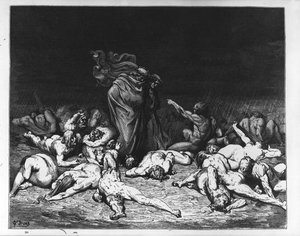
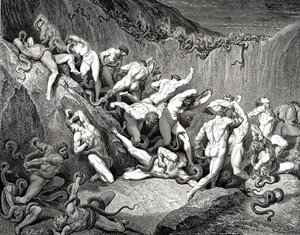
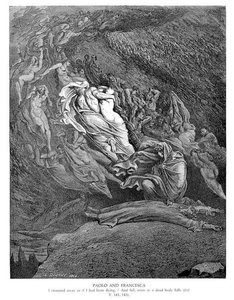
Artist Biography
A Life Etched in Shadow and Light: The World of Gustave Doré
Paul Gustave Louis Christophe Doré, known to the world as Gustave Doré, was a figure who straddled the worlds of illustration, painting, and sculpture with an astonishing virtuosity. Born in Strasbourg, France, on January 6th, 1832, his life unfolded during a period of immense social and artistic change, a time when Romanticism still held sway but was giving way to new currents of realism and symbolism. Even as a child, Doré displayed a precocious talent, not merely in drawing—which he began at an incredibly young age—but also in a personality that hinted at the dramatic flair which would come to define his work. Stories abound of youthful pranks demonstrating a maturity beyond his years, foreshadowing the complex and often melancholic themes that would permeate his art. He embarked on his professional career remarkably early, at just fifteen years old, as a caricaturist for the French journal *Le Journal pour rire*, honing his skills in observation and composition within the bustling world of Parisian satire.From Caricature to Literary Giants: The Rise of an Illustrator
Doré’s early commissions laid the foundation for his future renown. Works like *Les Travaux d'Hercule* (1847), *Trois artistes incompris et mécontents* (1851), and *Les Dés-agréments d'un voyage d'agrément* (1851) showcased a burgeoning talent for dynamic composition and a masterful use of light and shadow, even in these relatively modest beginnings. He was deeply influenced by the illustrations of J.J. Grandville, whose fantastical imagery and satirical edge resonated with Doré’s own developing style. However, it was through his collaborations with literary giants that Doré truly ascended to prominence. In 1853, he received a commission to illustrate the works of Lord Byron, an undertaking which opened doors to further prestigious projects. The monumental task of illustrating the Bible followed, a project that would cement his reputation and bring his art before a vast international audience. His illustrations for Cervantes’ *Don Quixote* in the 1860s were particularly impactful, profoundly influencing subsequent interpretations of the characters and narrative. He didn't simply illustrate these stories; he reimagined them, imbuing them with a dramatic intensity that captured the imagination of readers worldwide. The oversized edition of Edgar Allan Poe’s “The Raven,” completed in 1883, earned him an impressive 30,000 francs from Harper & Brothers, demonstrating the commercial success alongside the artistic acclaim he had achieved. His collaboration with Blanchard Jerrold on *London: A Pilgrimage* (1872) was a particularly poignant and controversial work, depicting the stark realities of Victorian London’s poverty and sparking debate about social conditions.A Master of Technique: Wood Engraving and Romantic Vision
Doré's artistic prowess lay not only in his imaginative vision but also in his technical mastery, particularly in wood engraving. He possessed an extraordinary ability to create incredibly detailed and dramatic images through this medium, a skill that allowed for the mass production and widespread dissemination of his work. His compositions are characterized by their dynamism, strong contrasts between light and shadow—a technique known as chiaroscuro—and a sense of grandeur that often evokes a feeling of awe or even terror. He frequently employed a large team of block-cutters to translate his designs into wood engravings, enabling the efficient production needed to meet the demands of publishers and readers alike. His style is firmly rooted in the Romantic tradition, emphasizing emotion, imagination, and the sublime—a fascination with the overwhelming power of nature and the human condition. He wasn’t merely recording scenes; he was interpreting them through a lens of heightened emotionality and dramatic flair. This approach, while celebrated by many, also drew criticism from some contemporaries who found his work overly theatrical or sensationalized.Legacy and Enduring Influence
Gustave Doré received the honor of being made a Chevalier de la Légion d'honneur by the French government in 1861, a testament to his growing recognition within artistic circles. However, his true legacy extends far beyond awards and accolades. His illustrations had a profound impact on visual culture, influencing artists and readers for generations. Vincent van Gogh was among those deeply inspired by Doré’s work, particularly his depictions of suffering and hardship, recognizing in them a shared sensitivity to the plight of humanity. Despite facing some criticism during his lifetime—some found his style overly dramatic or lacking in subtlety—Doré’s work is now celebrated for its artistic merit and historical importance. His illustrations continue to shape our understanding of classic literature and Victorian society, offering a powerful visual interpretation of timeless stories and enduring themes. He died on January 23rd, 1883, leaving behind an immense body of work that continues to captivate and inspire. His art remains a testament to the power of illustration to not only depict but also to interpret and transform the world around us.Notable Works
- Flower Sellers of London (1875): A poignant depiction of Victorian poverty and resilience, showcasing familial bonds amidst hardship.
- The Christian Martyrs: A dramatic masterpiece depicting faith and persecution with powerful emotion.
- Illustrations for Dante’s Inferno: Perhaps his most iconic work, these engravings brought the terrifying visions of Dante's hell to life with unparalleled intensity.
- Illustrations for Milton’s Paradise Lost: Doré’s interpretation of this epic poem is renowned for its grandeur and dramatic flair.
- The Wandering Jew (1856): A popular work, though it contains antisemitic undertones reflective of the time period.
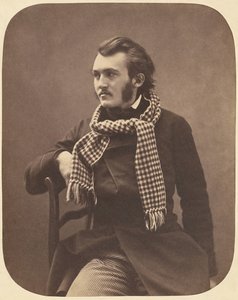
Paul Gustave Doré
1832 - 1883 , France
Quick Facts
- Artistic Movement Or Style: Romanticism
- Artists Or Movements Influenced By This Artist: ['Vincent van Gogh']
- Artists Who Influenced This Artist: ['J.J. Grandville']
- Date Of Birth: January 6, 1832
- Date Of Death: January 23, 1883
- Full Name: Paul Gustave Doré
- Nationality: French
- Notable Artworks:
- Don Quixote
- The Raven
- London: A Pilgrimage
- The Bible
- Dante's Inferno
- Place Of Birth: Strasbourg, France

