

 Preview
 Send
Send Share
Share
 Details

 Download
 Similars
 X-Ray
X-Ray Diaporama
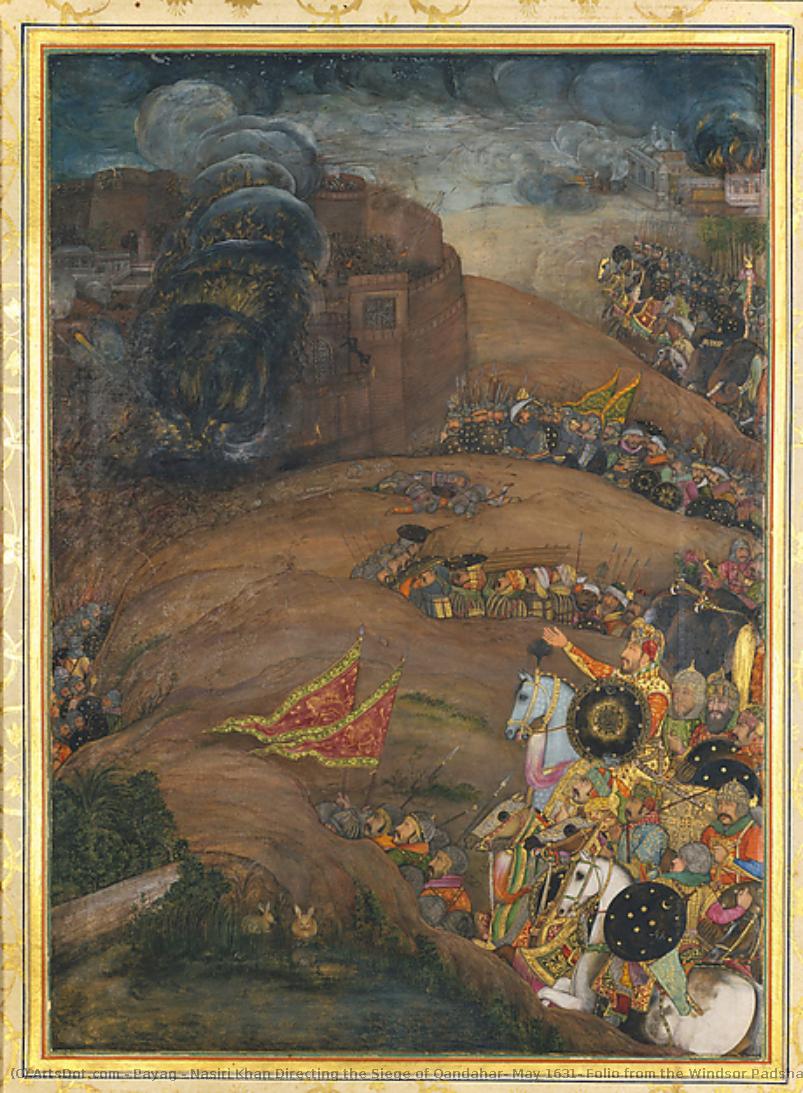
Nasiri Khan Directing the Siege of Qandahar, May 1631: Folio from the Windsor Padshahnama
 1633
1633 91.0 x 70.0 cm
 Read More
Giclée / Art Print
Museum-quality giclée or canvas print with fast production and flexible finish options. ( Buy Hand Made Painting Buy Image)




































Pick from our preset sizes that match the artwork's original proportions.

You may enter your own dimensions to fit a specific frame or space. If your selected size does not match the original image's proportions, we will either crop the artwork or extend the image with a mirrored or solid-fill edge. A digital mockup will be sent for your approval before production begins.
Please note that the on-screen preview does not reflect the actual cropping or extension. Only the mockup will accurately show the final composition.
While custom sizes are available, we recommend selecting a dimension from the predefined list to preserve the original proportions.
Worldwide Delivery () in 2 weeks instead of standard 4/5 weeks. (26 August)

Free Worldwide Express Shipping

High-Quality Linen Canvas

Full Shipping Insurance

Customs Tax Refund Guarantee

True Color Matching Guarantee

60-Day Return Policy (Defects Only)

100% Money-Back Guarantee

Bulk Discount Offer
 Glass option is only available in size under 110 CM

Nasiri Khan Directing the Siege of Qandahar, May 1631: Folio from the Windsor Padshahnama
Giclée / Art Print
Reproduction Size
-


Total Price
$ 63
Collectible Description
Related Artworks









Artist Biography
early life and career
payag, an indian miniature painter, was born in 1595 and remained active until his passing in 1655. as the older brother of the renowned mughal artist balchand, payag's career likely began within the mughal court, where he honed his skills in capturing intricate details and realism.artistic style and notable works
payag's artistic prowess is evident in his detailed and realistic paintings, often depicting scenes from the mughal court and military campaigns. one of his most notable contributions was to the padshahnama, a chronicle of the reign of shah jahan, now preserved in the royal library, windsor castle.- key artistic elements:
- detailed and realistic depictions
- mughal court and military campaign scenes
- contribution to the padshahnama
- notable works:**
- padshahnama (royal library, windsor castle)
- various mughal court and military campaign scenes (collections at ArtsDot.com)
legacy and influence
payag's work, though lesser known compared to his brother balchand, signifies the artistic excellence of 17th-century indian miniature painting. his contributions to the padshahnama and other mughal court depictions have solidified his place in art history. explore payag's artistic world:** * visit payag's profile on ArtsDot.com to view more of his works: [https://ArtsDot.com/@/payag](https://ArtsDot.com/@/payag) * discover the padshahnama and other mughal era artworks at ArtsDot's collection: /en/art/show/art-d3cl2x-en/conclusion
payag, a master of indian miniature painting, left an indelible mark on the art world with his detailed and realistic works. through ArtsDot.com, art enthusiasts can delve into payag's artistic genius and explore the rich cultural heritage of 17th-century india.- **note:** the provided links are for exploring payag's artworks and related content on ArtsDot.com.
Payag
1595 - 1655 , India
Quick Facts
- Artistic Movement Or Style: Mughal Miniature Painting
- Artists Or Movements Influenced By This Artist: ['European Chiaroscuro']
- Artists Who Influenced This Artist: ['Balchand']
- Date Of Birth: 1595
- Date Of Death: 1655
- Full Name: Payag
- Nationality: Indian
- Notable Artworks:
- Padshahnama
- Various Mughal court and military campaign scenes
- Place Of Birth: New Delhi, India

