 Preview
 Send
Send Share
Share
 Details

 Download
 Similars
 X-Ray
X-Ray Diaporama
 Stats
StatsSem título
 Oil
Oil- WallArt
- Contemporary Realism
 1990
1990- Contemporary
 38.0 x 92.0 cm
 Serralves Foundation
 Read More
Hand Made Oil Reproduction
Hand-painted oil on canvas in your size and frame, made to order by our artists. ( Switch to Print Switch to Digital Image)




P118B $10

P118H $10

P118W $10

P438Z $10

P508JH $12

P508YH $12

P805H $10

P805Z $10

P919BZ $10

P919G $10

P919XJ $10

P959ZH $10

P968JZ $12

W106C $8

W218G $10

W218JH $8

W218Y $10

W307PJ $10

W316G $10

W316PJ $8

W316Y $10

W398PJ $8

W4111J $10

W500HY $15

W500JH $15

W692G $12

W849H $8

W940BG $15

W953PJ $8




Pick from our preset sizes that match the artwork's original proportions.

You may enter your own dimensions to fit a specific frame or space. If your selected size does not match the original image's proportions, we will either crop the artwork or extend the painting with additional hand-painted elements. A digital mockup will be sent for your approval before production begins.
Please note that the on-screen preview does not reflect the actual cropping or extension. Only the mockup will accurately show the final composition.
While custom sizes are available, we recommend selecting a dimension from the predefined list to preserve the original proportions.
After order, ArtsDot.com team will email client for instructions and provide a mockup preview
Worldwide Delivery () in 3/4 weeks instead of standard 5 weeks. (11 September). No compromise on quality.

Free Worldwide Express Shipping

High-Quality Linen Canvas

Full Shipping Insurance

Customs Tax Refund Guarantee

True Color Matching Guarantee

100-Day Return Policy (Defects Only)

100% Money-Back Guarantee

Bulk Discount Offer
 Glass option is only available in size under 110 CM

Sem título
Reproduction Medium
Reproduction Size
-


Total Price
$ 263
A Still Life of Quiet Resonance
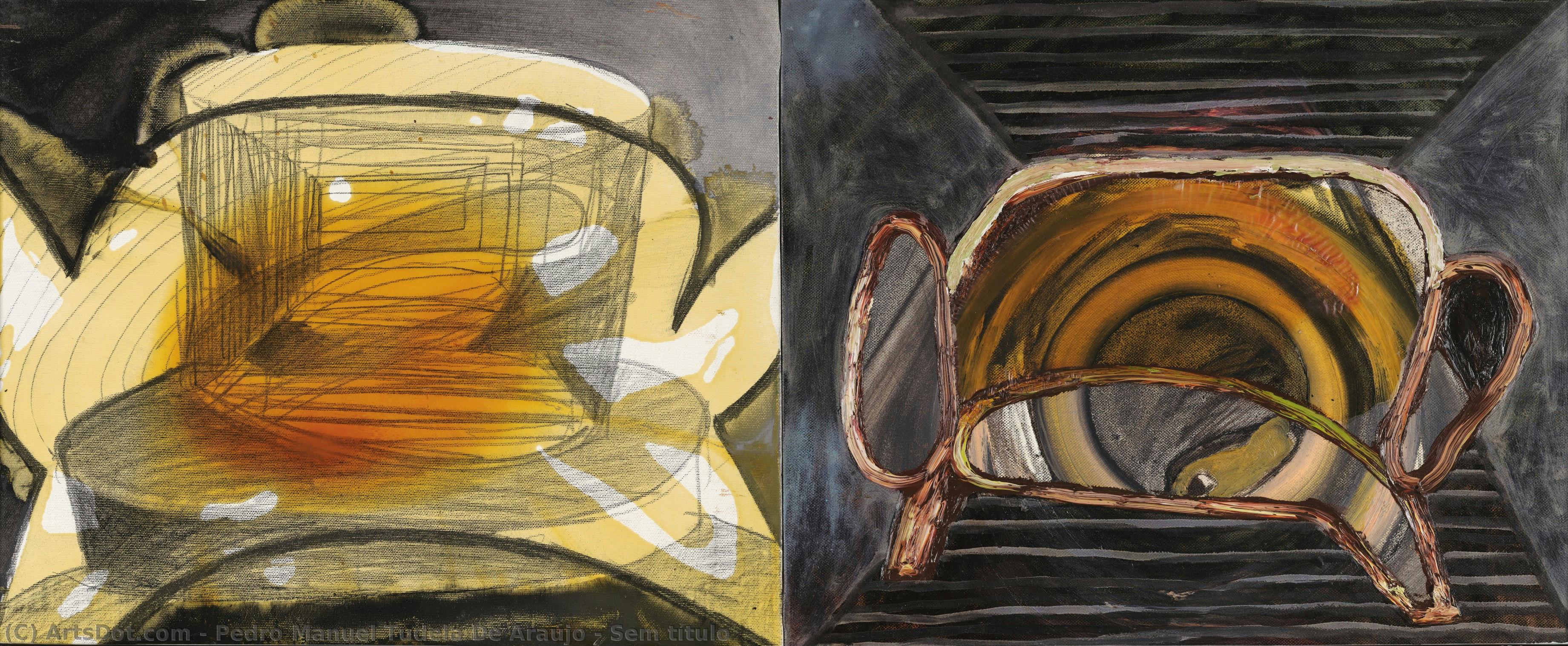
In the evocative painting Sem título, created in 1990 by the Portuguese master Pedro Manuel Tudela de Araújo, we are invited into a moment of profound stillness. The composition centers on a delicate dialogue between two distinct vessels, each possessing its own unique character and weight. To the left, a vibrant yellow vase with a graceful handle catches the light, offering a burst of warmth and vitality to the scene. In contrast, a more somber, brown metallic vase stands to the right, grounding the composition with its earthy, industrial presence. This juxtaposition of color and material creates a rhythmic tension that draws the eye across the canvas, exploring the balance between the delicate and the durable.
The artist masterfully populates the tabletop with three additional cups, strategically placed to guide the viewer’s gaze through the depth of the painting. One cup rests near the left periphery, another occupies the central space, and a third sits toward the right, creating a triangular movement that prevents the eye from resting too long in one place. This careful arrangement of objects transforms a simple domestic scene into a complex study of spatial relationships and light. The presence of these smaller vessels adds layers of complexity to the narrative, suggesting a lived-in space where even the most mundane objects are imbued with a sense of importance and history.
Technique and the Mastery of Light
Tudela de Araújo utilizes his command over oil painting to breathe life into these inanimate objects. The technique is characterized by a sophisticated handling of light and shadow, which gives the vases a palpable three-dimensionality. Through subtle gradations of tone, the artist captures the reflective sheen of the metallic vase and the soft, matte glow of the yellow ceramic. This interplay of light does more than just define form; it creates an atmosphere of contemplative quietude. The brushwork, while precise enough to render texture, retains a painterly quality that allows the colors to bleed into one another with organic grace, reminiscent of the classical traditions that have long inspired his work.
For the discerning collector or interior designer, this piece offers an unparalleled opportunity to introduce a sense of timelessness and sophistication into a space. The 38 x 92 cm dimensions provide a unique, elongated silhouette that is particularly striking when hung in hallways, above consoles, or as a focal point in a minimalist gallery setting. A high-quality reproduction of this work allows the rich textures and deep, emotive tones to become a cornerstone of a room's aesthetic, bridging the gap between contemporary decor and the profound legacy of Portuguese oil painting.
Symbolism and Emotional Depth
Beyond its formal beauty, Sem título serves as an exploration of duality. The contrast between the bright, welcoming yellow and the heavy, dark brown can be seen as a metaphor for the dualities of human experience: joy and melancholy, lightness and gravity, the ephemeral and the permanent. By stripping away any specific narrative context—leaving the work "Untitled"—the artist allows the viewer to project their own emotions onto the canvas. The painting does not demand an interpretation; rather, it offers a sanctuary for reflection.
The emotional impact of the piece lies in its ability to evoke a sense of nostalgia and peace. There is a certain dignity in the way these objects are presented, as if they are participants in a silent, eternal ceremony. For those seeking to decorate with art that possesses soul and substance, this work stands as a testament to the power of the still life genre to capture the essence of existence through the simple, beautiful arrangement of the world around us.
Related Artworks
Artist Biography
Deborah Roberts: Unveiling the Layers of Black Subjecthood
Deborah Roberts, born in Austin, Texas in 1962, is a profoundly significant contemporary artist whose work has consistently challenged conventional notions of beauty and representation within American art history. Her journey, marked by a rigorous academic background at the University of North Texas and Syracuse University – culminating in degrees in Fine Arts and MFA respectively – laid the foundation for an artistic practice deeply rooted in exploring themes of race, identity, gender politics, and the complexities of otherness. Roberts’s work isn't simply about depicting subjects; it’s a deliberate interrogation of how we see ourselves and others, particularly within the context of historical power dynamics. Her signature style—a masterful blend of collage, painting, drawing, and mixed media—allows her to build layered narratives that invite viewers into a dialogue with both the past and present. Roberts's work has been exhibited internationally at institutions like the Whitney Museum of American Art, Brooklyn Museum, and the Studio Museum in Harlem, solidifying her place as a leading voice in contemporary art.Early Life and Artistic Foundations
Roberts’s childhood in Austin provided an early exposure to both artistic expression and the realities of racial identity. Growing up during a period of significant social change in Texas, she developed a keen awareness of the complexities surrounding race relations. This formative experience profoundly shaped her artistic trajectory. Her formal education at North Texas and Syracuse University provided her with essential technical skills while simultaneously exposing her to diverse artistic movements and theoretical frameworks. Crucially, Roberts’s studies were influenced by Hoyt L. Sherman, a professor at Ohio State University who instilled in her a critical approach to art-making—a focus on composition, unity, and the ability to see beyond surface appearances. This emphasis on observation and interpretation became central to her artistic process. Roberts's early work began to explore themes of identity and representation, foreshadowing the powerful statements she would later make about Black subjecthood.The Language of Collage: Reclaiming Representation
Roberts’s distinctive artistic style is characterized by its innovative use of collage—a technique that allows her to juxtapose disparate images, textures, and materials to create complex visual narratives. She skillfully combines found photographs, magazine clippings, and hand-drawn elements, often layering them with paint and other media. This process isn't simply about assembling images; it’s a deliberate act of recontextualization—a way of challenging the dominant narratives that have historically shaped representations of Black people in art. Roberts frequently employs the technique of “repetition,” creating multiple iterations of a single image or motif, further emphasizing the complexities and nuances of her subjects. Her use of collage is not merely decorative; it’s a strategic tool for disrupting established visual hierarchies and offering alternative perspectives. The resulting works are rich with symbolism and invite viewers to engage in critical reflection on issues of race, gender, and identity.Themes of Black Subjecthood and the Construction of Identity
At the heart of Roberts’s work lies a profound exploration of Black subjecthood—the multifaceted experience of being Black in America. She confronts the often-problematic representations of Black people in art history, challenging the traditional canon that has historically marginalized or misrepresented this community. Her portraits are not idealized depictions; they are raw and honest portrayals of young girls and boys, capturing their vulnerability, resilience, and inherent beauty. Roberts’s subjects—often depicted as figures emerging from the shadows—are presented with a dignity and complexity rarely seen in mainstream art. She deliberately avoids simplistic narratives, instead offering layered portraits that acknowledge the historical trauma and ongoing struggles faced by Black communities while simultaneously celebrating their strength and agency. Her work is a powerful testament to the importance of representation and the need for diverse voices within the art world.Legacy and Recognition
Deborah Roberts’s impact on contemporary art extends far beyond her individual achievements. She has become an influential voice in discussions about race, identity, and representation, inspiring artists and viewers alike to critically examine the ways in which we see ourselves and others. Her work has been recognized with numerous awards and accolades, including the 2023 Texas Medal of Arts Award Honoree for the Visual Arts. Roberts’s paintings are held in prestigious collections, including those of the Whitney Museum of American Art, Brooklyn Museum, and Los Angeles County Museum of Art, ensuring that her powerful vision will continue to resonate with audiences for generations to come. Her ongoing commitment to challenging conventional notions of beauty and representation solidifies her position as a vital and enduring figure in the art world.
pedro manuel tudela de araújo
1962 - , Portugal
Quick Facts
- Artistic Movement Or Style: Mixed media collage
- Artists Or Movements Influenced By This Artist: ['Contemporary art']
- Artists Who Influenced This Artist:
- Paul Klee
- Contemporary artists
- Date Of Birth: November 1962
- Full Name: Deborah Roberts
- Nationality: American
- Notable Artworks: ['I’m']
- Place Of Birth: Austin, Texas, USA
Related Articles
Silent Narratives: Exploring the Enduring Appeal of Still Life Painting Across Centuries
Explore the rich history of still life painting with ArtsDot. Discover Dutch Masters, decode vanitas symbolism & learn about collecting timeless art. Expert insights and museum-quality reproductions.

The Golden Hue: Exploring Symbolism & Emotion in Yellow Art
Explore the rich symbolism & emotional power of yellow in art history! From Van Gogh to Kandinsky, discover how artists used this vibrant hue. Expert analysis & high-quality reproductions at ArtsDot.
Golden Hues: 10 Masterpieces Dominated by Chrome Yellow | ArtsDot
Immerse yourself in golden light! Explore 10 famous paintings dominated by 'Chrome Yellow', from Van Gogh’s Sunflowers to Monet's Haystacks. Discover the stories behind these iconic Impressionist & Post-Impressionist masterpieces and find museum-quality art reproductions at ArtsDot.com.
Golden Hues: Top 10 Paintings Dominated by Yellow Ochre |
Explore 10 iconic paintings bathed in golden yellow ochre! From Van Gogh's sunflowers to Monet’s haystacks, discover the stories behind these masterpieces. Find museum-quality art reproductions & elevate your home decor on .
Clyfford Still's Abstract Expressionism: A Study of Color, Form & the Existential Landscape
Explore the profound world of Clyfford Still's Abstract Expressionism with ArtsDot. Discover his unique style, existential themes & investment potential. Expert analysis for discerning collectors.