 Preview
 Send
Send Share
Share
 Details

 Download
 Similars
 X-Ray
X-Ray Diaporama
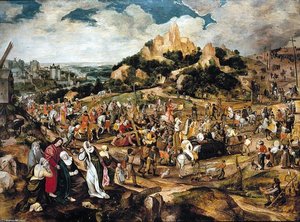
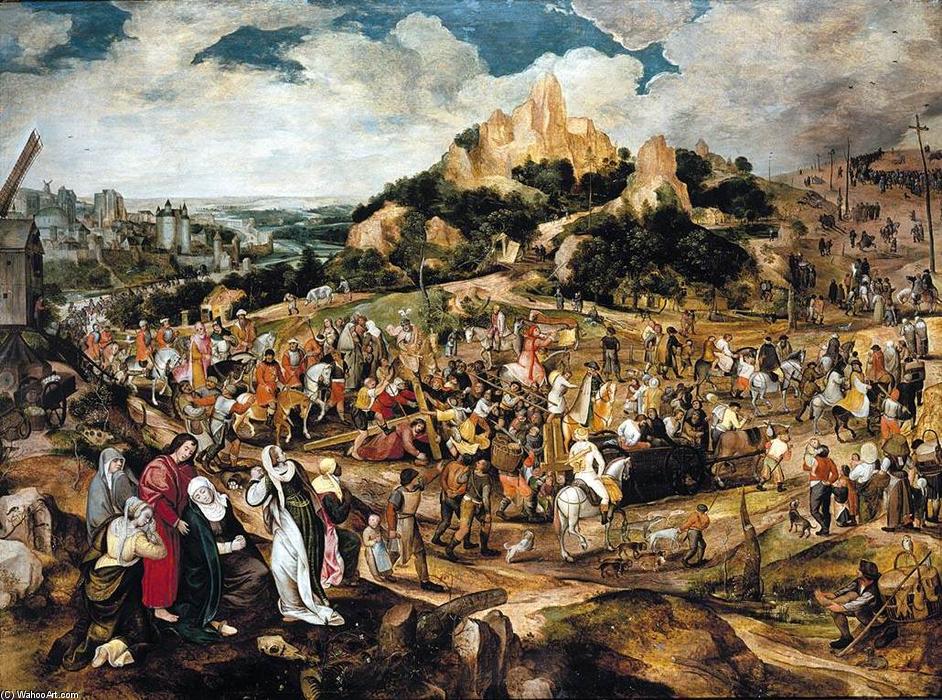
Christ on the Road to Calvary
 1560
1560 116.0 x 156.0 cm
 Read More
Hand Made Oil Reproduction
Hand-painted oil on canvas in your size and frame, made to order by our artists. ( Buy Print Buy Image)




































Pick from our preset sizes that match the artwork's original proportions.

You may enter your own dimensions to fit a specific frame or space. If your selected size does not match the original image's proportions, we will either crop the artwork or extend the painting with additional hand-painted elements. A digital mockup will be sent for your approval before production begins.
Please note that the on-screen preview does not reflect the actual cropping or extension. Only the mockup will accurately show the final composition.
While custom sizes are available, we recommend selecting a dimension from the predefined list to preserve the original proportions.
After order, ArtsDot.com team will email client for instructions and provide a mockup preview
Worldwide Delivery () in 3/4 weeks instead of standard 5 weeks. (21 August). No compromise on quality.

Free Worldwide Express Shipping

High-Quality Linen Canvas

Full Shipping Insurance

Customs Tax Refund Guarantee

True Color Matching Guarantee

60-Day Return Policy (Defects Only)

100% Money-Back Guarantee

Bulk Discount Offer
 Glass option is only available in size under 110 CM

Christ on the Road to Calvary
Reproduction Medium
Reproduction Size
-


Total Price
$ 263
Related Artworks
Artist Biography
The Vibrant Tapestry of Peeter Baltens
In the bustling, prosperous heart of sixteenth-century Antwerp, a period defined by both immense commercial wealth and profound religious transition, the brush of Peeter Baltens captured the very pulse of Flemish life. Born around 1527, Baltens emerged not merely as a painter, but as a multifaceted creator—a draughtsman, engraver, publisher, and even a poet. While the historical record offers only fragments of his personal journey, the sheer vitality of his surviving works provides a window into a man who was deeply embedded in the cultural fabric of the Renaissance. As the son of the sculptor Baltens Custodis, he was raised in an environment where craftsmanship and artistry were the cornerstones of society, eventually finding his place within the prestigious Guild of Saint Luke.
The legacy of Baltens is inextricably linked to the evolution of Flemish genre painting. He is often credited as a pioneering figure, one of the key inventors of the village scene that would become a staple of Dutch and Flemish art. His ability to transform a simple landscape into a stage for human drama allowed him to bridge the gap between high religious art and the relatable, everyday experiences of the common folk. Through his eyes, we witness the Kermis—the lively carnival fairs—where the air is thick with the sounds of music, the scent of food, and the chaotic energy of communal celebration. His work does not merely observe these scenes; it immerses the viewer in them, inviting us to participate in the dancing, the drinking, and the theatrical farces that defined the era's social spirit.
Mastery of Detail and Narrative Depth
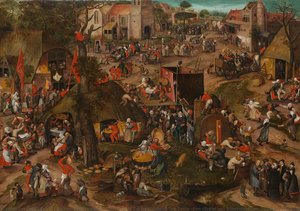
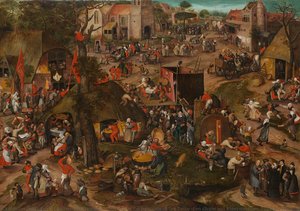
To look upon a Baltens masterpiece is to embark on a journey through meticulous detail. His technique was characterized by an extraordinary ability to manage complex compositions, guiding the eye through crowded marketplaces and festive squares without losing the sense of individual narrative. In works such as A Flemish Kermis with a Performance of the Farce ‘Een cluyte van Plaeyerwater’, the canvas becomes a sprawling tapestry of human interaction. One might find a group of musicians lost in melody on one side, while on another, the gritty reality of cooking, fighting, or even clandestine romance unfolds. This layered approach to storytelling creates a sense of depth that is both visual and emotional, making his paintings feel like living, breathing chronicles of 16th-century Antwerp.
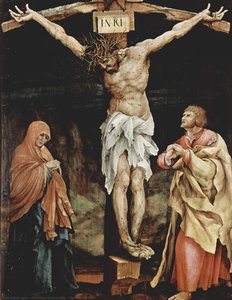
Beyond the boisterous celebrations, Baltens possessed a profound capacity for solemnity. His religious compositions, such as Christ on the Road to Calvary, demonstrate a mastery of light and shadow that speaks to the influence of the Italian Renaissance masters. While his genre scenes celebrate the earthly, his sacred works explore the divine, showcasing a versatility that allowed him to navigate the shifting theological landscapes of his time. This duality—the ability to capture both the sacred procession of a religious statue and the rowdy antics of a village fair—is what defines his unique contribution to the Mannerist period.
A Legacy Intertwined with Greatness
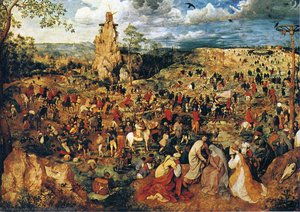
The historical significance of Peeter Baltens is further illuminated by his professional connections, most notably his relationship with Pieter Bruegel the Elder. Though later historians like Karel van Mander mistakenly labeled him a mere follower of Bruegel, modern scholarship reveals a much more sophisticated and collaborative relationship. In fact, the roles were often reversed; during the early 1550s, the young Bruegel actually worked as an assistant in Baltens’s workshop. This intersection of talents suggests that Baltens was a central figure in a creative ecosystem that nurtured some of the greatest minds in art history. Their collaboration on altarpieces and shared stylistic interests helped forge the very identity of Northern Renaissance painting.
Ultimately, the importance of Baltens lies in his role as a chronicler of the human condition. He captured a world in transition—a world where the medieval traditions of the village square met the burgeoning humanist ideals of the Renaissance. Through his engravings and paintings, he ensured that the laughter, the struggle, and the vibrant festivities of the Flemish people would endure long after the streets of Antwerp had changed forever. His life and work remain a testament to the power of art to document not just history, but the enduring spirit of humanity.
peeter baltens
1527 - 1584 , Belgium
Quick Facts
- Artistic Movement Or Style: Genre Painting
- Date Of Birth: ca. 1527
- Date Of Death: before 1584
- Full Name: Peeter Baltens
- Nationality: Flemish
- Notable Artworks:
- A Flemish Kermis with a Performance of the Farce ‘Een cluyte van Plaeyerwater’
- Christ on the Road to Calvary
- Place Of Birth: Antwerp, Belgium