 Send
Send Share
Share
 Details

 Download
 Similars
 Diaporama
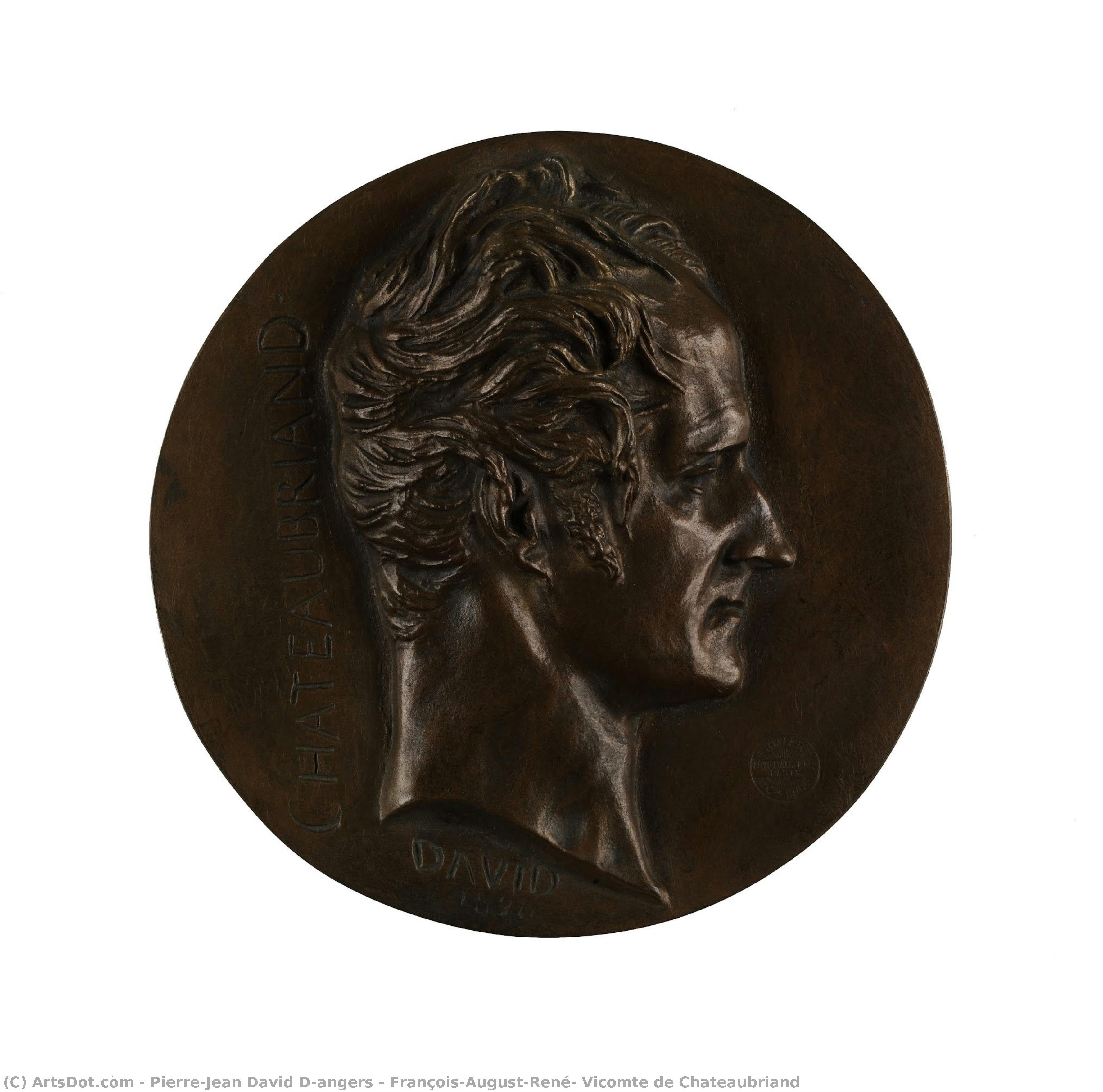
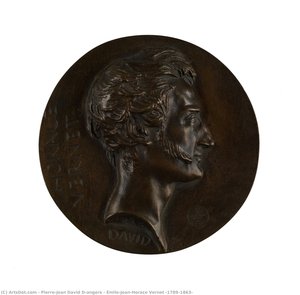
François-August-René, Vicomte de Chateaubriand


 Read More
Giclée / Art Print
Museum-quality giclée or canvas print with fast production and flexible finish options. ( Buy Hand Made Painting Buy Image)




































Pick from our preset sizes that match the artwork's original proportions.

You may enter your own dimensions to fit a specific frame or space. If your selected size does not match the original image's proportions, we will either crop the artwork or extend the image with a mirrored or solid-fill edge. A digital mockup will be sent for your approval before production begins.
Please note that the on-screen preview does not reflect the actual cropping or extension. Only the mockup will accurately show the final composition.
While custom sizes are available, we recommend selecting a dimension from the predefined list to preserve the original proportions.
Worldwide Delivery () in 2 weeks instead of standard 4/5 weeks. (25 August)

Free Worldwide Express Shipping

High-Quality Linen Canvas

Full Shipping Insurance

Customs Tax Refund Guarantee

True Color Matching Guarantee

60-Day Return Policy (Defects Only)

100% Money-Back Guarantee

Bulk Discount Offer
 Glass option is only available in size under 110 CM

François-August-René, Vicomte de Chateaubriand
Giclée / Art Print
Reproduction Size
-


Total Price
$ 63
Collectible Description
The Soul Captured in Bronze: A Portrait of Romantic Idealism
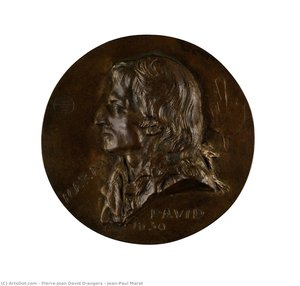
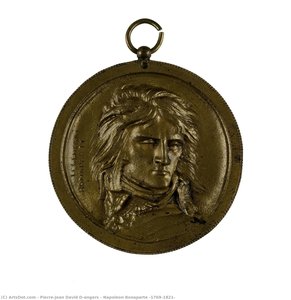
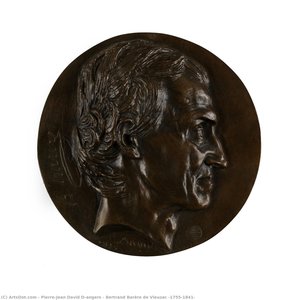
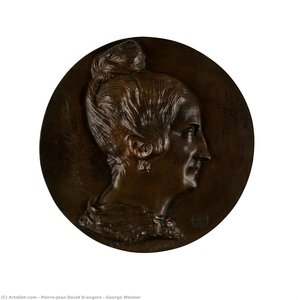
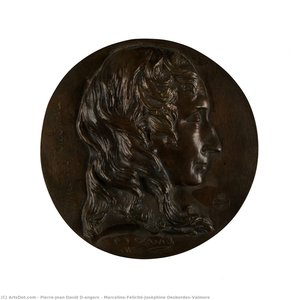
In the quiet, tactile presence of Pierre-Jean David d’Angers’ bronze medallion of François-August-René, Vicomte de Chateaubriand, one encounters more than a mere likeness; one meets the very heartbeat of the Romantic era. Created in 1830, this exquisite work serves as a window into a period defined by intense emotion, intellectual fervor, and a profound reverence for the individual spirit. The subject, Chateaubriand, was not merely a man but a titan of French literature and politics, a figure whose very existence shaped the cultural landscape of the nineteenth century. Through David d’Angers' masterful hand, the bronze transcends its metallic medium to breathe life into the psychological complexities of a statesman and poet.
The artistry of the piece lies in its delicate balance between Neoclassical precision and Romantic expression. While the composition adheres to the noble harmony and balanced proportions characteristic of the classical tradition, there is an unmistakable movement toward the emotive. The sculptor avoids the sterile perfection of antiquity, choosing instead to emphasize the subtle nuances of character. A furrowed brow or a contemplative, searching gaze invites the viewer to contemplate the inner life of the subject—the intellectual struggles and moral convictions that defined Chateaubriand’s legacy. It is this ability to capture the anima, the vital spirit, that elevates the work from a simple portrait to a profound psychological study.
Mastery of Form and the Legacy of the Medallion
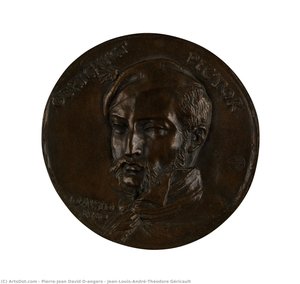
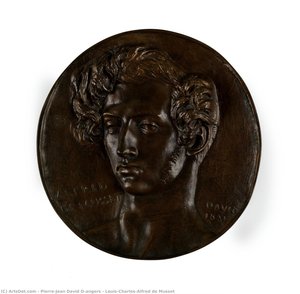
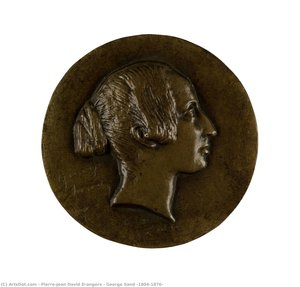
Technically, the medallion is a triumph of the hollow cast bronze method, a process requiring immense skill to ensure that every fine detail—from the texture of the hair to the soft contours of the face—is preserved with absolute fidelity. David d’Angers, a sculptor who famously sought to enshrine the greatness of his contemporaries, utilized this medium to create a sense of permanence and weight. The tactile quality of the bronze, with its deep, lustrous tones, lends an air of timelessness to the portrait, making it feel as though Chateaubriand has been plucked from the flow of history and frozen in a moment of eternal reflection.
For the discerning collector or interior designer, this reproduction offers a sophisticated focal point that commands attention through subtlety rather than spectacle. The piece carries an inherent dignity, making it an ideal addition to a curated library, a formal study, or a gallery space dedicated to classical elegance. It serves as a conversation piece that speaks of history, intellect, and the enduring power of art to immortalize the human experience. To possess such a work is to hold a fragment of the nineteenth century's most transformative era, bringing a sense of scholarly depth and aesthetic grace to any refined environment.
Related Artworks
Artist Biography
A Legacy Forged in Stone: The Life and Art of Pierre-Jean David d’Angers
Born in Angers, France, in 1788, Pierre-Jean David began his artistic journey steeped in the republican fervor that would define much of his life and work. Initially apprenticed to a local wood carver – his father – young David quickly demonstrated an aptitude for sculpting that propelled him towards greater ambitions. He arrived in Paris in 1808, a city brimming with both classical tradition and revolutionary spirit, seeking tutelage under Philippe-Laurent Roland at the École des Beaux-Arts. This period was formative, grounding him in neoclassical principles while simultaneously exposing him to the burgeoning Romantic movement. A pivotal moment came in 1809 when he entered the studio of Jacques-Louis David, adopting the name “David d’Angers” not merely as a professional designation but as a conscious assertion of lineage and artistic ambition – a distinction from his celebrated master. This adoption signaled a desire to forge his own path while acknowledging the profound influence of the era's leading painter. Early struggles marked his Parisian years, yet he persevered, winning recognition with works like “Othryades” in 1810 and ultimately securing the prestigious Prix de Rome in 1811 for his sculpture "Epaminondas."From Roman Reverie to Neoclassical Mastery
The five years David d’Angers spent in Rome, from 1811 to 1816, proved transformative. Immersed in the world of classical antiquity and under the influence of masters like Antonio Canova, his artistic vision matured. He absorbed the ideals of Greek sculpture – its emphasis on idealized form, heroic narrative, and emotional restraint – yet began to infuse these principles with a distinctly personal sensibility. This period wasn’t solely about academic study; it was also one of political awakening. The restoration of the Bourbon monarchy in France cast a shadow over his return, prompting a brief sojourn in England where he encountered both admiration and scrutiny due to his association with Jacques-Louis David, who had been linked to the revolutionary regime. Back in Paris, however, his talent quickly found favor. He became renowned for his portrait medallions – remarkably detailed and psychologically insightful representations of prominent figures – as well as monumental sculptures that celebrated civic virtue and national heroes. His work on the Arc de Triomphe and the Louvre demonstrated an early mastery of large-scale projects, establishing him as a sculptor capable of tackling ambitious commissions.A Sculptor of Heroes and Ideals
David d’Angers' artistic output was remarkably diverse, encompassing statues, bas-reliefs, tombs, and, most notably, portrait medallions. He possessed an extraordinary ability to capture not just the physical likeness but also the inner character of his subjects. His portraits weren’t simply representations; they were interpretations – imbued with a sense of dignity, intelligence, and moral strength. Among his celebrated works are “Wounded Philopoemen,” housed in the Louvre, a poignant depiction of the Greek general's tragic fate, and "La Douleur," showcasing his mastery of emotional expression. However, it was his monumental commissions that truly cemented his reputation. The pedimental sculpture for the Panthéon in Paris stands as perhaps his most significant achievement – a sweeping allegorical representation of French patriotism and intellectual heritage. Other notable works include the Gutenberg monument in Strasbourg and the equestrian statue of General Gobert in Père Lachaise Cemetery, both testaments to his skill in conveying power and dynamism through sculpted form. He also created a bust of Lafayette for the United States Congress, a symbol of Franco-American friendship.A Lasting Influence: Legacy and Historical Significance
Pierre-Jean David d’Angers was more than just a sculptor; he was a product of his time – a witness to revolution, empire, and restoration. His art reflects the political and intellectual currents that shaped 19th-century France. He embraced republican ideals, celebrating figures who embodied courage, integrity, and dedication to public service. While firmly rooted in neoclassical tradition, his work also foreshadowed the emergence of Romanticism, with its emphasis on emotional intensity and dramatic narrative. His influence extended beyond the realm of sculpture, inspiring generations of artists and shaping the visual landscape of France. Today, his works can be found in prominent museums around the world, including The Walters Art Museum in Baltimore and The Metropolitan Museum of Art in New York. The Musée David in Angers serves as a dedicated repository of his art, preserving his legacy for future generations. David d’Angers remains a compelling figure – a sculptor who not only captured the likenesses of heroes but also embodied the spirit of an era. His ability to blend classical form with Romantic expression continues to resonate with audiences today, solidifying his place as one of France's most important and enduring artists.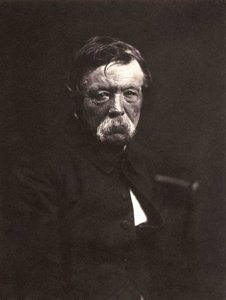
Pierre-Jean David d'Angers
1788 - 1856 , France
Quick Facts
- Artistic Movement Or Style: Neoclassical
- Artists Who Influenced This Artist:
- Jacques-Louis David
- Philippe-Laurent Roland
- Date Of Birth: 1788
- Date Of Death: 1856
- Full Name: Pierre-Jean David d'Angers
- Nationality: French
- Notable Artworks:
- Wounded Philopoemen
- La Douleur
- Epaminondas
- Place Of Birth: Angers, France
Related Articles

Bronze Age to Modern Masters: 10 Sculptures That Redefined Art | ArtsDot
Journey through art history with 10 legendary bronze sculptures – from Michelangelo's David to Rodin’s Thinker. Explore the stories, techniques & timeless beauty of these masterpieces. Find museum-quality reproductions & elevate your home decor on ArtsDot.com.

Bronze Sculptures That Defined Art History | ArtsDot
Journey through art history with our Top 10 bronze sculptures! Explore masterpieces by Rodin, Michelangelo & more. Discover stories behind iconic statues and find museum-quality reproductions for your home decor at ArtsDot.com.

The Enduring Legacy of Bronze: A Historical & Artistic Exploration for the Collector
Explore the rich history & enduring appeal of bronze sculpture with expert insights for collectors at ArtsDot. Learn about casting techniques, iconic artists, collecting tips & contemporary interpretations.

The Enduring Legacy of Bronze: History, Technique & Artistic Expression for the Collector
Explore the rich history & enduring appeal of bronze sculpture with expert insights for collectors at ArtsDot. Learn about casting techniques, iconic artists, and collecting tips.
The Enduring Legacy of Bronze Sculpture: History, Techniques & Contemporary Interpretations
Explore the rich history & enduring appeal of bronze sculpture. Learn about casting techniques, iconic artists, collecting tips, & contemporary interpretations. Expert insights for discerning art collectors.