 Preview
 Send
Send Share
Share
 Details

 Download
 Similars
 X-Ray
X-Ray Diaporama
Voyage au Soudan Oriental


 Read More
Hand Made Oil Reproduction
Hand-painted oil on canvas in your size and frame, made to order by our artists. ( Buy Print Buy Image)




P118B $10

P118H $10

P118W $10

P438Z $10

P508JH $12

P508YH $12

P805H $10

P805Z $10

P919BZ $10

P919G $10

P919XJ $10

P959ZH $10

P968JZ $12

W106C $8

W218G $10

W218JH $8

W218Y $10

W307PJ $10

W316G $10

W316PJ $8

W316Y $10

W398PJ $8

W4111J $10

W500HY $15

W500JH $15

W692G $12

W849H $8

W940BG $15

W953PJ $8




Pick from our preset sizes that match the artwork's original proportions.

You may enter your own dimensions to fit a specific frame or space. If your selected size does not match the original image's proportions, we will either crop the artwork or extend the painting with additional hand-painted elements. A digital mockup will be sent for your approval before production begins.
Please note that the on-screen preview does not reflect the actual cropping or extension. Only the mockup will accurately show the final composition.
While custom sizes are available, we recommend selecting a dimension from the predefined list to preserve the original proportions.
After order, ArtsDot.com team will email client for instructions and provide a mockup preview
Worldwide Delivery () in 3/4 weeks instead of standard 5 weeks. (23 August). No compromise on quality.

Free Worldwide Express Shipping

High-Quality Linen Canvas

Full Shipping Insurance

Customs Tax Refund Guarantee

True Color Matching Guarantee

60-Day Return Policy (Defects Only)

100% Money-Back Guarantee

Bulk Discount Offer
 Glass option is only available in size under 110 CM

Voyage au Soudan Oriental
Reproduction Medium
Reproduction Size
-


Total Price
$ 263
Artwork Description
A Window into the Orient: The Architectural Vision of Pierre-Victor Trémaux
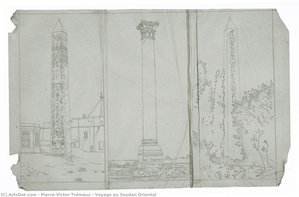
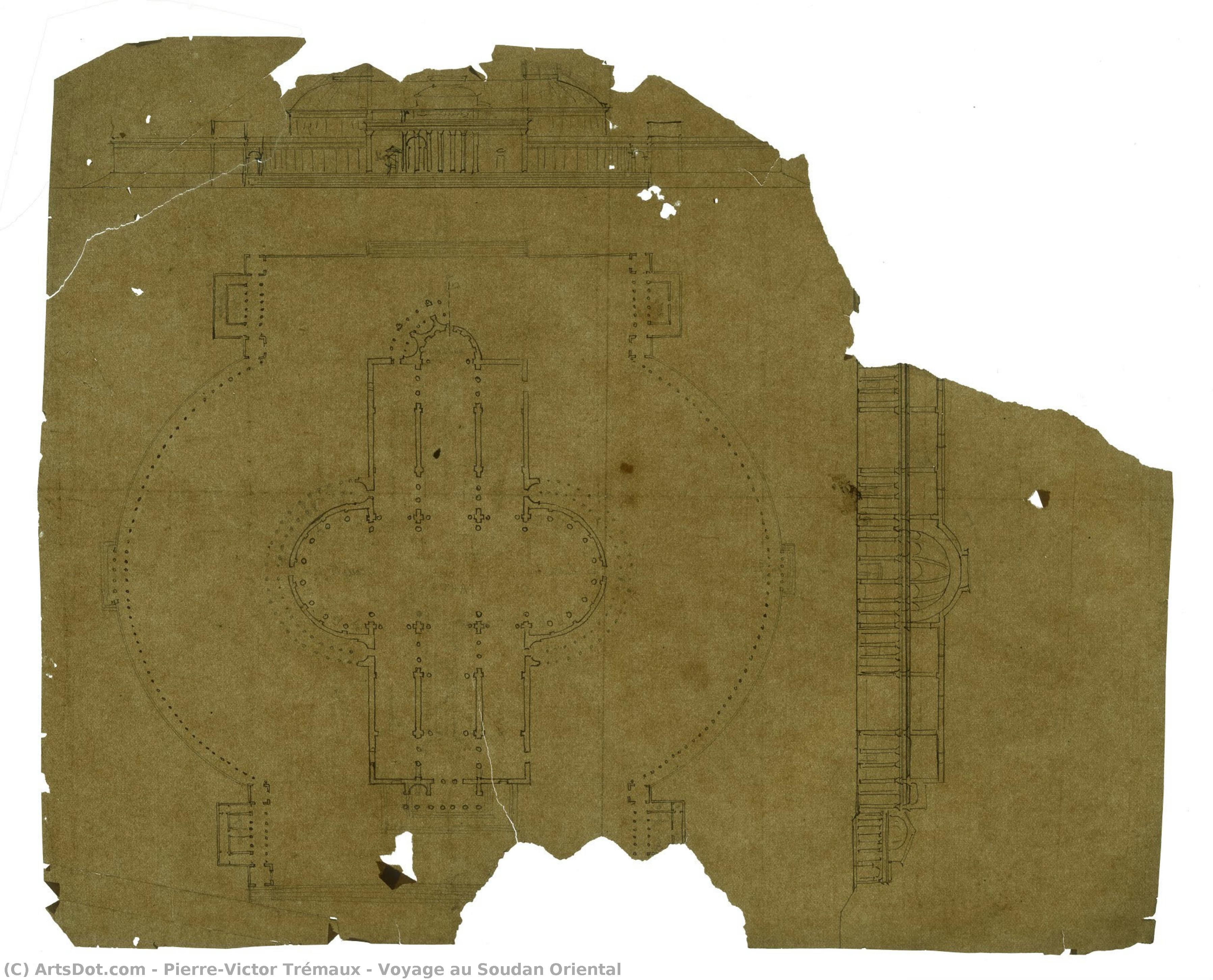
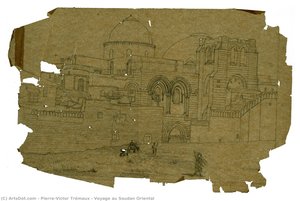
In the mid-19th century, as the boundaries between the West and the East began to blur through travel and scientific inquiry, Pierre-Victor Trémaux captured a moment of profound stillness and structural grandeur. His work, Voyage au Soudan Oriental, serves as more than just a visual record; it is an evocative portal into a landscape defined by both spiritual devotion and architectural complexity. Created in 1853, this piece invites the viewer to wander through a meticulously rendered scene where the heavy presence of stone and masonry meets the ethereal light of the Sudanese horizon. The composition is anchored by a commanding central structure, crowned with a cross that stands as a silent sentinel over the surrounding landscape, suggesting a deep-seated intersection of faith and colonial-era exploration.
The artistry of Trémaux lies in his unique ability to synthesize his rigorous training at the École des Beaux-Arts with the spontaneous curiosity of a traveler. As an architect by training, his approach to this painting is marked by an extraordinary attention to scale and perspective. Every smaller building surrounding the central edifice is placed with intentionality, creating a sense of depth that draws the eye inward toward the heart of the settlement. The interplay between the massive, imposing architecture and the delicate human figures scattered within the frame provides a poignant sense of scale, reminding us of the enduring nature of stone against the fleeting presence of man.
The Mastery of Light and Historical Resonance
To behold this work is to experience the atmospheric tension of an era defined by discovery. Trémaux utilizes a technique that emphasizes texture and form, allowing the viewer to almost feel the heat radiating from the sun-drenched surfaces of the buildings. The shadows are not merely absences of light but are sculptural elements that define the edges of the architecture, lending the scene a three-dimensional vitality. This mastery of light creates an emotional resonance that oscillates between the awe of witnessing a monumental civilization and the quiet intimacy of a solitary journey through a foreign land.
For the discerning collector or interior designer, Voyage au Soudan Oriental offers a sophisticated narrative for any curated space. Its monochromatic essence—often appreciated in its historical photographic reproductions—provides a timeless elegance that complements both classical and contemporary decor. The painting does not merely decorate a wall; it commands attention, acting as a conversation piece that speaks to the history of Orientalism, the evolution of architectural documentation, and the eternal human desire to map the unknown. Bringing a reproduction of this masterpiece into a home or gallery is an act of preserving a fragment of 19th-century wonder, offering a permanent sense of worldly exploration and intellectual depth.
Related Artworks


Artist Biography
Pierre-Victor Trémaux: Bridging Architecture, Photography, and the Orient
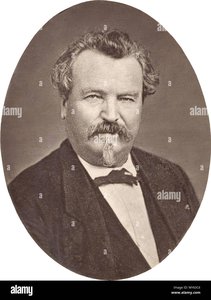
Born in Charrecey, France, on July 20, 1818, Pierre-Victor Trémaux’s life was a remarkable convergence of seemingly disparate passions – architecture, photography, scientific observation, and a profound fascination with the cultures of the East. He wasn't merely an artist; he was a pioneer, meticulously documenting a world undergoing rapid transformation through the lens of his era. His legacy lies not just in individual artworks but in the way he synthesized diverse disciplines to create a uniquely informed and evocative visual record.
Trémaux’s early education at the École des Beaux-Arts in Paris provided him with a rigorous grounding in architectural principles, shaping his understanding of space, form, and construction. This formal training was quickly complemented by an adventurous spirit and a keen interest in the natural world. He received significant recognition early in his career, culminating in the prestigious second Prix de Rome in architecture in 1845 – a testament to his burgeoning talent. However, it was his subsequent travels that truly defined his artistic trajectory. Beginning in 1847, Trémaux embarked on extended expeditions through North Africa and the Middle East, documenting landscapes, peoples, and artifacts with an unprecedented level of detail and sensitivity.
The Orientalist Vision: Photography as a Scientific Instrument
Trémaux’s approach to photography in this period was revolutionary. He didn't simply capture picturesque scenes; he treated his camera as a scientific instrument, meticulously analyzing the details of architecture, textiles, ceramics, and other cultural objects. His photographs weren’t romanticized depictions of exotic lands but rather carefully composed studies intended to reveal underlying structures and patterns. He sought to understand the relationship between form and function, light and shadow, and the very essence of these distant cultures. This is particularly evident in his extensive work on Sudan, meticulously documenting ancient Nubian artifacts – a rare glimpse into the region’s rich history through photographic means.
His 1853 monochrome sketch of Istanbul's mosque architecture, showcased in ArtsDot reproductions, exemplifies this approach. The precision and detail are remarkable, demonstrating not just artistic skill but also a deep understanding of architectural principles. These early photographs, though often fragile due to the limitations of the technology at the time, offer invaluable insights into a world largely unseen by European eyes before his expeditions.
Architectural Designs and Scientific Writings
While Trémaux’s photographic work is arguably his most celebrated contribution, he was also a skilled architect and a prolific scientific writer. His architectural designs reflected a sophisticated understanding of classical principles combined with an innovative approach to space planning. He contributed significantly to the construction of the Suez Canal, showcasing his expertise in engineering and design. Beyond architecture, Trémaux’s writings explored topics ranging from natural history to evolutionary theory – a testament to his intellectual curiosity and his desire to understand the interconnectedness of all things.
His 1865 book, *Origine et transformations de l'homme et des autres êtres* (Origin and Transformations of Man and Other Beings), is particularly noteworthy. This ambitious work proposed a theory of punctuated equilibrium – suggesting that evolution proceeds through periods of rapid change interspersed with long stretches of relative stability. While ultimately superseded by modern evolutionary theory, it was remarkably prescient for its time and demonstrated Trémaux’s willingness to challenge conventional wisdom.
Legacy and Influence
Pierre-Victor Trémaux's work profoundly impacted the art world and beyond. He bridged the gap between architecture, photography, and scientific observation, creating a uniquely informed and visually compelling record of the 19th century. His meticulous documentation of Oriental cultures influenced subsequent generations of artists and photographers, shaping the development of Orientalist painting and contributing to a greater understanding of diverse societies. His legacy can be seen in the works of other notable figures, including Edgar Degas, whose pastel drawings and oil paintings share a similar focus on capturing the essence of human experience. Trémaux’s work continues to be exhibited at institutions like the Musée Victor Hugo in Paris, ensuring that his remarkable contributions are recognized and appreciated for years to come.
ArtsDot is proud to offer high-quality reproductions of Trémaux's captivating images, allowing viewers to experience firsthand the beauty, detail, and intellectual depth of this extraordinary artist’s vision.
pierre-victor trémaux
1818 - 1895 , France
Quick Facts
- Artistic Movement Or Style: Orientalism, Architecture
- Artists Or Movements Influenced By This Artist: ['Victor Hugo']
- Artists Who Influenced This Artist: ['Edgar Degas']
- Date Of Birth: July 20, 1818
- Date Of Death: March 12, 1895
- Full Name: Pierre-Victor Trémaux
- Nationality: French
- Notable Artworks:
- Voyage au Soudan Oriental
- Istanbul Mosque Architecture
- Place Of Birth: Charrecey, France
Related Articles

Romantic Landscapes: 10 Masterpieces for Your Home | ArtsDot
Journey through 10 Romantic landscape masterpieces by Friedrich, Turner & Cole. Explore emotional art, sublime nature scenes & iconic 19th-century paintings. Find museum-quality reproductions for your home at ArtsDot.com – discover the full collection online!
Evoking Nature's Sublime: A Comprehensive Exploration of 19th-Century Landscape Painting
Explore the captivating world of 19th-century landscape painting! Discover renowned artists like Friedrich & Monet, key movements, and find the perfect artwork to bring nature's serenity into your home. Expert insights at ArtsDot.

John Constable's Masterpieces: Explore 25 Iconic Landscapes for Your Home
Journey through John Constable's 25 most celebrated landscapes. Explore Romanticism, Dedham Vale & his masterful use of light in iconic paintings like 'Hay Wain'. Find museum-quality art reproductions and elevate your home decor on ArtsDot.com.

Evocations of Place: A Historical Journey Through Landscape Art
Explore the rich history of landscape art with ArtsDot. Discover renowned artists, movements like Impressionism & Romanticism, and expert guidance for collecting timeless pieces. Find your perfect serene escape today!

Evocations of Place: A Historical Journey Through Landscape Art
Explore the rich history of landscape art with ArtsDot. Discover renowned artists, movements like Impressionism & tonalism, and expert guidance for collecting timeless pieces. Find your perfect serene escape today!