 Preview
 Send
Send Share
Share
 Details

 Download
 Similars
 X-Ray
X-Ray Diaporama
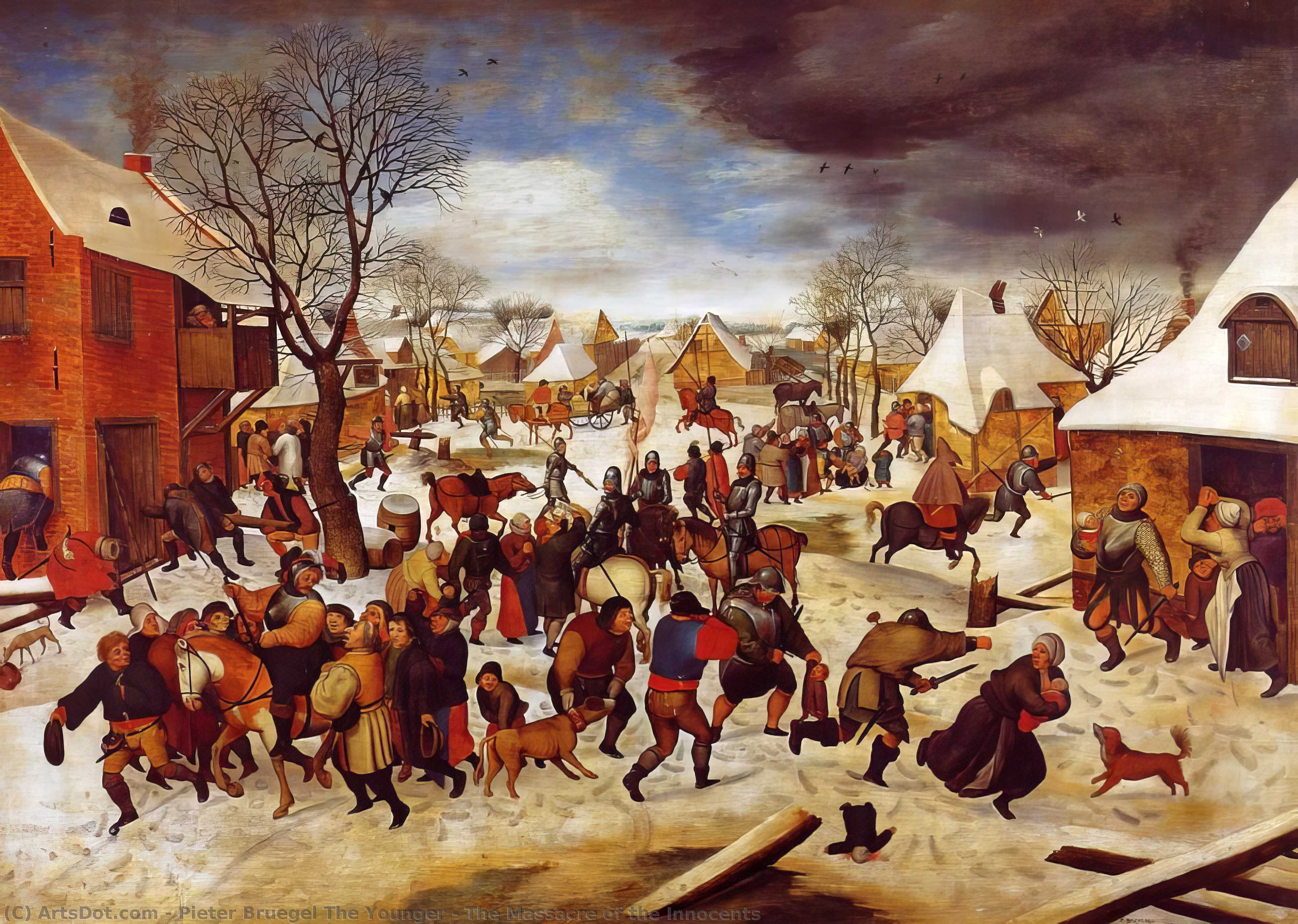
The Massacre of the Innocents


 Read More
Hand Made Oil Reproduction
Hand-painted oil on canvas in your size and frame, made to order by our artists. ( Buy Print Buy Image)




P118B $10

P118H $10

P118W $10

P438Z $10

P508JH $12

P508YH $12

P805H $10

P805Z $10

P919BZ $10

P919G $10

P919XJ $10

P959ZH $10

P968JZ $12

W106C $8

W218G $10

W218JH $8

W218Y $10

W307PJ $10

W316G $10

W316PJ $8

W316Y $10

W398PJ $8

W4111J $10

W500HY $15

W500JH $15

W692G $12

W849H $8

W940BG $15

W953PJ $8




Pick from our preset sizes that match the artwork's original proportions.

You may enter your own dimensions to fit a specific frame or space. If your selected size does not match the original image's proportions, we will either crop the artwork or extend the painting with additional hand-painted elements. A digital mockup will be sent for your approval before production begins.
Please note that the on-screen preview does not reflect the actual cropping or extension. Only the mockup will accurately show the final composition.
While custom sizes are available, we recommend selecting a dimension from the predefined list to preserve the original proportions.
After order, ArtsDot.com team will email client for instructions and provide a mockup preview
Worldwide Delivery () in 3/4 weeks instead of standard 5 weeks. (4 September). No compromise on quality.

Free Worldwide Express Shipping

High-Quality Linen Canvas

Full Shipping Insurance

Customs Tax Refund Guarantee

True Color Matching Guarantee

60-Day Return Policy (Defects Only)

100% Money-Back Guarantee

Bulk Discount Offer
 Glass option is only available in size under 110 CM

The Massacre of the Innocents
Reproduction Medium
Reproduction Size
-


Total Price
$ 413
The Massacre of the Innocents: A Masterpiece of Flemish Art
Subject and Historical Context
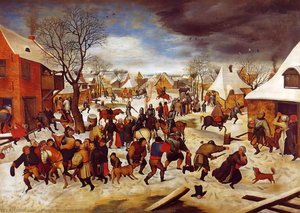
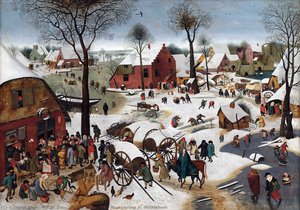
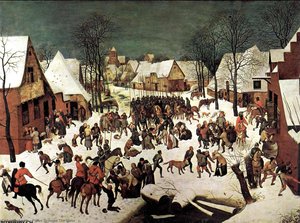
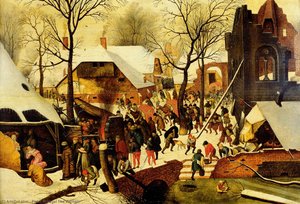
Pieter Bruegel the Younger's "The Massacre of the Innocents" is a powerful depiction of the biblical narrative from the Gospel of Saint Matthew, where King Herod orders the execution of all infant boys in Bethlehem. Created around 1567, this painting transcends its religious origins to offer a poignant commentary on the brutalities of war and oppression during the Dutch Revolt against Spanish rule. Bruegel masterfully translates this historical event into a winter scene set in the Southern Netherlands, capturing the essence of 16th-century Flemish life amidst the turmoil of conflict.Style and Technique
Bruegel's work is a testament to the Northern Renaissance style, characterized by its meticulous attention to detail and realistic portrayal of everyday life. The painting employs a dynamic composition filled with numerous figures engaged in various activities, creating a sense of movement and chaos. Bruegel's use of earthy tones mixed with bright accents, such as shades of brown, red, and blue, contrasts beautifully with the white snow covering the ground and rooftops. This color palette not only enhances the visual appeal but also underscores the harshness of the winter setting. The artist's technique involves intricate brushwork and layering, achieving a high level of detail and texture that brings the scene to life. The use of lines, shapes, and textures adds depth and dimension to the painting, making it a captivating visual experience. Bruegel's naturalistic lighting and elevated perspective provide a comprehensive view of the village street and its activities, inviting viewers to immerse themselves in the narrative.Symbolism and Emotional Impact
"The Massacre of the Innocents" is rich with symbolism, reflecting the artist's commentary on the human condition during times of conflict. The painting serves as a powerful reminder of the innocence lost to war and the resilience of communities in the face of adversity. The presence of animals and the bustling activity of the village underscore the everyday realities of life amidst turmoil, adding layers of emotional depth to the artwork. The contrast between the warm tones of the clothing and buildings and the cool white of the snow creates a visually striking effect that evokes a sense of melancholy and reflection. This juxtaposition, combined with the detailed portrayal of human suffering, makes the painting an emotionally resonant piece that continues to captivate viewers centuries later.Why Collect or Display This Artwork
For art lovers, collectors, and interior designers, "The Massacre of the Innocents" offers a unique opportunity to own a high-quality reproduction of a masterpiece that blends historical significance with artistic brilliance. The painting's rich detail and vibrant colors make it a striking addition to any collection or interior space. Its narrative quality invites viewers to explore and interpret the scene, adding a layer of intellectual engagement to its aesthetic appeal. Whether displayed in a private collection, gallery, or public space, this artwork serves as a conversation piece that sparks discussions about history, art, and the human experience. Its timeless themes and masterful execution make it a valuable addition to any art enthusiast's repertoire.Bring Home a Piece of History
Own a hand-painted reproduction of "The Massacre of the Innocents" and bring a piece of Flemish Renaissance art into your home or collection. Experience the emotional depth and historical significance of this masterpiece, and let it inspire and captivate all who view it.Related Artworks
Artist Biography
early life and training
pieter bruegel the younger, a prominent figure in the northern renaissance, was born in belgium around 1525. although his birth date is not documented, it is inferred that he entered the antwerp painters' guild in 1551, suggesting he was between 20 to 25 years old at the time. bruegel's master was pieter coecke van aelst, an antwerp painter.artistic career and innovations
bruegel's artistic career can be characterized by his innovative choices of subject matter, which marked a significant departure from the traditional religious themes prevalent during that time. he was one of the first generation of artists to grow up when non-religious subjects became more acceptable in art. notably, bruegel did not paint portraits, another common theme in netherlandish art.- between 1545 and 1550, bruegel worked as a pupil of pieter coecke, who passed away on december 6, 1550.
- before his training, bruegel was documented working in mechelen between september 1550 and october 1551, assisting peeter baltens on an altarpiece (now lost).
notable works and style
bruegel's famous paintings, which he produced over a decade before his early death in 1569, include:- the shepard (northern renaissance)
- the good shepherd (northern renaissance)
- the beater (northern renaissance)
museums and collections
bruegel's work can be found in various museums, including the groeninge museum, which is part of musea brugge, a network of museums and cultural institutions in bruges. the museum features an impressive collection of flemish and belgian paintings spanning six centuries. groeninge museum, bruges, belgiumlegacy
pieter bruegel the younger's influence on dutch golden age painting and later painting in general is undeniable. his innovative choices of subject matter paved the way for future generations of artists. as a significant figure in the northern renaissance, his work continues to inspire art lovers and scholars alike. explore more of pieter bruegel the younger's works on ArtsDot.com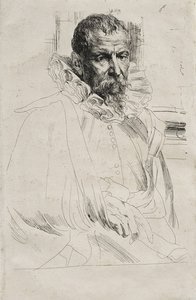
pieter bruegel the younger
1525 - 1569 , Belgium
Quick Facts
- Artistic Movement Or Style: Northern Renaissance
- Artists Or Movements Influenced By This Artist: ['Dutch Golden Age']
- Artists Who Influenced This Artist: ['Pieter Coecke van Aelst']
- Date Of Birth: c. 1525
- Date Of Death: 1569
- Full Name: Pieter Bruegel the Younger
- Nationality: Belgian
- Notable Artworks:
- The Shepherd
- The Good Shepherd
- Place Of Birth: Brussels, Belgium
Related Articles
Pieter Bruegel the Elder: A Master of Genre, Landscape & Social Commentary
Explore the life & art of Pieter Bruegel the Elder, a pivotal figure of the Renaissance. Discover his groundbreaking genre scenes, symbolic landscapes, and lasting influence on art history. Learn more at ArtsDot.
Northern Renaissance Masters: 10 Artworks That Shaped History |
Journey through the Northern Renaissance! Explore 10 iconic paintings by Jan van Eyck, Dürer & Bosch. Discover their stories, techniques & lasting impact. Find museum-quality art reproductions & elevate your home decor on .
Kunsthistorisches Museum's Masterpieces: 25 Art Treasures for Your Home | ArtsDot
Journey through 25 iconic artworks at Vienna's Kunsthistorisches Museum! Explore masterpieces by Raphael, Rembrandt & Vermeer. Discover art history, techniques & find museum-quality reproductions for your home on ArtsDot.com.
Oil on Panel Masters: 10 Paintings That Revolutionized Art |
Journey through 10 legendary 'Oil on Panel' masterpieces by Van Eyck, Bosch & Bruegel. Explore the stories behind these iconic Renaissance & Baroque paintings and find museum-quality art reproductions to elevate your home decor. Discover all masterpieces on !
Sacred Narratives Embodied: A Comprehensive Exploration of Religious Iconography in Art History
Explore the rich history of religious iconography in art! Discover symbolism, movements & masterpieces from Byzantine to Renaissance periods. Expert insights for collectors and enthusiasts at ArtsDot.