 Preview
 Send
Send Share
Share
 Details

 Download
 Similars
 X-Ray
X-Ray Diaporama
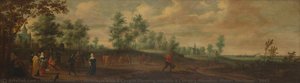
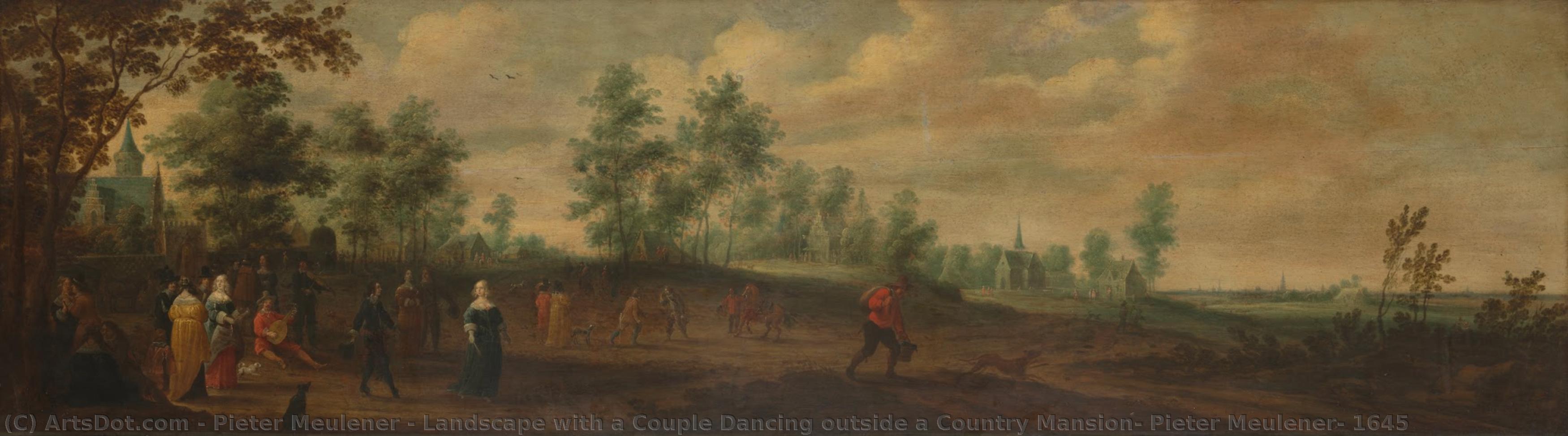
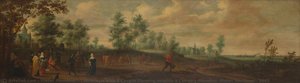
Landscape with a Couple Dancing outside a Country Mansion, Pieter Meulener, 1645
 1645
1645 50.0 x 172.0 cm
 Read More
Giclée / Art Print
Museum-quality giclée or canvas print with fast production and flexible finish options. ( Buy Hand Made Painting Buy Image)




































Pick from our preset sizes that match the artwork's original proportions.

You may enter your own dimensions to fit a specific frame or space. If your selected size does not match the original image's proportions, we will either crop the artwork or extend the image with a mirrored or solid-fill edge. A digital mockup will be sent for your approval before production begins.
Please note that the on-screen preview does not reflect the actual cropping or extension. Only the mockup will accurately show the final composition.
While custom sizes are available, we recommend selecting a dimension from the predefined list to preserve the original proportions.
Worldwide Delivery () in 2 weeks instead of standard 4/5 weeks. (29 August)

Free Worldwide Express Shipping

High-Quality Linen Canvas

Full Shipping Insurance

Customs Tax Refund Guarantee

True Color Matching Guarantee

60-Day Return Policy (Defects Only)

100% Money-Back Guarantee

Bulk Discount Offer
 Glass option is only available in size under 110 CM

Landscape with a Couple Dancing outside a Country Mansion, Pieter Meulener, 1645
Giclée / Art Print
Reproduction Size
-


Total Price
$ 63
Related Artworks









Artist Biography
The Dramatic Pulse of Flemish Baroque: The Life and Legacy of Pieter Meulener
In the heart of seventeenth-century Antwerp, a city vibrating with the creative energy of the Flemish Baroque, the name Pieter Meulener emerged as a master of both the chaotic battlefield and the tranquil pastoral. Born in 1602, Meulener was a child of an illustrious artistic lineage; he was the son of the genre painter Jan de Meuleneer and carried the legacy of his grandfather, the Renaissance landscape artist Cornelis Molenaer. This deep-rooted connection to the Antwerp tradition provided him with more than just a name—it offered a foundation of technical excellence that would allow him to capture the dualities of human existence, from the terrifying thunder of cavalry charges to the quiet, sun-drenched moments of country life.
Meulener’s artistic development was shaped by the rigorous traditions of his era. While some accounts suggest he may have been influenced by the legendary Abraham van Dyck, historical records indicate he was a pupil of his father and the renowned battle painter Sebastian Vrancx. This training under Vrancx is particularly significant, as it instilled in him the ability to render complex military maneuvers with anatomical precision and a sense of breathless movement. By 1631, Meulener had officially joined the prestigious Antwerp Guild of Saint Luke, marking his arrival as a professional force within the Flemish art scene. His work during this period began to reflect a sophisticated mastery of chiaroscuro, using the dramatic interplay of light and shadow to guide the viewer's eye through the smoke of battle or the dappled sunlight of a forest clearing.
A Mastery of Motion and Landscape
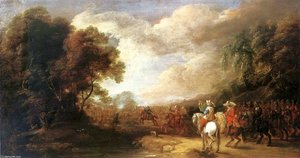
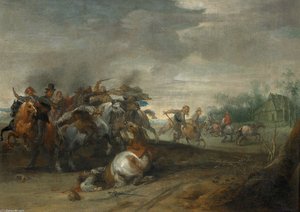
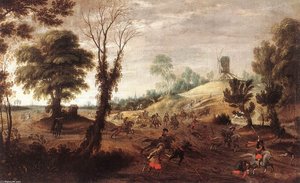
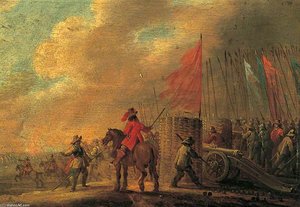
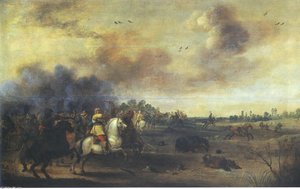
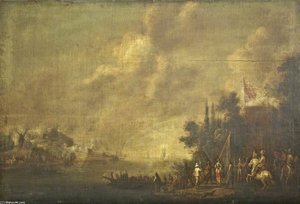
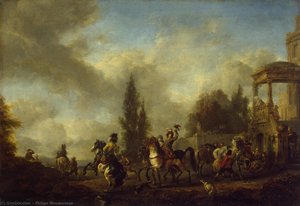
The true brilliance of Meulener lies in his ability to command the canvas through movement. He was, above all, a storyteller of action. In works such as "Battle Scene With Artillery" and "Cavalry Charge," the viewer is not merely an observer but a participant in the tumult. His brushwork captures the frantic energy of horses in mid-gallop and the meticulous, deadly detail of period weaponry. There is a palpable sense of immediacy in his military compositions; one can almost hear the clash of steel and the roar of cannons. This commitment to dynamism was not merely a stylistic choice but a reflection of the turbulent political landscape of the seventeenth century, where the reality of warfare was a constant presence in European life.
Yet, Meulener was far from a singular focus on conflict. He possessed a remarkable versatility that allowed him to pivot from the carnage of war to the serene beauty of the Flemish countryside. His landscapes often feature genre scenes—small, intimate human stories set against expansive vistas. In "Landscape With A Couple Dancing Outside A Country Mansion," Meulener demonstrates his capacity for tenderness and subtle symbolism. These pastoral works, such as "Festive Meal Outside a Country Mansion," reveal an artist capable of profound humanist contemplation, finding beauty in the rhythmic simplicity of rural life. Through these varied subjects, he achieved a rare balance between the epic and the intimate.
Historical Significance and Artistic Enduring Spirit
Though his life ended in 1654, Meulener’s contribution to the Flemish Baroque remains an essential chapter in art history. He bridged the gap between the structured landscapes of the Renaissance and the emotive, high-drama compositions of the late Baroque. His ability to navigate different genres—battle, landscape, and genre painting—allowed him to cater to a wide range of patrons, from those seeking historical documentation to those desiring decorative elegance for their homes.
The enduring legacy of Pieter Meulener can be summarized through several key artistic contributions:
- Narrative Dynamism: His unparalleled ability to capture the kinetic energy of military skirmishes and cavalry movements.
- Technical Versatility: The seamless transition between the gritty realism of war scenes and the lyrical beauty of pastoral landscapes.
- Influence of Lineage: The successful synthesis of his grandfather's landscape traditions with the contemporary Baroque interest in drama and light.
- Cultural Reflection: Providing a visual record of the social and political tensions of seventeenth-century Flanders through both conflict and tranquility.
Today, when we look upon a Meulener canvas, we see more than just paint on wood or cloth; we see the heartbeat of an era. His works serve as windows into a world defined by both the struggle for power and the enduring peace of the natural landscape, ensuring his place as one of the most compelling voices of the Flemish Golden Age.
pieter meulener
1602 - 1654 , Belgium
Quick Facts
- Artistic Movement Or Style: Baroque
- Date Of Birth: 1602 Antwerp Belgium
- Date Of Death: 1654
- Full Name: Pieter Meulener
- Nationality: Flemish
- Notable Artworks:
- Landscape with a Couple Dancing outside a Country Mansion
- Battle Scene With Artillery
- Cavalry Charge
- Place Of Birth: Antwerp Belgium