 Preview
 Send
Send Share
Share
 Details

 Download
 Similars
 X-Ray
X-Ray Diaporama
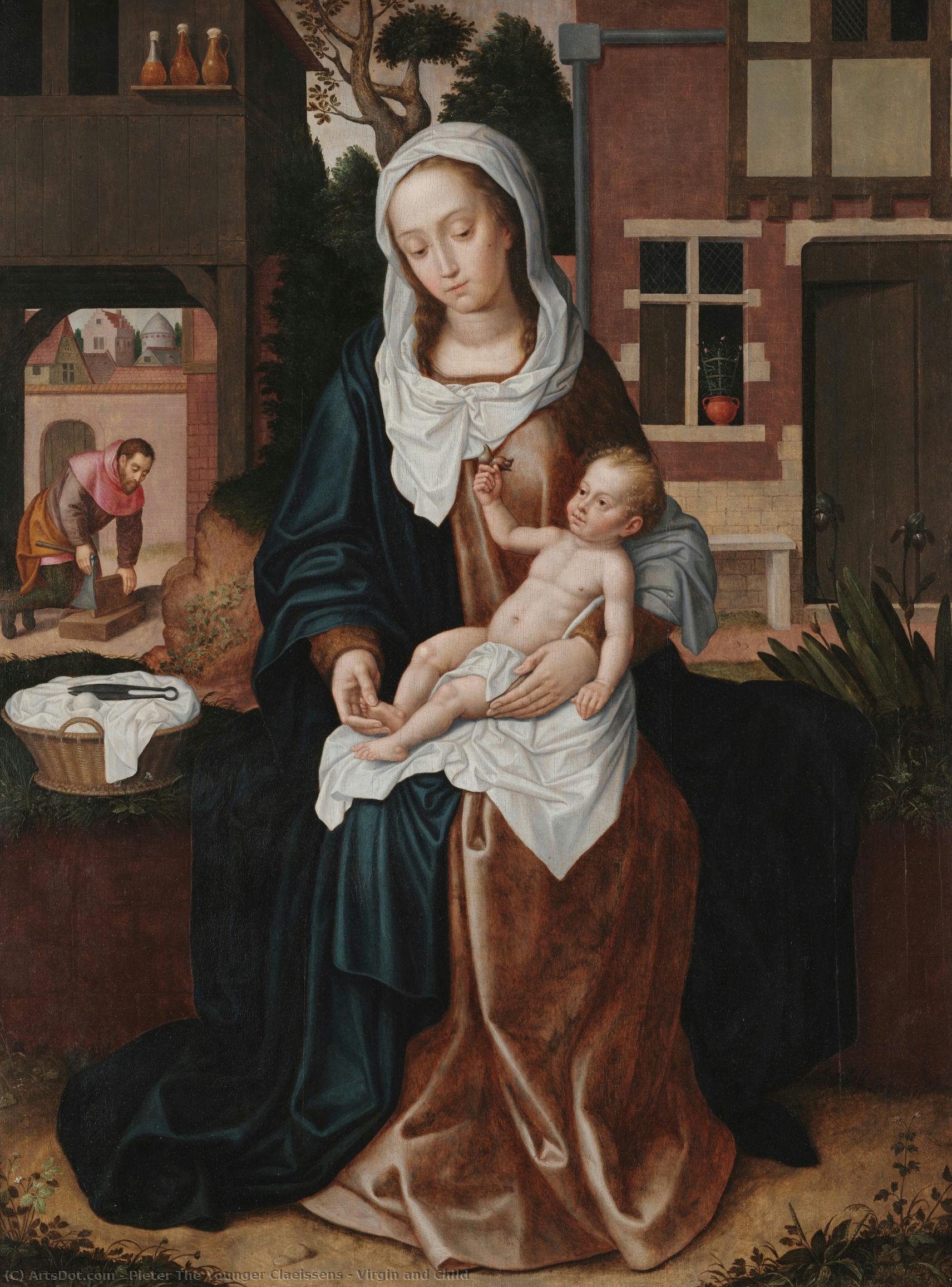
Virgin and Child


 Read More
Giclée / Art Print
Museum-quality giclée or canvas print with fast production and flexible finish options. ( Buy Hand Made Painting Buy Image)




































Pick from our preset sizes that match the artwork's original proportions.

You may enter your own dimensions to fit a specific frame or space. If your selected size does not match the original image's proportions, we will either crop the artwork or extend the image with a mirrored or solid-fill edge. A digital mockup will be sent for your approval before production begins.
Please note that the on-screen preview does not reflect the actual cropping or extension. Only the mockup will accurately show the final composition.
While custom sizes are available, we recommend selecting a dimension from the predefined list to preserve the original proportions.
Worldwide Delivery () in 2 weeks instead of standard 4/5 weeks. (24 August)

Free Worldwide Express Shipping

High-Quality Linen Canvas

Full Shipping Insurance

Customs Tax Refund Guarantee

True Color Matching Guarantee

60-Day Return Policy (Defects Only)

100% Money-Back Guarantee

Bulk Discount Offer
 Glass option is only available in size under 110 CM

Virgin and Child
Giclée / Art Print
Reproduction Size
-


Total Price
$ 63
Collectible Description
Related Artworks






Artist Biography
A Legacy of Light and Devotion: The Life of Pieter the Younger Claeissens
In the heart of Bruges, a city where the echoes of the Middle Ages met the burgeoning intellectual light of the Renaissance, Pieter the Younger Claes Jansz. Claeissens emerged as a master of profound visual storytelling. Born around 1540, his very existence was woven into the rich tapestry of the Flemish artistic tradition. As the son of the esteemed painter Pieter Claes Jansz., Claeissens did not merely learn a trade; he inherited a lineage of meticulous precision and a deep-seated reverence for the oil medium. This early tutelage under his father provided him with the technical foundation necessary to master the subtle luminosity and tactile realism that would become the hallmarks of his mature style, allowing him to breathe life into skin, fabric, and the very atmosphere of his compositions.
The world Claeissens inhabited was one of intense transition, marked by the humanist revival and the complex political shifts of the Low Countries. His career flourished during the reign of Philip II, a period where art served as both a tool for religious devotion and a mirror for political identity. Claeissens rose to significant prominence within the Guild of St. Luke in Bruges, eventually serving as its dean on multiple occasions between 1587 and 1606. His professional ascent was further solidified by his appointment as the official painter to Bruges, a prestigious mantle he held from 1581 until 1621, succeeding his brother Antoon. This position allowed him to shape the visual identity of his home city, producing works that resonated with both the local citizenry and the ruling elite.
The Mastery of Allegory and Sacred Imagery
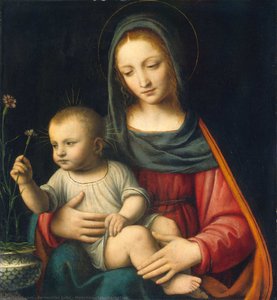
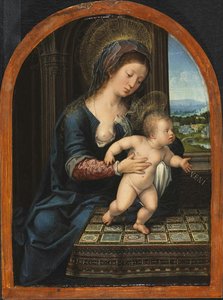
While Claeissens was a gifted portraitist capable of capturing the psychological depth of his subjects, it is in his religious and allegorical works that his true genius resides. He possessed a rare ability to marry the earthly with the divine, using the dramatic interplay of chiaroscuro to evoke a sense of spiritual awe. In his depictions of the Virgin and Child, such as those set within elegant Gothic frames, he moved beyond simple iconography. Through the careful placement of figures—like the presence of Joseph working in the background—he transformed static devotional panels into living narratives of the Holy Family, inviting the viewer into a moment of quiet, domestic sanctity.
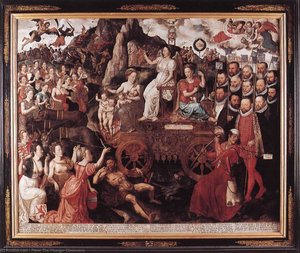
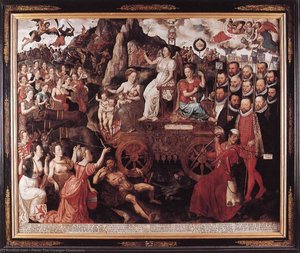
Beyond the sacred, Claeissens was a master of the complex political allegory. His monumental work, Allegory of the 1577 Peace in the Low Countries, stands as a testament to his ability to translate the turbulent sociopolitical climate of his era into a cohesive visual language. In this sweeping composition, he utilizes a central female figure atop a cart to act as an anchor for a diverse assembly of souls, capturing the collective breath of a society yearning for stability amidst upheaval. Through these works, Claeisspecens demonstrated that painting could serve as much more than decoration; it could function as a profound psychological study of a nation in transition.
The enduring significance of Pieter the Younger Claeissens lies in his role as a bridge between eras. His work embodies the following essential elements of the Flemish tradition:
- Technical Precision: A commitment to the meticulous detail and luminous textures inherited from the great Flemish masters.
- Symbolic Depth: The use of humanist symbolism to convey complex theological and political truths.
- Narrative Emotion: An ability to utilize light and shadow to heighten the emotional impact of both sacred and secular scenes.
- Civic Importance: A career deeply embedded in the institutional and cultural life of Bruges, serving as a guardian of the city's artistic heritage.
As we look back upon his prolific career, Claeissens remains a pivotal figure of the Northern Renaissance. His ability to navigate the delicate balance between the meticulous realism of his Flemish roots and the grand, symbolic ambitions of the Renaissance era ensures that his works continue to captivate the modern eye, offering a window into a world where every brushstroke was an act of faith and every shadow held a story.
pieter the younger claeissens
1540 - 1623 , Belgium
Quick Facts
- Artistic Movement Or Style: Renaissance Painting
- Artists Or Movements Influenced By This Artist: ['Northern Renaissance']
- Artists Who Influenced This Artist: ['Jan Bruegel the Elder']
- Date Of Birth: ca. 1540
- Date Of Death: 1623
- Full Name: Pieter Claeissens
- Nationality: Flemish
- Notable Artworks: ['Virgin and Child']
- Place Of Birth: Bruges, Belgium