 Preview
 Send
Send Share
Share
 Details

 Download
 Similars
 X-Ray
X-Ray Diaporama
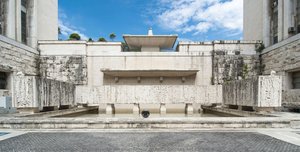
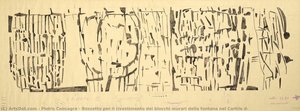
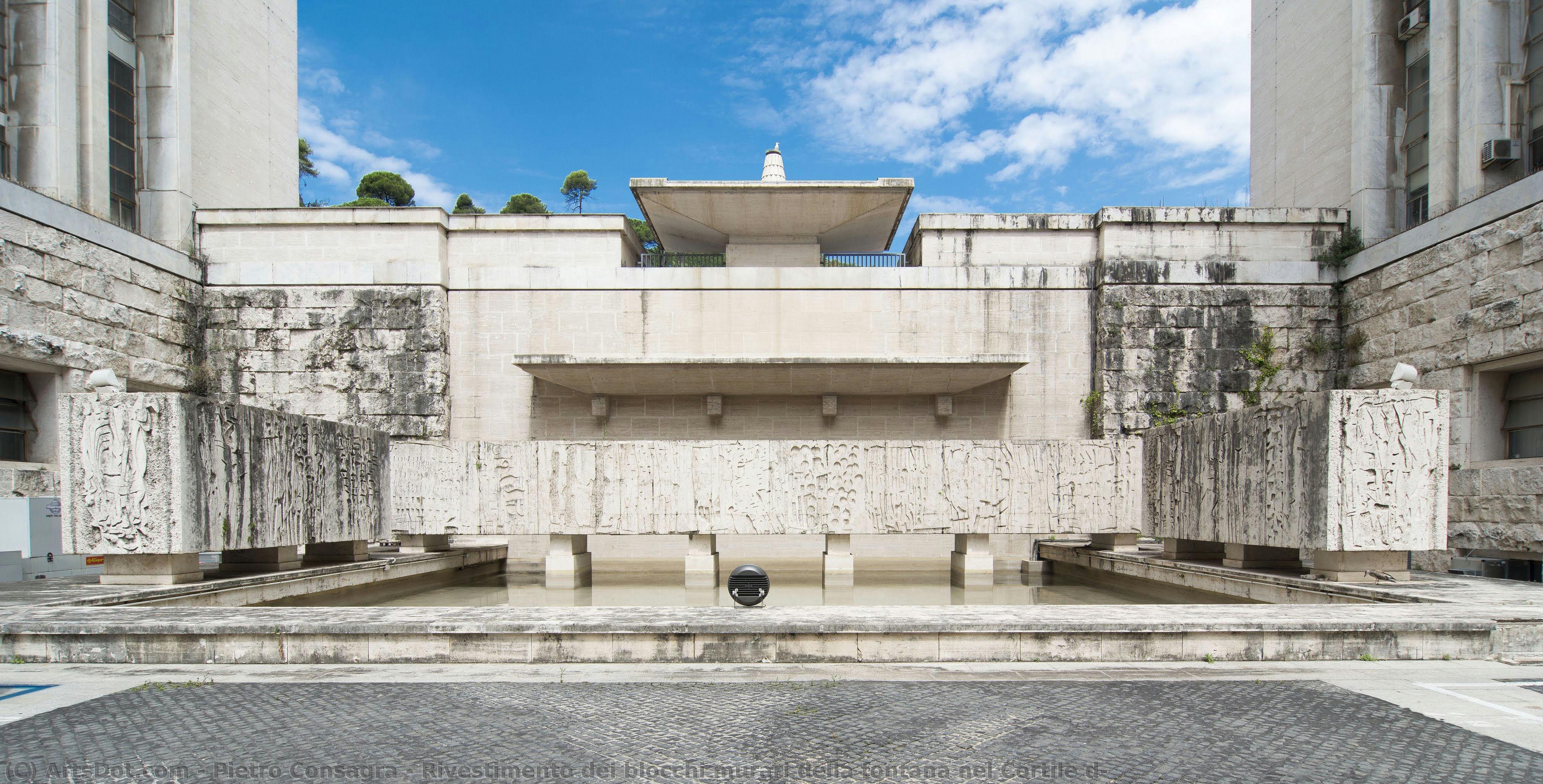
Rivestimento dei blocchi murari della fontana nel Cortile d

 Read More
Giclée / Art Print
Museum-quality giclée or canvas print with fast production and flexible finish options. ( Buy Hand Made Painting Buy Image)




































Pick from our preset sizes that match the artwork's original proportions.

You may enter your own dimensions to fit a specific frame or space. If your selected size does not match the original image's proportions, we will either crop the artwork or extend the image with a mirrored or solid-fill edge. A digital mockup will be sent for your approval before production begins.
Please note that the on-screen preview does not reflect the actual cropping or extension. Only the mockup will accurately show the final composition.
While custom sizes are available, we recommend selecting a dimension from the predefined list to preserve the original proportions.
Worldwide Delivery () in 2 weeks instead of standard 4/5 weeks. (28 August)

Free Worldwide Express Shipping

High-Quality Linen Canvas

Full Shipping Insurance

Customs Tax Refund Guarantee

True Color Matching Guarantee

60-Day Return Policy (Defects Only)

100% Money-Back Guarantee

Bulk Discount Offer
 Glass option is only available in size under 110 CM

Rivestimento dei blocchi murari della fontana nel Cortile d
Giclée / Art Print
Reproduction Size
-


Total Price
$ 63
Related Artworks




Artist Biography
The Sculptor of Flattened Space
Born on the 4th of October, 1920, in the sun-drenched landscape of Mazara del Vallo, Sicily, Pietro Consagra emerged as a transformative force in the landscape of post-war European sculpture. His journey began far from the refined studios of Rome; it was rooted in the rugged textures of his youth, where he initially trained in a trade school for sailors with ambitions of becoming a captain. Yet, an irrepressible pull toward the visual arts led him to pursue evening art classes and even work within a carpentry studio, where his hands first learned the tactile language of clay. This early intimacy with raw materials would later define his revolutionary approach to form, as he sought to strip sculpture of its traditional weight and density.
After moving to Palermo to study at the Accademia di Belle Arti, Consagra’s path was marked by both hardship and profound discovery. Despite a battle with tuberculosis, his talent flourished, eventually drawing him to Rome in 1944. It was in this vibrant, turbulent atmosphere that he entered the inner sanctum of the Italian avant-garde, sharing studios with luminaries like Renato Guttuso. His travels through Paris in the late 1940s acted as a spiritual and aesthetic catalyst; encountering the legendary ateliers of Brancusi, Giacometti, and Laurens, Consagra absorbed the essence of modernism while simultaneously feeling the urge to break away from it. He did not merely want to replicate the masters; he sought to redefine the very boundaries of what a sculpture could be.
A Revolution of Form and Movement
In 1947, Consagra became a pivotal figure in the Forma 1 group, a collective of artists who championed structured abstraction and engaged deeply with the socio-political currents of the era. This period marked his departure from traditional three-dimensional mass toward what would become his most significant contribution to art history: the concept of the "flattened" sculpture. Consagra challenged the heavy, monolithic expectations of the medium, instead creating works that emphasized a thin, planar existence. By reducing the depth of his sculptures, he invited the spectator into a more immediate, intimate dialogue with the artwork, turning the surface into a stage for light, shadow, and movement.
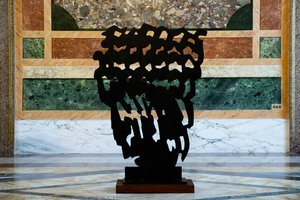
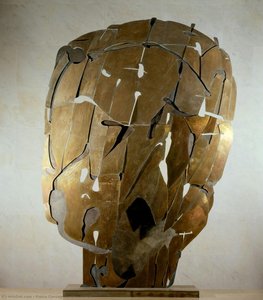
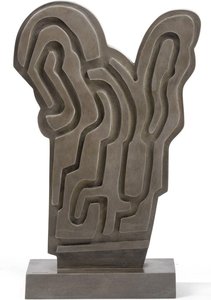
His mastery was particularly evident in his Colloqui series, where metal, wood, and marble were manipulated to create rhythmic, almost calligraphic traces in space. These works functioned less as objects to be circled and more as surfaces to be experienced, blurring the line between sculpture and painting. His ability to navigate this liminal space earned him immense recognition, including eleven appearances at the Venice Biennale between 1950 and 1993, and a prestigious sculpture prize in 1960. The legendary Peggy Guggenheim was among the first to recognize his genius, acquiring his works during the formative years of his career.
Legacy and the Architecture of Memory
As his career progressed, Consagra’s scale expanded from intimate reliefs to monumental public commissions that reshaped urban environments. His work found permanent homes in prestigious institutions such as the Tate Gallery in London, the Museum of Modern Art in Paris, and the National Gallery of Art in Washington, D.C. Beyond the gallery walls, his artistic vision became deeply intertwined with the reconstruction of Sicilian identity. Following the devastating earthquake of 1968, he worked alongside Senator Ludovico Corrao to help establish an open-air museum in the rebuilt town of Gibellina, designing gates and structures that served as architectural anchors for a community finding its footing once more.
Pietro Consagra’s significance lies in his refusal to accept the status quo of the sculptural medium. He transformed the heavy into the ethereal, the solid into the planar, and the distant into the conversational. His life's work remains a testament to the power of abstraction to communicate profound human truths through the simplest of lines and the most delicate of surfaces. When he passed away in 2005, he left behind a legacy that continues to challenge how we perceive space, volume, and the very essence of form.
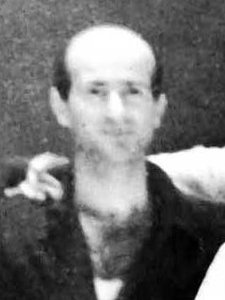
pietro consagra
1920 - 2005
Quick Facts
- Artistic Movement Or Style: Post-war abstract sculpture
- Artists Who Influenced This Artist:
- Brancusi
- Giacometti
- Renato Guttuso
- Date Of Birth: October 4, 1920
- Date Of Death: July 16, 2005
- Full Name: Pietro Consagra
- Nationality: Italian
- Notable Artworks:
- Colloqui series
- Untitled (817)
- Place Of Birth: Mazara del Vallo, Italy