 Preview
 Send
Send Share
Share
 Details

 Download
 Similars
 X-Ray
X-Ray Diaporama
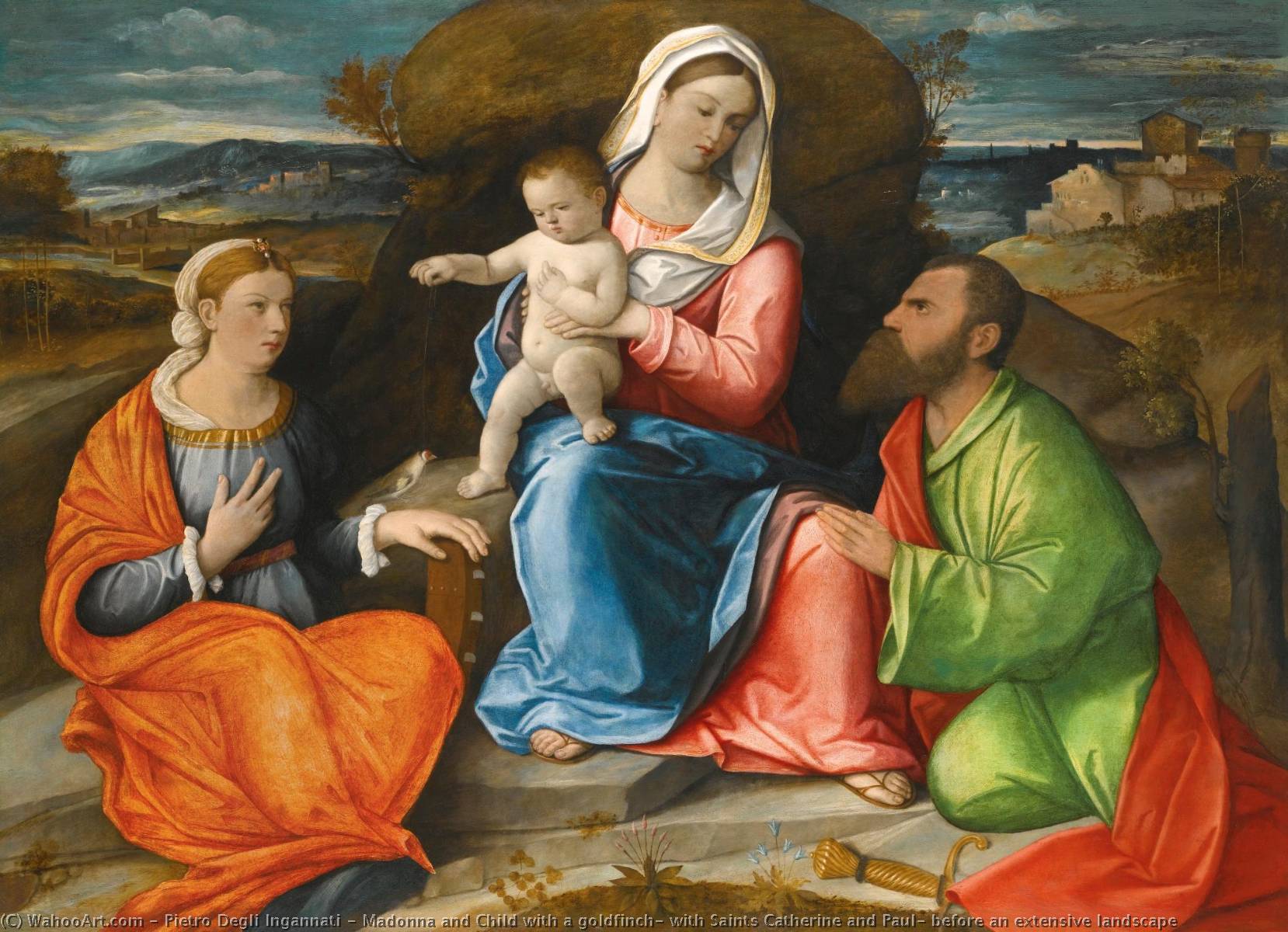
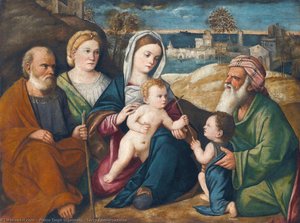
Madonna and Child with a goldfinch, with Saints Catherine and Paul, before an extensive landscape
 101.0 x 138.0 cm
 Read More
Giclée / Art Print
Museum-quality giclée or canvas print with fast production and flexible finish options. ( Buy Hand Made Painting Buy Image)




































Pick from our preset sizes that match the artwork's original proportions.

You may enter your own dimensions to fit a specific frame or space. If your selected size does not match the original image's proportions, we will either crop the artwork or extend the image with a mirrored or solid-fill edge. A digital mockup will be sent for your approval before production begins.
Please note that the on-screen preview does not reflect the actual cropping or extension. Only the mockup will accurately show the final composition.
While custom sizes are available, we recommend selecting a dimension from the predefined list to preserve the original proportions.
Worldwide Delivery () in 2 weeks instead of standard 4/5 weeks. (29 August)

Free Worldwide Express Shipping

High-Quality Linen Canvas

Full Shipping Insurance

Customs Tax Refund Guarantee

True Color Matching Guarantee

60-Day Return Policy (Defects Only)

100% Money-Back Guarantee

Bulk Discount Offer
 Glass option is only available in size under 110 CM

Madonna and Child with a goldfinch, with Saints Catherine and Paul, before an extensive landscape
Giclée / Art Print
Reproduction Size
-


Total Price
$ 63
Related Artworks



Artist Biography
The Enigma of the Venetian Brush
Pietro degli Ingannati, a name that translates to a sense of deception, remains one of the most captivating mysteries of the Venetian Renaissance. Known also by his more formal moniker, Pellegrino di Giovanni di Antonio, this painter’s identity was long obscured by the shadows of his contemporaries. For centuries, much of his prolific output was mistakenly attributed to Francesco Bissolo, a confusion that nearly erased his individual legacy from the annals of art history. It is only through recent scholarly devotion and the careful rediscovery of lost masterpieces that the true hand of Ingannati has been recognized, revealing an artist of profound spiritual depth and technical command.
While the exact dates of his birth and death remain shrouded in uncertainty, we know he was active during the vibrant mid-sixteenth century, specifically between 1529 and 1548. Born likely in the Veneto region, his early life was shaped by the rich, atmospheric traditions of Venice. His formative training took place in the studio of Alvise Vivarini, a master sculptor and architect whose influence gifted Ingannati with a unique sensitivity to structural grandeur and sculptural weight. This foundation allowed him to imbue his figures with a physical presence that felt both grounded in reality and elevated by divine grace.
A Tapestry of Influences and Stylistic Evolution
The evolution of Ingannati’s style is a journey through the very heart of the Venetian cinquecento. In his earliest works, one can detect the lingering echoes of Giovanni Bellini, the titan of Venetian painting. From Bellini, Ingannary inherited a devotion to luminous color palettes and serene, balanced compositions that seemed to radiate a soft, celestial light. However, his path was not a mere imitation; he drew inspiration from a diverse constellation of masters, including Lazzaro Bastiani, Marco Basaiti, and Benedetto Rusconi, which infused his work with a broader stylistic vocabulary.
As his career progressed, a fascinating metamorphosis occurred within his brushwork. While his initial compositions leaned toward the structured clarity of his contemporaries, his later period saw him gravitating closer to the atmospheric innovations of Vincenzo Catena and even the subtle, evocative textures introduced by Giorgione. This transition moved his art away from rigid outlines toward a more fluid, emotive style, where light and shadow began to dance across the canvas with greater spontaneity. His ability to synthesize these varying influences allowed him to create works that felt both deeply rooted in tradition and vibrantly modern for his era.
The Sacred Conversation and Lasting Legacy
The true heartbeat of Ingannati’s oeuvre lies in his mastery of the Sacra Conversazione, or Holy Conversation. This quintessential Venetian genre—depicting the Virgin Mary and the Christ Child surrounded by a celestial assembly of saints—became the vessel for his most profound religious expressions. In these paintings, he achieved a remarkable feat: arranging complex groups of figures, such as Saint Peter and Saint Paul, in a way that felt both mathematically harmonious and intimately human.
His achievements are characterized by several enduring artistic hallmarks:
- Mastery of Sacred Imagery: His ability to transform the Madonna and Child motif into a profound theological experience through light and composition.
- Architectural Integration: The seamless blending of sculptural depth, learned from Vivarini, with the ethereal landscapes typical of the Venetian school.
- Historical Re-emergence: The triumph of his individual identity over historical misattribution, marking him as a distinct voice in the Renaissance canon.
Though his life ended around 1548, the impact of Pietro degli Ingannati continues to resonate. He stands as a testament to the enduring power of the Venetian tradition—a painter who, despite a name suggesting trickery, provided the art world with a profound and honest glimpse into the divine.
Quick Facts
- Artistic Movement Or Style: Renaissance Venetian
- Artists Or Movements Influenced By This Artist: ['Titian']
- Artists Who Influenced This Artist: ['Giovanni Bellini']
- Date Of Death: 1548
- Full Name: Pietro degli Ingannati
- Nationality: Italian
- Notable Artworks: ['Madonna and Child with Saints Peter and Paul']
- Place Of Birth: Veneto