 Preview
 Send
Send Share
Share
 Details

 Download
 Similars
 X-Ray
X-Ray Diaporama
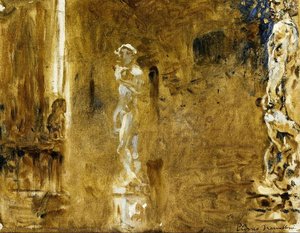
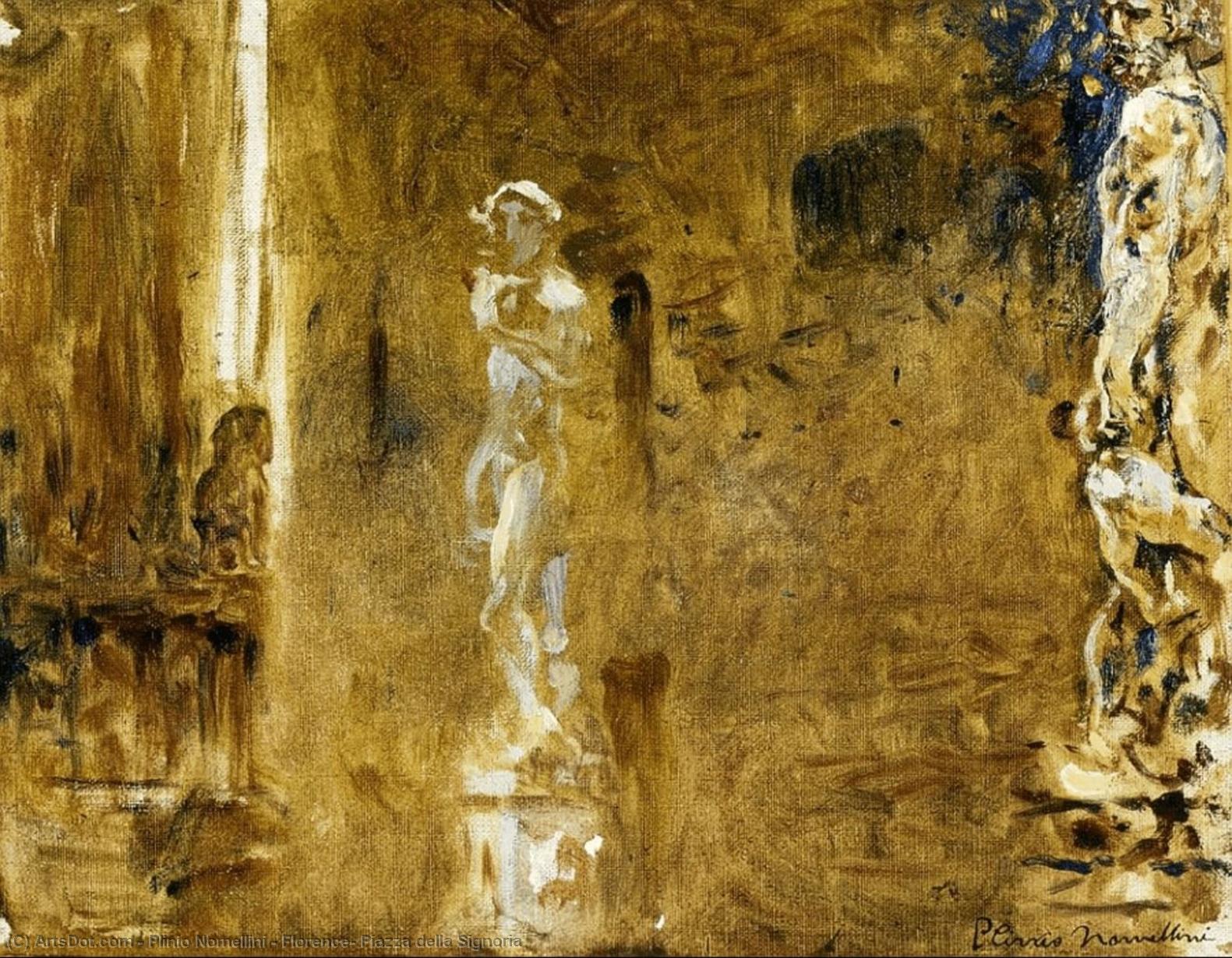
Florence, Piazza della Signoria

 Read More
Hand Made Oil Reproduction
Hand-painted oil on canvas in your size and frame, made to order by our artists. ( Buy Print Buy Image)




































Pick from our preset sizes that match the artwork's original proportions.

You may enter your own dimensions to fit a specific frame or space. If your selected size does not match the original image's proportions, we will either crop the artwork or extend the painting with additional hand-painted elements. A digital mockup will be sent for your approval before production begins.
Please note that the on-screen preview does not reflect the actual cropping or extension. Only the mockup will accurately show the final composition.
While custom sizes are available, we recommend selecting a dimension from the predefined list to preserve the original proportions.
After order, ArtsDot.com team will email client for instructions and provide a mockup preview
Worldwide Delivery () in 3/4 weeks instead of standard 5 weeks. (24 August). No compromise on quality.

Free Worldwide Express Shipping

High-Quality Linen Canvas

Full Shipping Insurance

Customs Tax Refund Guarantee

True Color Matching Guarantee

60-Day Return Policy (Defects Only)

100% Money-Back Guarantee

Bulk Discount Offer
 Glass option is only available in size under 110 CM

Florence, Piazza della Signoria
Reproduction Medium
Reproduction Size
-


Total Price
$ 263
Related Artworks



Artist Biography
A Visionary of Light and Color: The Life of Plinio Nomellini
Plinio Nomellini stands as a luminous figure in the tapestry of Italian art, a painter whose brush captured not just the physical landscape of Tuscany but the very vibration of light itself. Born in Livorno in 1866, Nomellini’s early life was steeped in the coastal atmosphere of his birthplace, an environment that would later inform his profound sensitivity to atmospheric shifts. His formal artistic journey began with rigorous training at the municipal school of arts and crafts and drawing lessons under Natale Betti, but it was his enrollment at the Academy of Fine Arts in Florence in 1885 that truly ignited his creative spirit. Under the mentorship of the esteemed Giovanni Fattori, Nomellini absorbed the foundations of Academic painting while simultaneously being drawn toward the burgeoning revolutionary movements of his era.
As his talent matured, Nomellini moved beyond the traditional boundaries of his training to embrace Divisionism, a technique that would become his artistic hallmark. This method, characterized by the application of small, distinct strokes of color that blend in the viewer's eye, allowed him to achieve a shimmering, ephemeral quality in his works. Influenced by the pioneering spirit of Telemaco Signorini and the emotional depth of artists like Eugène Delacroix and Gustave Courbet, Nomellini sought to capture the fleeting essence of nature. His work became a dialogue between color and light, where the boundaries of objects seemed to dissolve into the surrounding atmosphere, creating a sense of movement and vitality that was entirely modern for its time.
The Struggle and Spirit of the Divisionist Movement
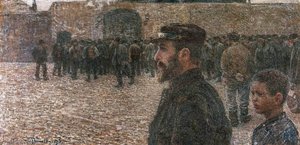
Nomellini’s career was never merely an aesthetic pursuit; it was deeply intertwined with the social and political currents of late 19th-century Italy. His move to Genoa in 1890 marked a period of intense experimentation and social engagement. During his years in Genoa, he focused heavily on watercolors, further refining his ability to manipulate translucency and light. However, it was his commitment to the struggles of the working class that led to one of the most dramatic episodes of his life. His paintings, which often depicted the raw reality of labor and social unrest—such as those inspired by Genoese workers' strikes—brought him into direct conflict with authority. In 1894, he was even arrested on charges of anarchism, a testament to the provocative power of his art. This period of hardship only served to solidify his reputation as an artist of profound conviction, supported by a community of fellow creators who provided for his legal defense.
The evolution of his style saw him navigating through various influential artistic circles, from the Macchiaioli group to the Symbolist movement. By 1907, Nomellini began integrating Symbolist elements into his work, adding layers of psychological depth and metaphorical meaning to his landscapes and figures. This transition allowed him to move from the purely optical sensations of Divisionism toward a more profound exploration of the human soul and the mysteries of nature. His ability to blend the scientific precision of color theory with the poetic ambiguity of Symbolism ensured that his oeuvre remained both visually striking and intellectually stimulating.
Legacy and Artistic Triumph
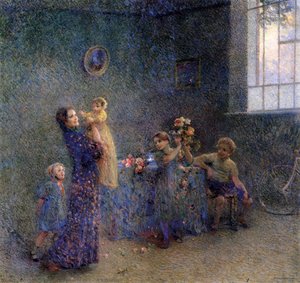
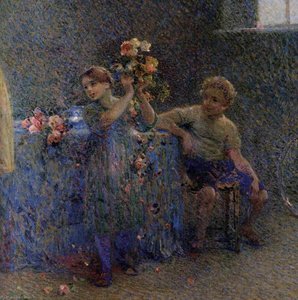
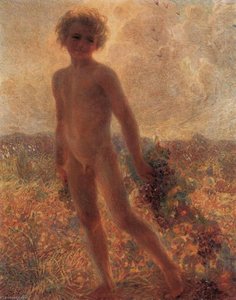
Throughout his long and prolific career, Nomellini’s presence in the international art scene was undeniable. He was a regular contributor to the prestigious Venice Biennale and participated in significant exhibitions such as the 1st Brera Triennale and the Exposition Universelle of 1889 in Paris. His paintings, ranging from the intimate warmth of The First Birthday (1914) to the vibrant, sun-drenched Little Bacchus (1910), showcase a remarkable versatility that spans from tender domesticity to sweeping, expressive landscapes.
The historical significance of Plinio Nomellini lies in his role as a bridge between tradition and modernity. He took the lessons of the Florentine masters and infused them with the radical energy of Divisionism and Symbolism, creating a unique visual language that remains captivating to this day. His legacy is found in the way he taught viewers to see the world not as a collection of static objects, but as a continuous, breathing flow of light and emotion. Today, his works serve as vital windows into the soul of an era defined by transformation, standing as enduring monuments to the power of the Italian visionary.
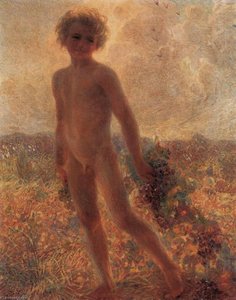
plinio nomellini
1866 - 1943
Quick Facts
- Artistic Movement Or Style: Divisionist
- Artists Or Movements Influenced By This Artist: ['Macchiaioli']
- Artists Who Influenced This Artist:
- Giovanni Fattori
- Giuseppe Pellizza
- Date Of Birth: August 6, 1866
- Full Name: Plinio Nomellini
- Nationality: Italian
- Notable Artworks:
- Little Bacchus
- The First Birthday
- Place Of Birth: Livorno