

 Preview
 Buy Print
 Send
Send Share
Share


 Download
 Similars
 X-Ray
X-Ray Diaporama
Les Jours Gigantesques

René Magritte (1898 – 1967)
René Magritte (1898-1967): Explore the surreal world of this Belgian master! Discover iconic paintings like 'The Lovers,' challenging reality & perception.
A Fragment of Intimacy: Decoding Magritte’s *Les Jours Gigantesques*
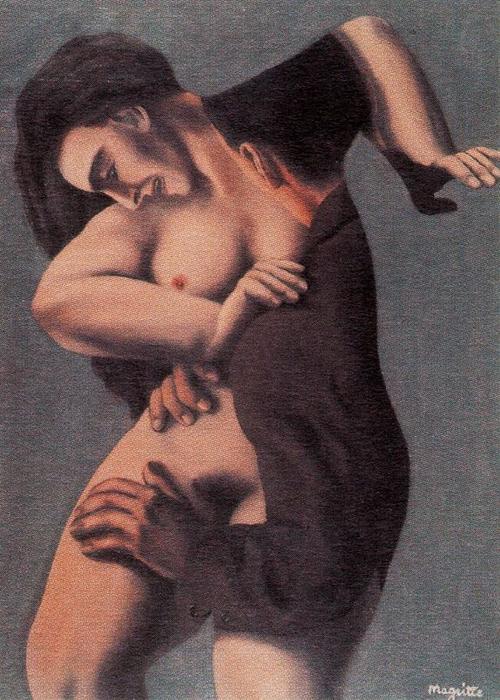 René Magritte’s *Les Jours Gigantesques* (The Giant Days), painted between 1927 and 1930, is a masterclass in Surrealist suggestion. It isn't a depiction of a complete scene, but rather an evocative fragment – the exposed back of a woman embraced by an unseen presence. This deliberate incompleteness is central to the painting’s enduring power and mystery.
Subject & Style: The Poetry of What Isn’t Shown
Magritte deliberately rejects conventional romantic imagery. Instead of a full embrace, we are presented with the graceful curve of a woman's spine, the delicate line of her bra strap, and an overall sense of vulnerability. This partial view isn’t about *seeing* intimacy; it’s about *feeling* its presence. The style is starkly minimalist, focusing on form and texture over elaborate detail. This approach aligns with Magritte’s core Surrealist principle: to create a dreamlike quality within the realm of reality, rather than simply illustrating dreams themselves. He aims for an unsettling familiarity – something recognizable yet profoundly strange.Technique & Palette: Hyperrealism Serving the Unreal
The painting is executed in a predominantly monochromatic palette of grays, blacks, and whites. This limited color scheme amplifies the dramatic tension and contributes to a timeless quality. Magritte’s brushwork is meticulous, achieving a smooth, almost photographic realism that sharply contrasts with the illogical nature of the scene. This juxtaposition – hyperrealism serving an unreal subject matter – is a defining characteristic of his artistic approach. The precise rendering emphasizes the tangible reality of the woman's form while simultaneously highlighting the absence and mystery surrounding her companion.Historical Context & Surrealist Roots
Emerging in the aftermath of World War I, Magritte’s work reflects a broader post-war sensibility questioning established norms and exploring themes of desire, alienation, and the irrationality of existence. The Surrealist movement, to which he was central, sought to unlock the creative potential of the unconscious mind. *Les Jours Gigantesques* embodies this ethos, hinting at hidden narratives and challenging conventional representations of love and relationships. While initially influenced by Impressionism and Cubism, Magritte ultimately rejected their aesthetic principles in favor of a more precise and enigmatic style – one that prioritized psychological impact over purely visual representation.Symbolism & Emotional Resonance
The unseen partner is the key to unlocking the painting’s emotional depth. Who are they? What is the nature of their connection with the woman? Magritte intentionally leaves these questions unanswered, inviting viewers to project their own interpretations and experiences onto the scene. This ambiguity evokes a complex range of emotions – desire, longing, vulnerability, perhaps even a subtle unease. The painting isn’t about depicting a specific event; it's about exploring the psychological space surrounding intimacy, the power of suggestion, and the inherent mystery of human connection. The exposed back symbolizes both vulnerability and surrender, while the unseen presence represents the unknown aspects of love and desire.Display & Interior Design Considerations
*Les Jours Gigantesques* would be best showcased in a space that complements its contemplative mood. Consider these recommendations:- Color Palette: Surround the artwork with neutral tones – grays, whites, or deep blues – to enhance its dramatic impact.
- Setting: Its relatively small size makes it ideal for more intimate settings such as a bedroom, study, or hallway.
- Furniture & Lighting: Pair the painting with minimalist furniture and subtle lighting to allow its inherent drama to take center stage. Avoid overly busy surroundings that might detract from its contemplative mood.
- Framing: A simple, elegant frame in black or a muted metallic tone will complement the artwork’s monochromatic palette without overpowering it.
Further Exploration
To delve deeper into René Magritte's world and Surrealist art, consider visiting The Menil Collection in Houston. Their significant collection offers invaluable insights into this fascinating artistic movement.About this artwork
- Title: Les Jours Gigantesques
- Artist: René Magritte
- Format: Portrait
- Copyright status: Under copyright
- Movement: Surrealism
- Creative period: Modern
- Corpus context: hidden desires" , magritte's paradoxes
- Main color: Gray
- Keywords: female figure art , intimate painting , art reproduction
- Color intensity: Monochromatic
Quick Facts
- subject: Intimacy, Embrace, Back of a Woman
- artist: René Magritte
- year: 1927-1930
- style: Hyperrealism, Minimalist
- medium: Paint
- influences: Impressionism, Cubism
QR Code


