 Preview
 Send
Send Share
Share
 Details

 Download
 Similars
 X-Ray
X-Ray Diaporama
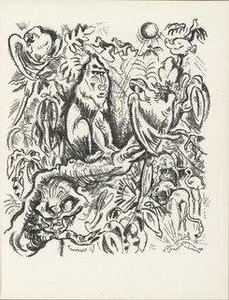
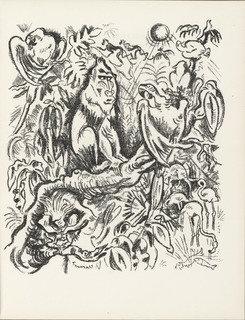
Dreamed Primeval Forest (Geträumte Urwaldlandscaft) (plate, page 43) from the periodical Münchner Blätter für Dichtung und Graphik, vol. 1, no. 3 (March 1919)
 1919
1919 28.0 x 22.0 cm
 Read More
Hand Made Oil Reproduction
Hand-painted oil on canvas in your size and frame, made to order by our artists. ( Buy Print Buy Image)




































Pick from our preset sizes that match the artwork's original proportions.

You may enter your own dimensions to fit a specific frame or space. If your selected size does not match the original image's proportions, we will either crop the artwork or extend the painting with additional hand-painted elements. A digital mockup will be sent for your approval before production begins.
Please note that the on-screen preview does not reflect the actual cropping or extension. Only the mockup will accurately show the final composition.
While custom sizes are available, we recommend selecting a dimension from the predefined list to preserve the original proportions.
After order, ArtsDot.com team will email client for instructions and provide a mockup preview
Worldwide Delivery () in 3/4 weeks instead of standard 5 weeks. (21 August). No compromise on quality.

Free Worldwide Express Shipping

High-Quality Linen Canvas

Full Shipping Insurance

Customs Tax Refund Guarantee

True Color Matching Guarantee

60-Day Return Policy (Defects Only)

100% Money-Back Guarantee

Bulk Discount Offer
 Glass option is only available in size under 110 CM

Dreamed Primeval Forest (Geträumte Urwaldlandscaft) (plate, page 43) from the periodical Münchner Blätter für Dichtung und Graphik, vol. 1, no. 3 (March 1919)
Reproduction Medium
Reproduction Size
-


Total Price
$ 263
Related Artworks






Artist Biography
Richard Seewald: Weaver of Dreamscapes and German Modernism
Born in Arnswalde, Poland, in 1889 – a location that would later profoundly shape his artistic vision – Richard Seewald emerged as a pivotal figure in the early decades of 20th-century German art. His journey was one of constant evolution, marked by periods of intense experimentation and a deep engagement with both the natural world and the burgeoning currents of Expressionism and Modernism. Initially drawn to architecture at Munich Polytechnic, he quickly abandoned formal study for the more immediate allure of painting, establishing himself as a self-taught artist driven by an innate sense of visual poetry. His early career involved producing caricatures for popular magazines, a pragmatic step that provided a crucial foundation while simultaneously honing his observational skills and understanding of audience engagement – qualities that would later inform his broader artistic practice.
Seewald’s formative years were deeply influenced by the vibrant artistic scene of Munich. He became a member of the “Neue Sezession” in 1913, a group dedicated to exploring new forms of expression and challenging established conventions. This association exposed him to a network of like-minded artists and provided a platform for his work to be recognized. Crucially, he also developed a close relationship with the Galerie Thannhauser, which played a significant role in introducing his prints to a wider public. It was during this period that Seewald began experimenting with drypoint etching, discovering its potential to create rich textures and evocative tonal effects – a technique that would become central to his distinctive style.
A pivotal moment in Seewald’s artistic development occurred in 1913 when he traveled to the Dalmatian island of Rab. This journey proved transformative, sparking an enduring fascination with the Mediterranean landscape and its inherent symbolism. He began to paint extensively during this time, capturing the light, color, and atmosphere of the region with a remarkable sensitivity. His work from this period reflects a shift towards greater painterly expression, moving beyond mere representation to convey emotional resonance and subjective experience. The influence of Impressionism is evident in his use of light and color, but he quickly developed a unique style that blended these influences with elements of Expressionism.
The Münchner Blätter Period: Myth, Landscape, and the Dawn of Modernity
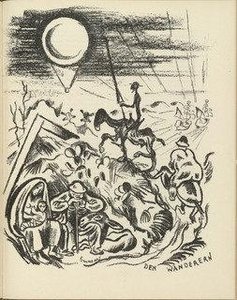
Seewald’s most celebrated work emerged during his involvement with the *Münchner Blätter für Dichtung und Graphik*, a prestigious periodical dedicated to poetry and graphic art. Beginning in 1919, he contributed a series of lithographs that became instantly iconic, establishing him as a leading figure in German Modernism. These prints – including “Dreamed Primeval Forest” (1919) and “To the Wayfarers” (1919) – are characterized by their dreamlike quality, evocative symbolism, and masterful use of line and texture.
The *Münchner Blätter* period represents a culmination of Seewald’s artistic explorations. He drew inspiration from mythology, folklore, and the natural world, creating images that were both visually stunning and deeply layered in meaning. The recurring motifs – ancient forests, solitary figures, and glimpses of distant landscapes – suggest themes of isolation, longing, and the search for spiritual truth. His meticulous attention to detail and his ability to capture the essence of a scene through subtle variations in line and tone are hallmarks of his style.
The lithographs from this period demonstrate Seewald’s technical virtuosity and his willingness to experiment with different printing techniques. He skillfully manipulated the texture of the stone, creating a range of tonal effects that enhanced the emotional impact of his images. Furthermore, he embraced the limitations of the medium, using hatching, cross-hatching, and drypoint textures to create a sense of depth and atmosphere.
A Swiss Retreat and Late Works
Following World War I, Seewald sought refuge in Switzerland, settling in Ronco sopra Ascona on Lake Maggiore. This move marked a significant shift in his artistic focus, as he increasingly turned towards sacred subjects and architectural commissions. He converted to Catholicism in 1934, which profoundly influenced his work during this period.
In Switzerland, Seewald continued to produce prints and paintings that reflected his evolving spiritual beliefs. His frescoes for churches and other ecclesiastical buildings demonstrate his mastery of color and composition, as well as his ability to create images that were both aesthetically pleasing and spiritually resonant. He also dedicated himself to teaching at the Munich Fine Arts Academy, though he ultimately left due to disagreements with the administration.
Despite a personal tragedy – the death of his wife Uli in 1958 – Seewald remained active as an artist until his death in Munich in 1976. His late works are characterized by a quiet dignity and a profound sense of peace, reflecting his lifelong engagement with nature and spirituality.
Legacy and Influence
Richard Seewald’s work occupies a unique position within the history of German art. He was a key figure in the transition from Expressionism to Modernism, bridging the gap between these two movements. His prints are admired for their technical brilliance, their evocative symbolism, and their ability to transport viewers to other realms.
His influence can be seen in the work of numerous artists who followed him, including Max Beckmann and Ernst Ludwig Kirchner. Seewald’s legacy continues to inspire contemporary artists working in printmaking and illustration. His exploration of myth, landscape, and spirituality remains relevant today, offering a timeless meditation on the human condition.
Today, his works are held in major museums and private collections around the world, ensuring that his artistic vision will continue to be appreciated for generations to come.
richard seewald
1889 -
Quick Facts
- Artistic Movement Or Style: Expressionism, German modernism
- Artists Or Movements Influenced By This Artist: ['German Expressionism']
- Artists Who Influenced This Artist: ['Marc Chagall']
- Date Of Birth: May 4, 1889
- Date Of Death: Oct 29, 1976
- Full Name: Richard Seewald
- Nationality: Swiss
- Notable Artworks:
- Dreamed Primeval Forest
- To the Wayfarers
- Place Of Birth: Arnswalde, Poland