

 Preview
 Send
Send Share
Share
 Details

 Download
 Similars
 X-Ray
X-Ray Diaporama
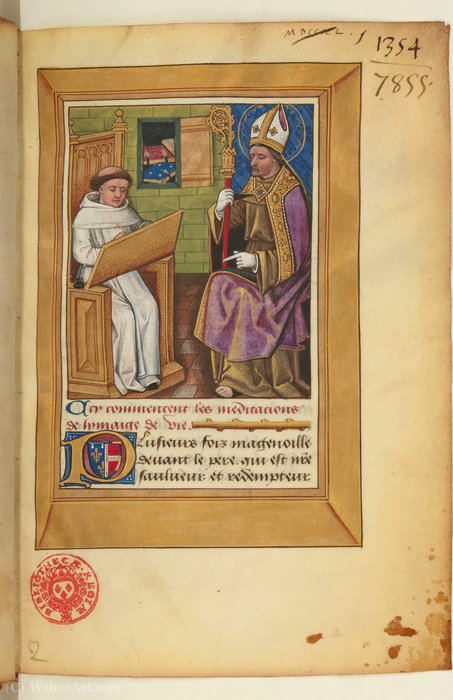
Portrait of the author and his scribe, miniature Meditations of life image.

 Read More
Purchase a high-resolution, enhanced digital image, far superior to the online preview.
Each file is meticulously prepared by our in-house specialists using advanced tools and expert manual retouching. We ensure every image has exceptional clarity, precise color accuracy, and fine detail.
The final file is delivered via email within 72 hours, optimized for immediate use in professional, editorial, and print environments. This is the same quality trusted by top-tier design studios, publishers, and galleries.
Digital Image
Download a high-resolution file for personal display, printing, and creative projects. ( Buy Print Buy Hand Made Painting)
Included in Every Digital Image Order
Expert Digital Delivery, Guaranteed
When you choose ArtsDot.com, you're not just getting an image - you're receiving a professionally enhanced digital artwork, crafted with precision and backed by a satisfaction guarantee. Here's everything that comes with your order, automatically:

Fast Email Delivery
Your high-resolution digital image file will be emailed to you within 72 hours of ordering - ready for immediate use.

AI-Enhanced Digital File
Your artwork is professionally optimized using advanced AI tools and manual editing, ensuring maximum detail, clarity, and color accuracy.

Free Lifetime Re-Delivery
Accidentally deleted or lost your file? No worries - we'll resend it to you anytime, free of charge.

No Import Fees - Ever
Enjoy your artwork instantly with zero customs, duties, or delivery fees - digital downloads are always tax-free.

Color Accuracy Guarantee
We ensure your digital image reflects the original colors as closely as possible using professional tools and color management.

60-Day Satisfaction Guarantee
If you're not satisfied with your digital image, we'll revise it or refund 100% within 60 days - no questions asked.

100% Money-Back Guarantee
Not satisfied? Get a full refund within 60 days of receiving your digital file - no questions asked.

Bulk Order Discounts
Buy 3 images, save 10% - Buy 5, save 15% - Buy 10+, save 20%. Great for creative projects, galleries, and agencies.
Collectible Description
A Glimpse into Medieval Scholarship: "Portrait of the Author and his Scribe"
This exquisite miniature painting, attributed to Robinet Testard (c. 1470-1531), offers a captivating window into the intellectual and religious life of late medieval France. The scene depicts a dignified clergyman, likely a bishop or high-ranking cleric, engaged in conversation with his scribe. The cleric is adorned in elaborate pontifical vestments, complete with a mitre and staff topped with a cross – clear indicators of his ecclesiastical authority. His posture suggests contemplation and perhaps the review of important documents. The scribe, positioned respectfully before him, appears to be presenting an open manuscript, hinting at a scholarly exchange or the recording of vital information. This intimate portrayal transcends a simple portrait; it embodies the crucial role of literacy and knowledge preservation within the medieval Church and aristocratic circles.Style & Technique: Illuminating Medieval Tradition
Testard’s work exemplifies the meticulous detail and vibrant color characteristic of French manuscript illumination during the late 15th and early 16th centuries. The style is rooted in Gothic artistic conventions, but shows a developing Renaissance influence with its more naturalistic depiction of figures and attention to architectural details. The technique employed likely involved layering thin washes of gouache (opaque watercolor) on prepared vellum or parchment. Notice the delicate rendering of the cleric’s robes, the intricate floral border, and the subtle shading that gives depth to the figures. The inclusion of 17 engravings by Israhel van Meckenem, colored by Testard himself, is a unique feature demonstrating the artistic collaborations of the period. The aged appearance of the page – with its stains and handwritten annotations – adds to its authenticity and historical charm.Historical Context & Patronage
This miniature likely originated within the context of a lavishly illuminated manuscript commissioned for either religious or personal use. Robinet Testard served at the courts of Charles, Count of Angoulême, and his widow Louise of Savoy, indicating that this piece may have been created as part of a book of hours – devotional books popular among the nobility – or another significant liturgical text. The presence of a coat of arms within the composition suggests a specific patron or dedication to a particular individual or family. The period was marked by increasing literacy and a flourishing of manuscript production, reflecting both religious devotion and aristocratic patronage of the arts.Symbolism & Emotional Impact
Beyond its aesthetic beauty, this miniature is rich in symbolic meaning. The cleric’s attire represents spiritual authority and learning, while the scribe embodies the transmission of knowledge. The open manuscript symbolizes wisdom and divine inspiration. The architectural setting—the window suggesting a connection to the outside world—hints at the interplay between faith, reason, and the broader societal context. Emotionally, the piece evokes a sense of quiet contemplation, scholarly dedication, and the enduring power of written word. It offers a poignant glimpse into a bygone era where knowledge was painstakingly preserved and revered.- Artist: Robinet Testard (c. 1470-1531)
- Period: Late Medieval/Early Renaissance (late 15th - early 16th century)
- Medium: Gouache on vellum or parchment
- Origin: France
Related Artworks
Artist Biography
Robinet Testard: A Master of Medieval Detail
Robinet Testard (c. 1470 – 1531) remains a captivating enigma within the history of French art, a figure whose brilliance is often obscured by the lack of definitive biographical markers—no signature, no dated work. Yet, through meticulous examination of his surviving illuminations and illustrations, we can reconstruct a compelling portrait of a highly skilled artist who flourished during the late 15th and early 16th centuries, serving as a vital link between the Gothic and Renaissance traditions.
Testard’s career began in Poitiers, a significant center for manuscript production at the time. His early works, such as a page from a Missal for the Poitiers use, demonstrate a solid grounding in established medieval styles—precise rendering of figures, rich color palettes, and an adherence to traditional religious iconography. However, it was his association with the court of Charles, Count of Angoulême, that truly shaped his artistic trajectory. Appointed as Valet de Chambre in 1484, Testard became deeply embedded within a vibrant intellectual and artistic environment, one characterized by humanist ideals and a burgeoning interest in classical literature.
The Angoulême Court and the Roman de la Rose
Testard’s work for the Count of Angoulême's household is arguably his most celebrated achievement. The Roman de la Rose, a lavishly illustrated manuscript produced around 1480, stands as a testament to his skill and artistic vision. This monumental work, featuring 17 engravings by Israhel van Meckenem meticulously colored by Testard himself, showcases a remarkable synthesis of techniques. The intricate details, the vibrant hues, and the expressive faces of the characters are all hallmarks of Testard’s mature style. The inclusion of Van Meckenem's engravings—a relatively unconventional practice at the time—suggests a sophisticated understanding of printmaking and an openness to new artistic influences.
Beyond the Roman de la Rose, Testard produced several other significant works during his tenure with the Angoulême court, including the Nouailher Missal and various Books of Hours. These pieces are characterized by a tighter compositional style and an even more sharply defined coloring than his earlier work, reflecting a growing influence from the emerging Renaissance aesthetic. The “Les Secrets de l’histoire naturelle contenant les merveilles et choses memorables du monde,” illustrating Dioskurides and incorporating mythological scenes after Solinus and Pliny, further demonstrates Testard's versatility and his willingness to engage with diverse subject matter.
A Legacy of Detail and Influence
Testard’s career continued even after the death of Charles, Count of Angoulême in 1496. He served Louise of Savoy, the count’s widow, until her own demise in 1531, cementing his position as a trusted artist within a prominent aristocratic household. His work during this later period—including a copy of Matthaeus Platearius' “The Book of Simple Medicines”—continues to exhibit the meticulous detail and refined technique that defined his artistic practice.
Despite the absence of signatures or dated works, Robinet Testard’s legacy endures through his illuminated manuscripts. His contributions to the Roman de la Rose, in particular, offer a rare glimpse into the artistic world of 15th-century France—a world where medieval tradition and nascent Renaissance ideals converged to produce some truly remarkable works of art. His meticulous attention to detail, combined with his willingness to experiment with new techniques (as evidenced by the inclusion of Van Meckenem’s engravings), makes him a fascinating figure in the history of French illumination and a testament to the enduring power of artistic skill.
robinet testard
1470 - 1531 , France
Quick Facts
- Artistic Movement Or Style: Medieval illumination
- Date Of Birth: 1470, France
- Date Of Death: 1531
- Full Name: Robinet Testard
- Nationality: French
- Notable Artworks:
- Roman de la Rose
- La Rochefoucauld Hours
- Nouailher Missal
- Place Of Birth: France

