

 Preview
 Send
Send Share
Share
 Details

 Download
 Similars
 X-Ray
X-Ray Diaporama
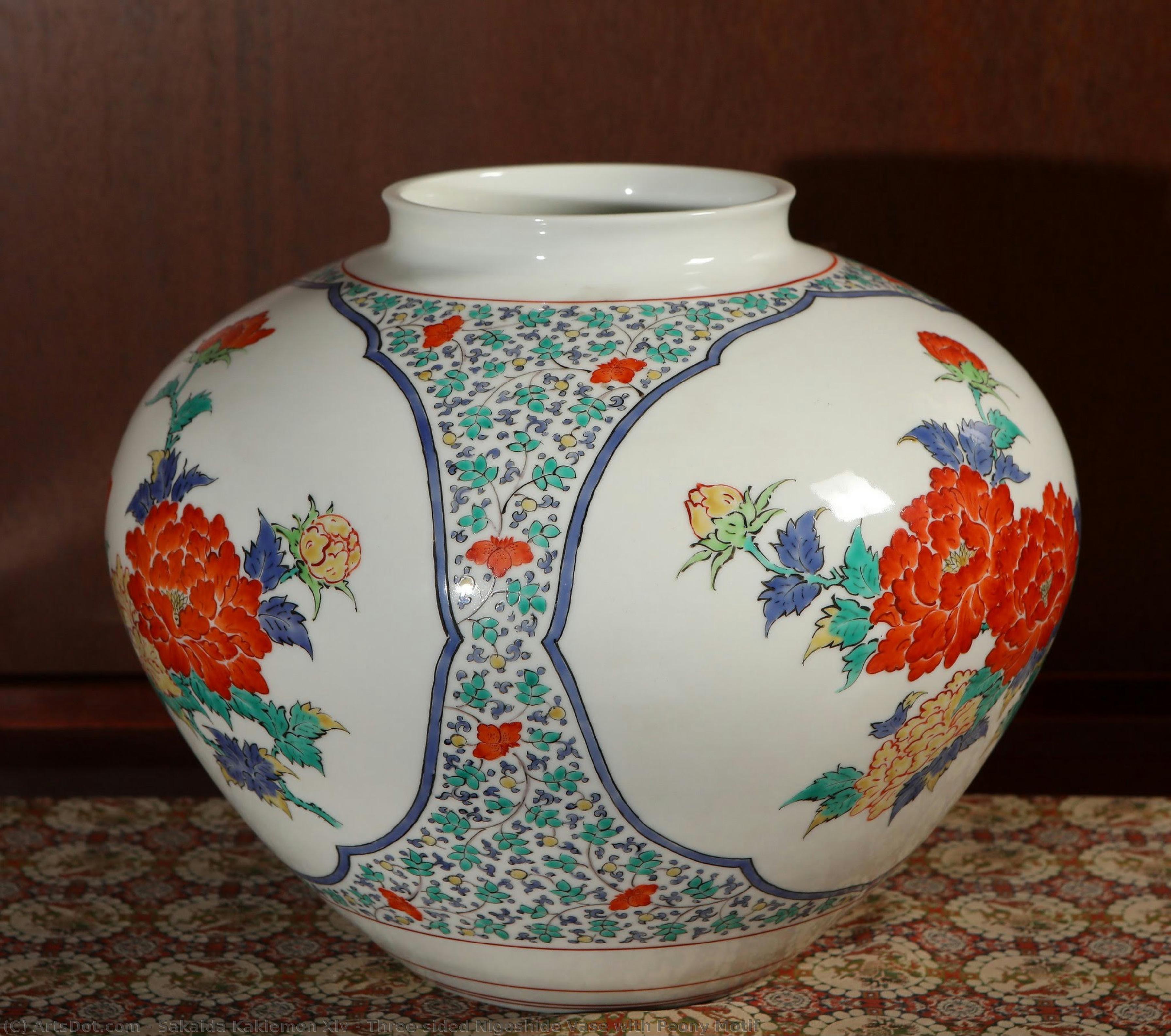
Three-sided Nigoshide Vase with Peony Motif
 24.0 x 26.0 cm
 Read More
Purchase a high-resolution, enhanced digital image, far superior to the online preview.
Each file is meticulously prepared by our in-house specialists using advanced tools and expert manual retouching. We ensure every image has exceptional clarity, precise color accuracy, and fine detail.
The final file is delivered via email within 72 hours, optimized for immediate use in professional, editorial, and print environments. This is the same quality trusted by top-tier design studios, publishers, and galleries.
Digital Image
Download a high-resolution file for personal display, printing, and creative projects. ( Buy Print Buy Hand Made Painting)
Included in Every Digital Image Order
Expert Digital Delivery, Guaranteed
When you choose ArtsDot.com, you're not just getting an image - you're receiving a professionally enhanced digital artwork, crafted with precision and backed by a satisfaction guarantee. Here's everything that comes with your order, automatically:

Fast Email Delivery
Your high-resolution digital image file will be emailed to you within 72 hours of ordering - ready for immediate use.

AI-Enhanced Digital File
Your artwork is professionally optimized using advanced AI tools and manual editing, ensuring maximum detail, clarity, and color accuracy.

Free Lifetime Re-Delivery
Accidentally deleted or lost your file? No worries - we'll resend it to you anytime, free of charge.

No Import Fees - Ever
Enjoy your artwork instantly with zero customs, duties, or delivery fees - digital downloads are always tax-free.

Color Accuracy Guarantee
We ensure your digital image reflects the original colors as closely as possible using professional tools and color management.

60-Day Satisfaction Guarantee
If you're not satisfied with your digital image, we'll revise it or refund 100% within 60 days - no questions asked.

100% Money-Back Guarantee
Not satisfied? Get a full refund within 60 days of receiving your digital file - no questions asked.

Bulk Order Discounts
Buy 3 images, save 10% - Buy 5, save 15% - Buy 10+, save 20%. Great for creative projects, galleries, and agencies.
Related Artworks









Artist Biography
The Legacy of White: Sakaida Kakiemon XIV and the Art of Porcelain
Sakaida Kakiemon XIV, born Masashi Sakaida in 1934 in Arita, Japan, was more than a potter; he was the fourteenth generation steward of a lineage that fundamentally shaped Japanese porcelain. His life unfolded within the very walls of the Kakiemon kiln, a place steeped in centuries of tradition and artistic innovation. From his earliest years, Masashi was immersed in the world of clay, glaze, and fire, absorbing not just the technical skills but also the profound aesthetic principles passed down through his family. The weight of this heritage – a name synonymous with elegance and refinement – would eventually lead him to adopt the title Kakiemon upon succeeding his father in 1982, a symbolic act signifying his complete dedication to preserving and evolving the family’s legacy. His passing in 2013 marked the end of an era, but the artistry he embodied continues to resonate within the world of ceramics.A Dynasty Forged in Korean Fire
The story of Kakiemon porcelain is inextricably linked to the tumultuous events of the late sixteenth and early seventeenth centuries. The Japanese invasions of Korea during the Momoyama period were not merely military campaigns; they resulted in a forced migration of skilled Korean potters, individuals whose expertise would prove transformative for Japanese ceramics. Among these was Yi Sam-Pyeong, who discovered porcelain stone on Mount Izumiyama near Arita. This discovery laid the foundation for the distinctive Kakiemon ware. The early success of the kiln coincided with disruptions to Chinese porcelain exports due to civil unrest, creating a demand that Kakiemon readily filled. The Dutch East India Company became a key patron, exporting Kakiemon wares from the port of Imari and establishing an international reputation for the artistry emanating from Arita. This historical context is crucial; Kakiemon didn’t emerge in isolation but as a response to specific geopolitical forces and a thirst for beauty that transcended borders.Training and Artistic Development
Kakiemon XIV's artistic journey was deeply rooted in traditional Japanese aesthetics. Before dedicating himself fully to porcelain, he pursued formal training in *nihonga*, or Japanese-style painting. This foundation proved invaluable, instilling in him a keen eye for composition, color harmony, and the delicate rendering of natural forms – qualities that would become hallmarks of his work. He apprenticed under both his grandfather, Kakiemon XII, and his father, Kakiemon XIII, absorbing their knowledge and refining his skills within the kiln’s time-honored processes. This rigorous training wasn't simply about mastering technique; it was about internalizing a philosophy – an understanding of *yohaku*, or “negative space,” as integral to the design itself. He learned that the unpainted areas were just as important as those adorned with vibrant enamels, creating a sense of balance and ethereal beauty.The Art of Nigoshide and Floral Motifs
Kakiemon porcelain is instantly recognizable for its distinctive *nigoshide* base – a milky white porcelain unique to the kiln. Revived by Kakiemon XII and XIII in the mid-20th century, this technique involved carefully controlled firing processes that resulted in a soft, luminous surface perfectly suited for showcasing the vibrant overglaze enamels. Kakiemon XIV excelled at applying these enamels with remarkable precision, often depicting floral motifs – peonies, chrysanthemums, irises, and bamboo – rendered with exquisite detail and subtle gradations of color. His compositions were characterized by a dynamic interplay between form and space, creating a sense of movement and vitality. He didn’t merely replicate nature; he distilled its essence, capturing the fleeting beauty of blossoms and leaves in porcelain.Recognition and Enduring Influence
Sakaida Kakiemon XIV's contributions to Japanese art were widely recognized during his lifetime. In 2001, he was designated a Living National Treasure – an honor bestowed upon artists who have achieved mastery of traditional techniques and demonstrated exceptional artistic skill. He received the Order of the Rising Sun in 2005, further solidifying his status as a cultural icon. His work is held in prestigious collections worldwide, including the Metropolitan Museum of Art and the British Museum. Beyond accolades, Kakiemon’s lasting legacy lies in his ability to seamlessly blend tradition with innovation, preserving the essence of Kakiemon ware while imbuing it with his own unique sensibility. He wasn't simply a craftsman; he was a poet working in porcelain, transforming clay and glaze into objects of enduring beauty that continue to inspire awe and admiration.
sakaida kakiemon xiv
1934 - 2013 , Japan
Quick Facts
- Artistic Movement Or Style: Kakiemon enamel ceramics
- Artists Who Influenced This Artist:
- Yi Sam-Pyeong
- Sakaida Kakiemon XII
- Date Of Birth: August 26, 1934
- Date Of Death: June 15, 2013
- Full Name: Sakaida Kakiemon XIV
- Nationality: Japanese
- Notable Artworks:
- Sherd
- Incense burner
- Place Of Birth: Arita, Japan

