Menu
FREE ART CONSULTATION
PreviewPreview AR previewAR preview Buy Hand Made Painting Buy Hand Made PaintingBuy Image Buy Image SendSend
DetailsDetails Add to favorites Add to favorites DownloadDownload SimilarsSimilars X-RayX-Ray DiaporamaDiaporama

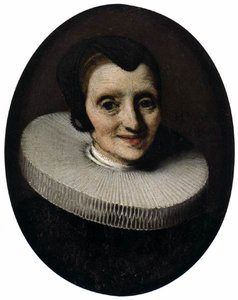
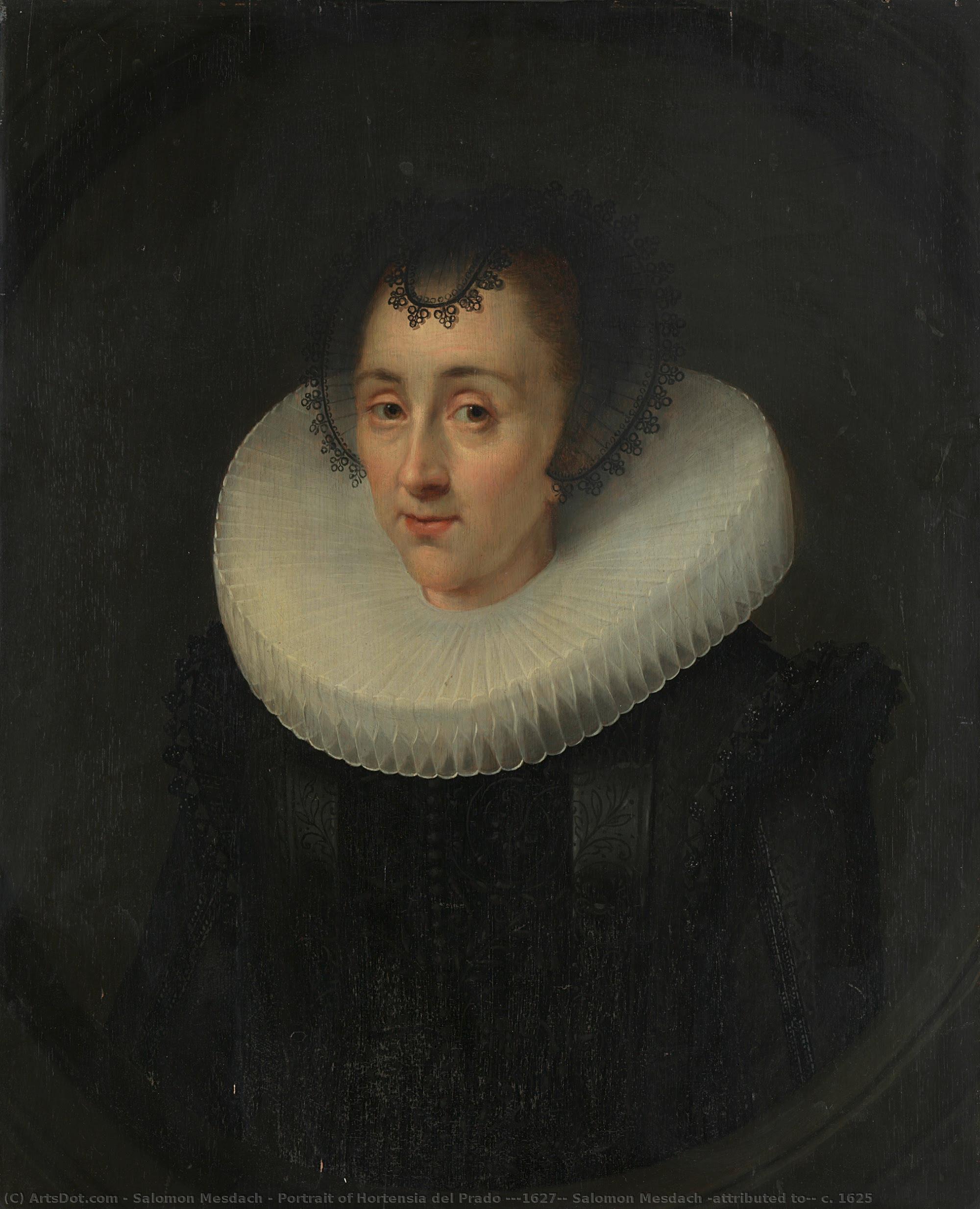
Portrait of Hortensia del Prado (?-1627), Salomon Mesdach (attributed to), c. 1625

  • Creation date1625
  • Dimensions73.0 x 59.0 cm

Salomon Mesdach (attributed) was a Dutch Golden Age painter known for his captivating architectural interiors and genre scenes, possibly contributing to the work on the famous Panorama of The Hague; discover the subtle beauty within these historic masterpieces.

Giclée / Art Print

Museum-quality giclée or canvas print with fast production and flexible finish options. (Buy Hand Made Painting Buy Hand Made PaintingBuy Image Buy Image)

Standard
custom
CM
INCH

Pick from our preset sizes that match the artwork's original proportions.

width
height

You may enter your own dimensions to fit a specific frame or space. If your selected size does not match the original image's proportions, we will either crop the artwork or extend the image with a mirrored or solid-fill edge. A digital mockup will be sent for your approval before production begins.
Please note that the on-screen preview does not reflect the actual cropping or extension. Only the mockup will accurately show the final composition.
While custom sizes are available, we recommend selecting a dimension from the predefined list to preserve the original proportions.

Worldwide Delivery () in 2 weeks instead of standard 4/5 weeks. (5 September)

why_choose_icon
Free Worldwide Express Shipping
why_choose_icon
High-Quality Linen Canvas
why_choose_icon
Full Shipping Insurance
why_choose_icon
Customs Tax Refund Guarantee
why_choose_icon
True Color Matching Guarantee
why_choose_icon
60-Day Return Policy (Defects Only)
why_choose_icon
100% Money-Back Guarantee
why_choose_icon
Bulk Discount Offer

Total Price

$ 63

reproduction

Portrait of Hortensia del Prado (?-1627), Salomon Mesdach (attributed to), c. 1625

Giclée / Art Print

Reproduction Size

-

Total Price

$ 63

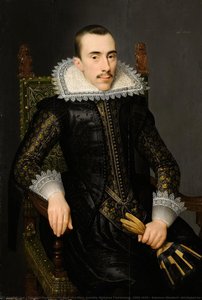
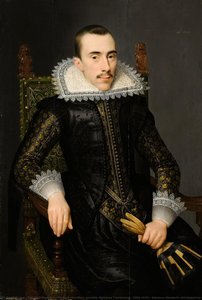
Sir Pieter Courten was the son of Guillaume Courten and Margarita Cassier.5 He married a widow, Hortensia del Prado, in Cologne, and settled with her in Middelburg, where they lived in ‘Het Grote Huis’ in Lange Noordstraat, which Courten had commissioned.6 A few houses away lived the poet Jacob Cats, who was a member of their circle. Hortensia del Prado was the model for the virtuous wife whose praises Cats sang in his Houwelyck (Marriage).7 No children were born to the couple. After Hortensia’s death in 1627, Pieter Courten married Elisabeth Honing on 17 March 1629. According to his nephew Pieter Boudaen Courten,8 Pieter Courten fell ill in October of the same year, and died, ‘wasted away’, on 12 January 1630.9 The Rijksmuseum portrait of Pieter Courten (SK-A-2074) comes from the De Witte van Citters Bequest and entered the museum in 1903. Oddly enough, it has never been associated with that of his wife Hortensia del Prado (shown here), which arrived in the museum from the same family collection nearly 20 years earlier.10 The paintings have the same dimensions, very similar frames, and the same compositional setting of an oval, stone framework. Given the dates of death of the two individuals and the differences in the frames, it can be assumed that the two paintings were not made at the same time. Courten’s portrait, with the inscription ‘1630’, must be posthumous, painted either in 1630, the year of his death, or even later. The undated portrait of his wife, who died three years before him, must date from the 1620s, for Hortensia del Prado is wearing the fashion of that period.11 It is possible that the portraits in the Rijksmuseum served as companion pieces. An 18th-century list of paintings in Kasteel Popkensburg mentions the portraits of Pieter Courten and Hortensia del Prado one after the other.12 According to that list, both works had an inscription by Johan Boudaen Courten.13 The strip of vellum with this text is still on the back of Hortensia’s portrait, but it is missing from Pieter Courten’s. It could have been removed, or possibly there was another version of the same portrait, although none is known. The likeliest people to have commissioned the portraits of Pieter Courten and Hortensia del Prado in Popkensburg are Pieter Boudaen Courten and his wife Catharina Fourmenois. Boudaen Courten was Pieter Courten’s nephew and heir, and Fourmenois was Del Prado’s daughter. The labels written by their son Johan show that both works were in the Boudaen Courten family at an early date. The portraits of Courten and Del Prado have both been associated with the Middelburg painter Salomon Mesdach. The one of Hortensia del Prado, in particular, displays similarities to the paintings attributed to Mesdach in the Rijksmuseum as regards style and the structure of the paint layers.14 Courten’s portrait is built up in a similar way, with light grey dead-colouring beneath the face and the ruff, but it is hard to say whether the painting is by the same hand, since the face has been heavily overpainted. Ekkart assumes that it is a later copy, partly on the evidence of the weak execution of the ruff, the folds of which were not properly understood.15 However, the condition of the painting and the lack of an original preclude a definitive pronouncement. There is a second version of Hortensia’s portrait, possibly a replica.16 A modern copy of her portrait by Aat Veldhoen (1934-) was auctioned in 1998.17 The Rijksmuseum has two other portraits of Hortensia del Prado, by Gortzius Geldorp (SK-A-2072 and SK-A-2081) as well as a copper shield of 1625 with the arms of the Del Prado and Courten families (SK-A-928). Gerdien Wuestman, 2007 See Bibliography and Rijksmuseum painting catalogues See Key to abbreviations and Acknowledgements This entry was published in J. Bikker (ed.), Dutch Paintings of the Seventeenth Century in the Rijksmuseum Amsterdam, I: Artists Born between 1570 and 1600, coll. cat. Amsterdam 2007, no. 181.

Artist Biography

The Enigmatic Brush of Salomon Mesdach (Attributed To)

Salomon Mesdach remains a figure shrouded in the mists of art historical attribution, a name whispered alongside canvases brimming with Dutch Golden Age sensibilities yet lacking definitive biographical anchors. While concrete details regarding his life are scarce – birth and death dates remain largely unknown beyond an active period suggesting activity into the 19th century – the works attributed to him speak volumes about a painter deeply immersed in the traditions of genre painting, particularly those scenes depicting intimate domesticity and the quiet dignity of everyday life. He is often associated with the circle of painters working in or around The Hague, though establishing a firm connection proves elusive. This ambiguity adds an intriguing layer to his oeuvre; each canvas feels like a rediscovered fragment of a forgotten world, prompting speculation about his training, influences, and place within the broader artistic landscape.

A Master of Interior Light and Narrative

The paintings consistently attributed to Mesdach are characterized by a remarkable sensitivity to light – not the dramatic chiaroscuro favored by some contemporaries, but rather a soft, diffused illumination that bathes interiors in a warm, inviting glow. This mastery allows him to render textures with exquisite detail: the sheen of polished pewter, the delicate folds of linen, the subtle gradations of color in a woman’s dress. More than mere technical skill, however, Mesdach demonstrates an exceptional ability to imbue these scenes with narrative depth. His subjects are rarely grand or overtly dramatic; instead, he focuses on moments of quiet contemplation – a mother reading to her children, a family sharing a meal, a solitary figure lost in thought. These are not staged tableaux but glimpses into the lived experiences of ordinary people, rendered with empathy and psychological insight. The compositions often feature carefully arranged objects that subtly hint at deeper meanings, inviting viewers to contemplate the lives unfolding within these domestic spaces.

Influences and Artistic Lineage

Pinpointing Mesdach’s direct influences is a complex undertaking, given the lack of documented connections. However, scholars frequently note stylistic affinities with painters such as Pieter de Hooch and Jan Steen – masters renowned for their depictions of Dutch interiors and genre scenes. Like De Hooch, Mesdach exhibits a keen eye for architectural perspective and a talent for capturing the play of light on surfaces. The influence of Steen can be seen in the subtle humor and anecdotal details that occasionally surface in his work, though Mesdach generally avoids Steen’s more boisterous and overtly comedic tendencies.
  • The meticulous detail and realistic rendering suggest an awareness of the Leiden tradition
  • A preference for harmonious color palettes points to a possible familiarity with the works of Gabriel Metsu.
  • His focus on domestic interiors aligns him with the broader trend of Dutch Realism, which sought to depict the world as it was, without idealization or embellishment.
Rediscovering Mesdach: A Legacy in Quiet Observation

Despite the uncertainties surrounding his biography, Salomon Mesdach’s work continues to captivate and intrigue. His paintings offer a rare glimpse into the daily lives of 17th- and 18th-century Dutch society, rendered with remarkable sensitivity and technical skill. While he may not be a household name like Rembrandt or Vermeer, his contribution to the genre painting tradition is undeniable. The enduring appeal of his work lies in its ability to evoke a sense of intimacy and quiet contemplation, inviting viewers to connect with the subjects on a deeply personal level. As more paintings are attributed to him – often through careful stylistic analysis and provenance research – Mesdach’s place within the art historical canon is slowly being solidified, ensuring that his legacy of quiet observation will continue to resonate for generations to come. His work serves as a poignant reminder that beauty can be found not in grand gestures or heroic narratives, but in the simple moments of everyday life.
Explore artworks organized by themes, styles, and characteristics.