Menu
PreviewPreview AR previewAR preview Buy Print Buy PrintBuy Hand Made Painting Buy Hand Made Painting SendSend
DetailsDetails Add to favorites Add to favorites DownloadDownload SimilarsSimilars X-RayX-Ray DiaporamaDiaporama

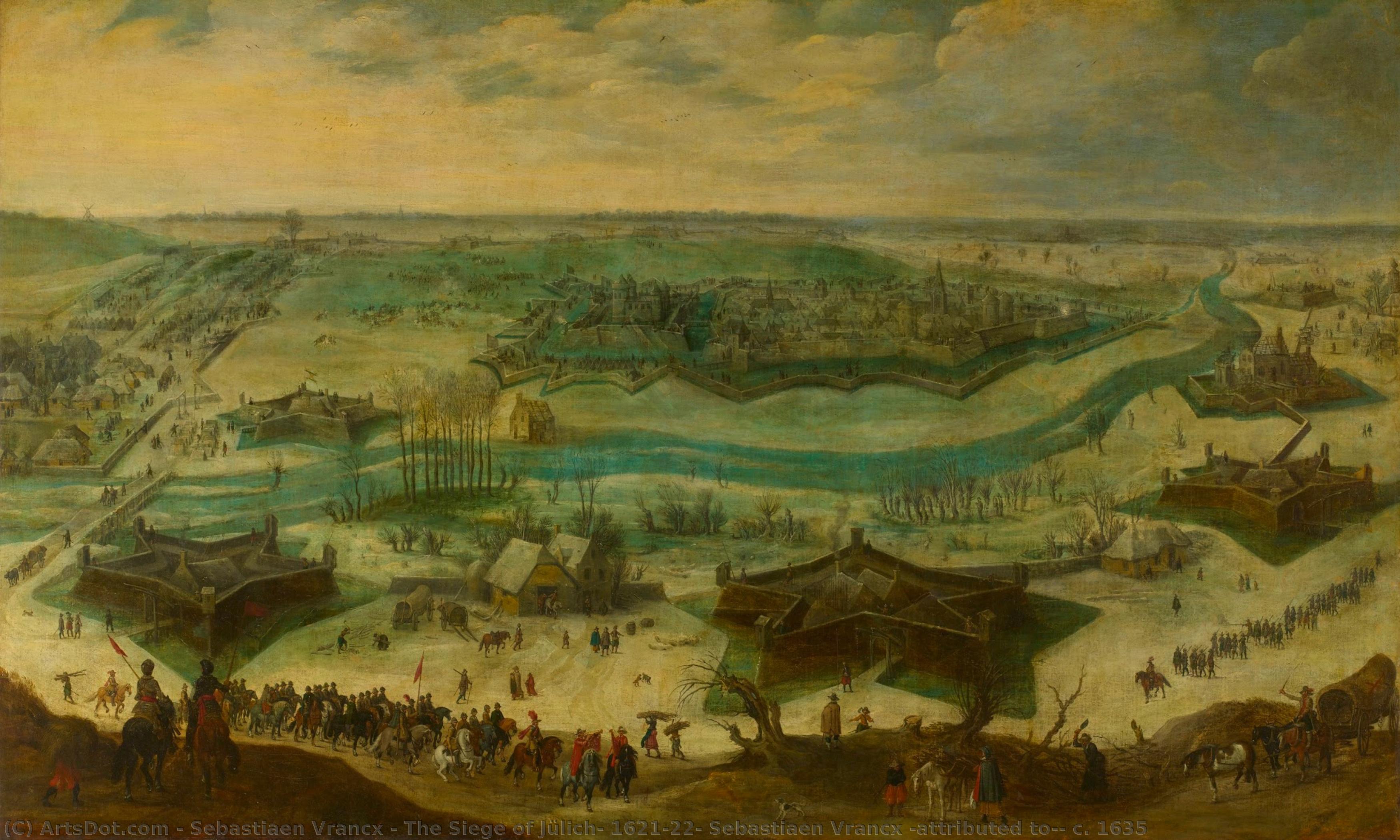
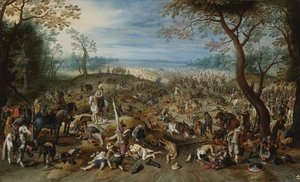
The Siege of Jülich, 1621-22, Sebastiaen Vrancx (attributed to), c. 1635

  • Creation date1635
  • Dimensions142.0 x 233.0 cm

Discover Sebastiaan Vrancx's pioneering battle scenes & landscapes! A Flemish Baroque master of intense emotion & detail, his art reflects the Antwerp School.

Purchase a high-resolution, enhanced digital image, far superior to the online preview.

Each file is meticulously prepared by our in-house specialists using advanced tools and expert manual retouching. We ensure every image has exceptional clarity, precise color accuracy, and fine detail.

The final file is delivered via email within 72 hours, optimized for immediate use in professional, editorial, and print environments. This is the same quality trusted by top-tier design studios, publishers, and galleries.

Digital Image

Download a high-resolution file for personal display, printing, and creative projects. (Buy Print Buy PrintBuy Hand Made Painting Buy Hand Made Painting)

Total Price

$ 24.00

Included in Every Digital Image Order

Expert Digital Delivery, Guaranteed

When you choose ArtsDot.com, you're not just getting an image - you're receiving a professionally enhanced digital artwork, crafted with precision and backed by a satisfaction guarantee. Here's everything that comes with your order, automatically:

shipping_icon
Fast Email Delivery

Your high-resolution digital image file will be emailed to you within 72 hours of ordering - ready for immediate use.

canvas_icon
AI-Enhanced Digital File

Your artwork is professionally optimized using advanced AI tools and manual editing, ensuring maximum detail, clarity, and color accuracy.

insurance_icon
Free Lifetime Re-Delivery

Accidentally deleted or lost your file? No worries - we'll resend it to you anytime, free of charge.

tax_icon
No Import Fees - Ever

Enjoy your artwork instantly with zero customs, duties, or delivery fees - digital downloads are always tax-free.

color_icon
Color Accuracy Guarantee

We ensure your digital image reflects the original colors as closely as possible using professional tools and color management.

return_icon
100-Day Satisfaction Guarantee

If you're not satisfied with your digital image, we'll revise it or refund 100% within 100 days - no questions asked.

guarantee_icon
100% Money-Back Guarantee

Not satisfied? Get a full refund within 100 days of receiving your digital file - no questions asked.

discount_icon
Bulk Order Discounts

Buy 3 images, save 10% - Buy 5, save 15% - Buy 10+, save 20%. Great for creative projects, galleries, and agencies.

Following the war of the Jülich (Gulick) succession and the siege of the town in 1609-14, the next investment of Jülich, a strategically important centre some 25 kilometres north-east of Aachen, lasted some five months during the exceptionally cold winter of 1621/22.10 From the viewpoint of the Eighty Years’ War, it was the first major event following the end of the Twelve Years Truce in April 1621.11 The town was garrisoned by the army of Wolfgang Ernst I (1560-1633), Count of Isenburg, made up of 4000 soldiers and eight cannon, and commanded by the Dutch military governor, Lieutenant-Colonel Frederik Pithan. The town was invested by Hendrik (1573-1638), Count van den Bergh, on orders from Ambrogio Spinola (1569-1630), commander-in-chief of the Spanish army in the Netherlands, leading some 7000 Spanish infantry and 700 cavalry to be reinforced by further troops.12 The siege began on 5 September and the town surrendered on 3 February. It remained under Spanish control until 1660. Although early identified as the 1603 siege of Wassendonk or Wachtendonk, there can be no doubt that the view in the present picture is of Jülich taken from the west. It shows a snow-covered landscape with the frozen river Roer or Ruhr. Beyond is the town with the two round towers of the Hexenturm and, nearby, the spire of the parish church, Maria Himmelfahrt. To the left is the citadel – the palazzo in fortezza designed by Alessandro Pasqualini, responsible for the lay-out of Jülich as an ideal Renaissance town from 154813 – with its towers incorrectly configured. To the left is the village of Broich, and beyond what was described in contemporary prints as ‘Das erste Principal Quartier’ of the Spanish army.14 Before the citadel is a cavalry skirmish, perhaps that which took place on 21 October,15 near the Cologne road. In the near middle ground is the line of the besiegers’ fortified outworks. Two Spanish cavalry patrols at some distance approach each other. That to the left has two trumpeters in the van, which might well indicate that its commander, thus suitably escorted and wearing a red plume to his helmet and red sash, was intended to be identified as van den Bergh himself (he wears the Spanish army commander’s red armband in Anthony van Dyck’s portrait in the Museo Nacional del Prado).16 The Amsterdam picture was given to the museum as the work of Sebastiaen Vrancx, an attribution which was early changed to his pupil, Peeter Snayers (1592-1667), and has been accepted as such ever since. In fact, Snayers did depict the siege from a similar, but higher, viewpoint.17 However, the figures in the Snayers are quite differently handled and Vander Auwera agrees that those in the museum picture should be returned to Vrancx.18 As he points out, Vrancx painted another view of the siege, probably in the mid-1620s;19 this has a lower viewpoint and was taken from a position further from the redoubts. In all three works the configuration of the outworks and cottages is similar, but not the same. Judging only from a digital image Vander Auwera believes that the landscape in the present picture is also by Vrancx working in the 1630s. The state of the paint surface and discoloured varnish makes assessment of it difficult. While it might be thought that the fieldworks, buildings and defences round the town and citadel are too crude to be his work, he points out that in the 1630s Vrancx’s manner of execution is ‘somewhat less finished and weaker as to definition of form’.20 Against this are the pentiments, seemingly incoherent, in the foreground redoubts, buildings and walls betraying an uncertainty not easily explained if his, as Vrancx had painted the view before. In one instance – the cottage in the right foreground – a pentiment in the roof makes it accord with that in his earlier picture. A further complication is that the design of the outworks is more like those devised by Snayers. Such being the case it seems wisest at this stage to attribute the painting as a whole to Vrancx, without ruling out the possibility that the landscape is the work of a lesser hand to which Vrancx added figures. Dautzenberg is the last to repeat that the star-shaped redoubts (in the Snayers) are probably imagined.21 However, contemporary prints of the siege, published by Neumann, show similar field-works.22 These were aerial views mostly taken from the north, which would have provided sufficient information for Vrancx and Snayers to execute their seemingly more realistic formulations of the event as seen from the east. Gregory Martin, 2022

Artist Biography

a flemish baroque painter's legacy

sebastiaan vrancx or sebastian vranckx, a prominent flemish baroque painter, left an indelible mark on the art world with his pioneering battle scenes. born in 1573 and passing away in 1647, vrancx's work not only dominated the netherlandish painting genre but also showcased his versatility in landscapes, mythological scenes, and city celebrations.

artistic contributions

* the skirmish between cuirassiers, 5 february 1600, on the vughterheide, is a notable piece that highlights vrancx's mastery of capturing intense battle moments. * a village kermesse showcases his ability to portray vibrant village scenes, often infused with allegorical elements. * winter landscape with skaters on a frozen canal demonstrates his skill in depicting serene landscapes, a departure from his usual battle scenes.

museums featuring vrancx's work

* musée d'ixelles (brussels, belgium): this museum houses an impressive collection of over 10,000 works of art, including vrancx's pieces. * onze-lieve-vrouwekerk (bruges, belgium): while primarily known for its religious artworks, this gothic church also features works by vrancx and other flemish painters.

key art movements and mediums

  • baroque: characterized by dramatic lighting and intense emotions, reflecting in vrancx's battle scenes.
  • antwerp school: influenced by the city where vrancx was active, known for its vibrant and detailed style.
  • oil paint and graphite: primary mediums used by vrancx to bring his visions to life.

further exploration on ArtsDot.com

* visit the sebastiaan vrancx or sebastian vranckx page for more artworks and detailed information: https://ArtsDot.com/@/sebastiaan-vrancx-or-sebastian-vranckx * discover the musée d'ixelles (brussels, belgium) and its masterpieces: https://ArtsDot.com/@@/a@d3cen7

unravel the mystique of sebastiaen vrancx's art

delve into the world of this flemish baroque painter, and experience the evolution of netherlandish painting through his works on ArtsDot.com.
Quick Facts

  • Artistic Movement Or Style: Baroque
  • Artists Who Influenced This Artist:
    • Peter Paul Rubens
    • Anthony van Dyck
  • Date Of Birth: January 22, 1573
  • Date Of Death: May 19, 1647
  • Full Name: Sebastiaan Vrancx
  • Nationality: Flemish
  • Notable Artworks:
    • A Company of Cavalry
    • The Battle of Leckerbeetje
    • January
  • Place Of Birth: Antwerp, Belgium