Menu
FREE ART CONSULTATION
PreviewPreview AR previewAR preview Buy Hand Made Painting Buy Hand Made PaintingBuy Image Buy Image SendSend
DetailsDetails Add to favorites Add to favorites DownloadDownload SimilarsSimilars X-RayX-Ray DiaporamaDiaporama

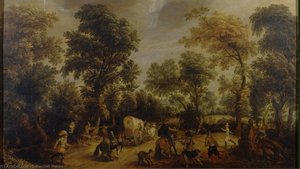
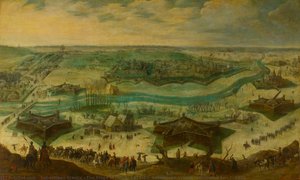
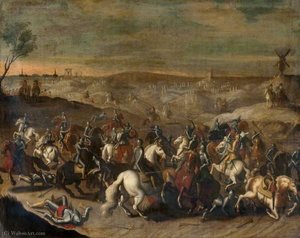
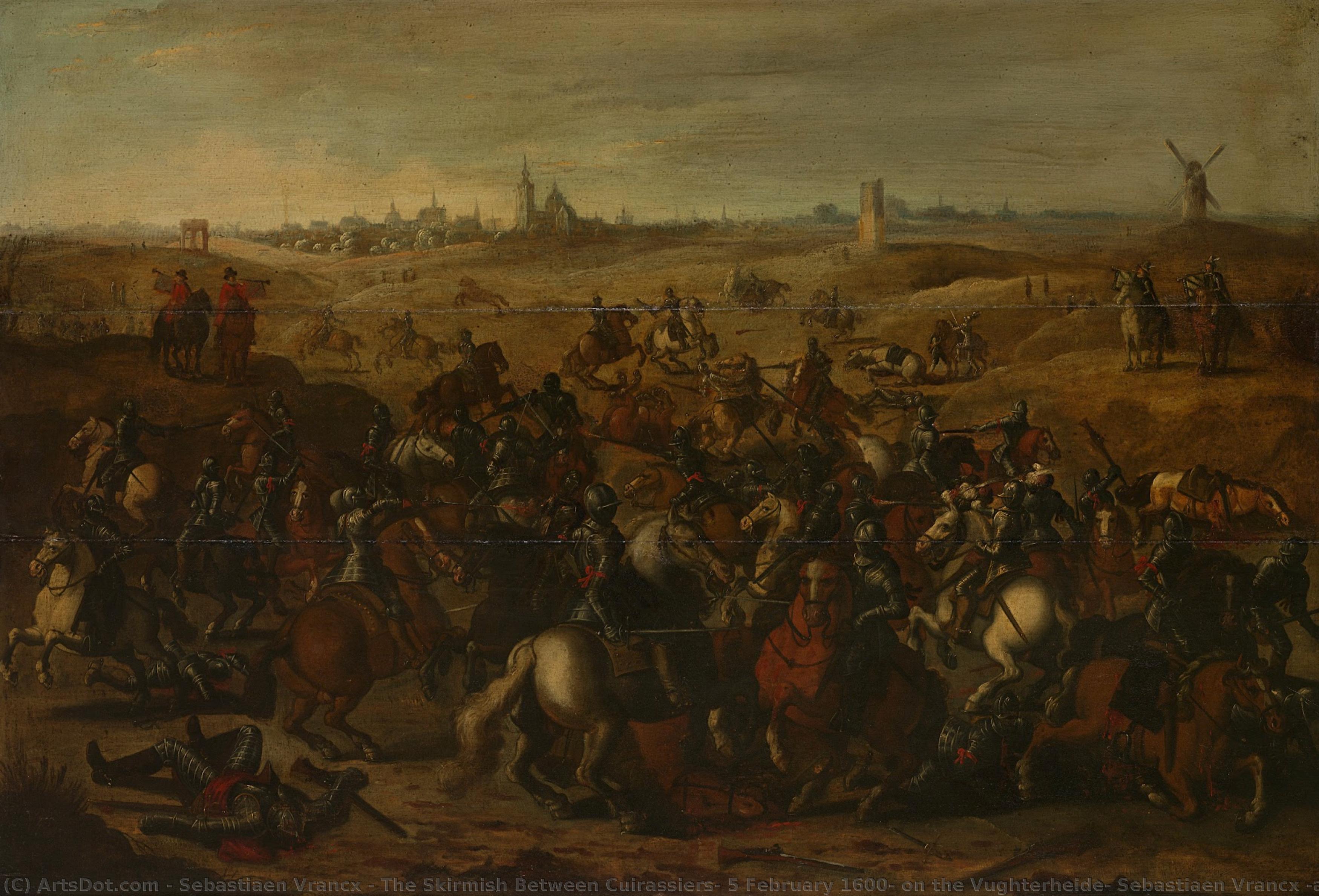
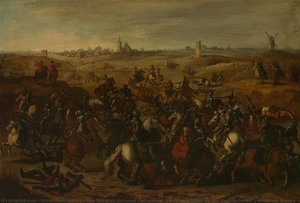
The Skirmish Between Cuirassiers, 5 February 1600, on the Vughterheide, Sebastiaen Vrancx (after), c. 1635

  • Creation date1635
  • Dimensions72.0 x 106.0 cm

Discover Sebastiaan Vrancx's pioneering battle scenes & landscapes! A Flemish Baroque master of intense emotion & detail, his art reflects the Antwerp School.

Giclée / Art Print

Museum-quality giclée or canvas print with fast production and flexible finish options. (Buy Hand Made Painting Buy Hand Made PaintingBuy Image Buy Image)

Standard
custom
CM
INCH

Pick from our preset sizes that match the artwork's original proportions.

width
height

You may enter your own dimensions to fit a specific frame or space. If your selected size does not match the original image's proportions, we will either crop the artwork or extend the image with a mirrored or solid-fill edge. A digital mockup will be sent for your approval before production begins.
Please note that the on-screen preview does not reflect the actual cropping or extension. Only the mockup will accurately show the final composition.
While custom sizes are available, we recommend selecting a dimension from the predefined list to preserve the original proportions.

Worldwide Delivery () in 2 weeks instead of standard 4/5 weeks. (5 September)

why_choose_icon
Free Worldwide Express Shipping
why_choose_icon
High-Quality Linen Canvas
why_choose_icon
Full Shipping Insurance
why_choose_icon
Customs Tax Refund Guarantee
why_choose_icon
True Color Matching Guarantee
why_choose_icon
60-Day Return Policy (Defects Only)
why_choose_icon
100% Money-Back Guarantee
why_choose_icon
Bulk Discount Offer

Total Price

$ 63

reproduction

The Skirmish Between Cuirassiers, 5 February 1600, on the Vughterheide, Sebastiaen Vrancx (after), c. 1635

Giclée / Art Print

Reproduction Size

-

Total Price

$ 63

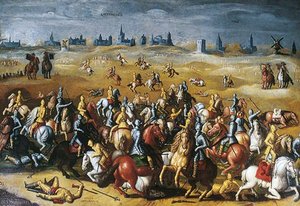
This notorious incident took place on the Vughterheide not far from ’s-Hertogenbosch on 5 February 1600.11 It resulted from a challenge by Pierre (or François) de Bréauté (1580-1600), a Norman cavalry officer based in Geertruidenberg, in the service of Prince Maurits of Orange, the Dutch stadholder, offered to Anton Schetz (1564-1640), from 1619 2nd Baron Grobbendonck and from 1598 governor of ’s-Hertogenbosch, which city remained under Spanish suzerainty until 1629.12 He appointed a native of Brabant from the city, Gerard Abramsz van Houwelingen (c. 1560-1600), his lieutenant, to answer the summons. Houwelingen had an odd nickname, Leckerbeetje, which has had various interpretations; Vander Auwera has recently suggested that the Dutch nickname should mean ‘he who likes tasty things’.13 The formalities seem to have followed those of the traditional, medieval tournament.14 Settled beforehand by the heralds would have been the place and time of the encounter – the Vughterheide between the Vught windmill and the ’s-Hertogenbosch gallows on the 5 February 1600 – and the numbers on each side, twenty-two. The cuirassiers are wearing three-quarter length, heavy armour and are fighting with pistols/bludgeons and armour piercing swords. Houwelingen wears a red sash and his comrades the red armband of the Spanish army (their opponents’ armbands should be green). The Rijksmuseum picture, which is on an oak support that has not been dated, is a copy of the print, designed by Sebastiaen Vrancx and engraved by Joannes van Doetecum II (by 1587-1630), of which there appear to be no extant examples.15 It has been suggested that the engraver worked from a painting by Vrancx,16 but this is unlikely as the latter is described as the ‘inventor’ and this in spite of there being a record of a painting of the skirmish (mêlée) by Vrancx of 1601.17 The plates, which made up the print, were purchased after Van Doetecum’s death by Claes Jansz Visscher (1587-1652) and republished by him in 1631 as Batalie van Breaute ende Leckerbeetien.XXII.Tegens XXII. Inscriptions on Visscher’s print identify the town, centre, as ‘shertogenbos’ (’s-Hertogenbosch) and the villages to the left and right as ‘Orten’ (Orthen) and ‘Vucht’ (Vught) respectively. The present copy is not accurate; in particular the gallows in the middle distance, left, was misunderstood and the tower to the left of the windmill differs, as do the buildings along the horizon. There are far fewer spectators in the middle ground. Dendrochronological analysis of the three pieces of oak timber which make up the support might provide a terminus post quem for its execution. Hofstede de Groot suggested that it was the work of Gerrit van Santen (1609/11-1687/1700),18 but it seems rather to be the work of a not very skilful, journeyman hand active very probably in the Netherlands in the first half of the seventeenth century. Depicted is the moment after the impact of the first charge, which would have been signalled by each sides’ trumpet-blowing heralds on raised ground to the left and right. At this first encounter, De Bréauté shot Houwelingen dead and his own horse was killed. The former, identified as Lieutenant Lackbeetken (Leckerbeetje), is shown lying prone in the left foreground of the print, while De Bréauté is identified in the print as the cuirassier remounting by his dead charger, to the left of the heralds on the right. Whether these identifications are as Vrancx intended is an open question, but it seems likely. As is shown in the print (and painted copy), this skirmish was to the death (a mêlée à outrance) and thus fiercely contested.19 Nineteen of De Bréauté’s companions were killed as were four Brabanters and thirty horses. Among the Brabanters to die were Houwelingen’s brother and brother-in-law. De Bréauté was himself captured and then murdered as he was brought into ’s-Hertogenbosch. An account of the mêlée in Dutch and French is given at the base of Visscher’s print. Although Houwelingen is prominently depicted in the foreground, and De Bréauté is inconspicuous in the middle ground, the accounts are sympathetic to him and condemn his murder in cold blood, after his surrender and disarming, by a cornet, Jan van Mil, acting on the orders of the governor, who had been driven by hatred and revenge (haet en wraeck). This was to be expected as the print was published in the northern Netherlands; the narratives were probably the work of, or commissioned by, Visscher as the governor is referred to by his title, inherited in 1619. The prototype of the image is one of the few prints engraved by Van Doetecum when he was working independently in Rotterdam (1598-1603).20 Vrancx only became a master in the Antwerp guild in 1600/01; how the two came into contact and whether the design was commissioned by the engraver remains unknown, as do the sources on which Vrancx relied for the design. An earlier depiction of a mêlée à outrance is the print by Lucas Cranach I (1472-1553) of 1../..

Artist Biography

a flemish baroque painter's legacy

sebastiaan vrancx or sebastian vranckx, a prominent flemish baroque painter, left an indelible mark on the art world with his pioneering battle scenes. born in 1573 and passing away in 1647, vrancx's work not only dominated the netherlandish painting genre but also showcased his versatility in landscapes, mythological scenes, and city celebrations.

artistic contributions

* the skirmish between cuirassiers, 5 february 1600, on the vughterheide, is a notable piece that highlights vrancx's mastery of capturing intense battle moments. * a village kermesse showcases his ability to portray vibrant village scenes, often infused with allegorical elements. * winter landscape with skaters on a frozen canal demonstrates his skill in depicting serene landscapes, a departure from his usual battle scenes.

museums featuring vrancx's work

* musée d'ixelles (brussels, belgium): this museum houses an impressive collection of over 10,000 works of art, including vrancx's pieces. * onze-lieve-vrouwekerk (bruges, belgium): while primarily known for its religious artworks, this gothic church also features works by vrancx and other flemish painters.

key art movements and mediums

  • baroque: characterized by dramatic lighting and intense emotions, reflecting in vrancx's battle scenes.
  • antwerp school: influenced by the city where vrancx was active, known for its vibrant and detailed style.
  • oil paint and graphite: primary mediums used by vrancx to bring his visions to life.

further exploration on ArtsDot.com

* visit the sebastiaan vrancx or sebastian vranckx page for more artworks and detailed information: https://ArtsDot.com/@/sebastiaan-vrancx-or-sebastian-vranckx * discover the musée d'ixelles (brussels, belgium) and its masterpieces: https://ArtsDot.com/@@/a@d3cen7

unravel the mystique of sebastiaen vrancx's art

delve into the world of this flemish baroque painter, and experience the evolution of netherlandish painting through his works on ArtsDot.com.
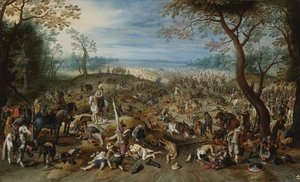
Quick Facts

  • Artistic Movement Or Style: Baroque
  • Artists Who Influenced This Artist:
    • Peter Paul Rubens
    • Anthony van Dyck
  • Date Of Birth: January 22, 1573
  • Date Of Death: May 19, 1647
  • Full Name: Sebastiaan Vrancx
  • Nationality: Flemish
  • Notable Artworks:
    • A Company of Cavalry
    • The Battle of Leckerbeetje
    • January
  • Place Of Birth: Antwerp, Belgium
Explore artworks organized by themes, styles, and characteristics.