 Preview
 Send
Send Share
Share
 Details

 Download
 Similars
 X-Ray
X-Ray Diaporama
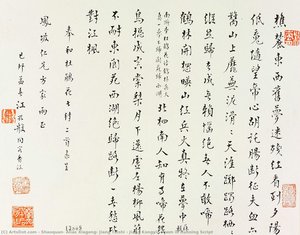
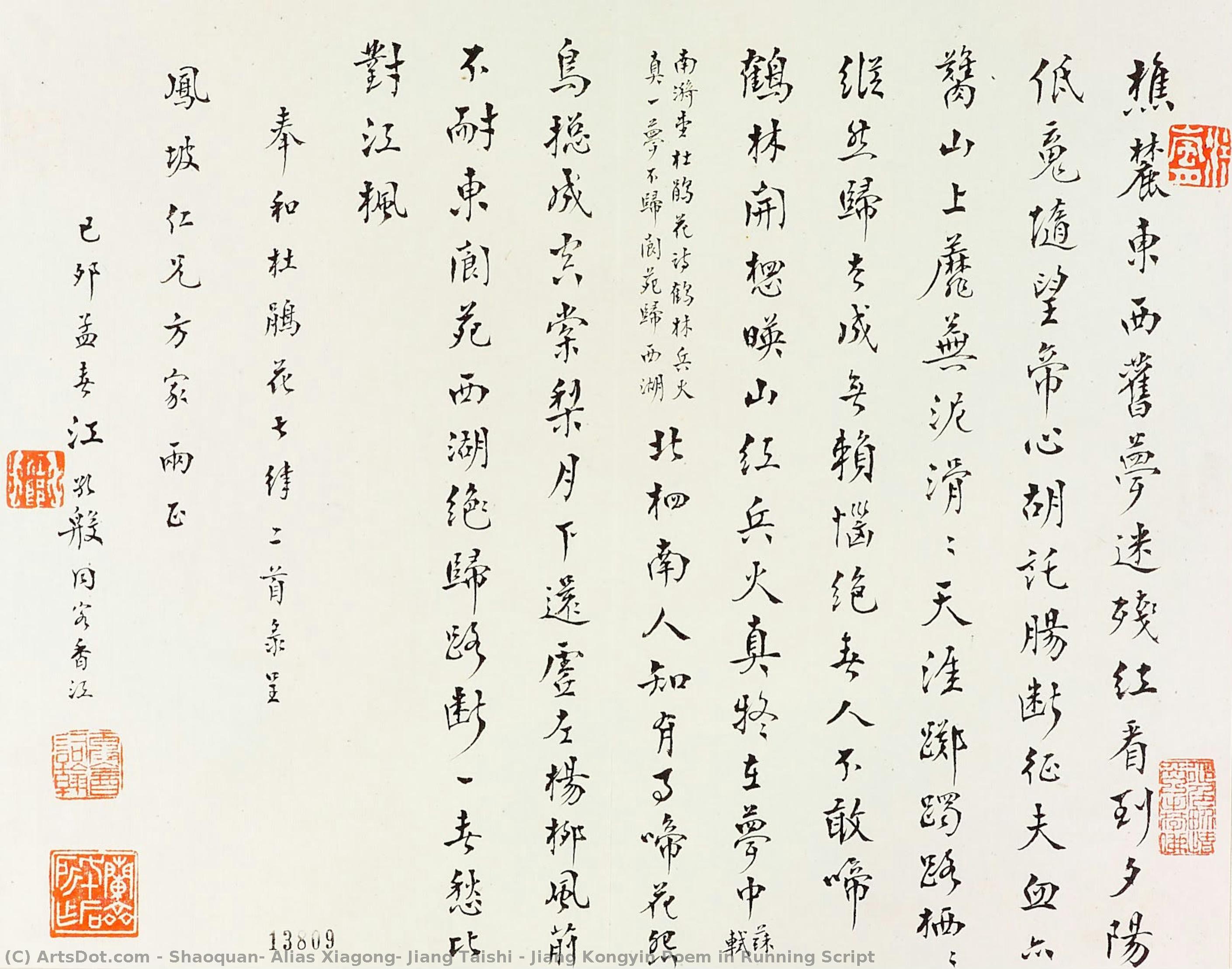
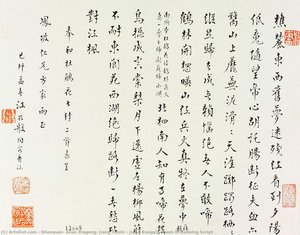
Jiang Kongyin Poem in Running Script
 1939
1939 27.0 x 34.0 cm
 The Chinese University of Hong Kong Art Museum
 Read More
Hand Made Oil Reproduction
Hand-painted oil on canvas in your size and frame, made to order by our artists. ( Buy Print Buy Image)




































Pick from our preset sizes that match the artwork's original proportions.

You may enter your own dimensions to fit a specific frame or space. If your selected size does not match the original image's proportions, we will either crop the artwork or extend the painting with additional hand-painted elements. A digital mockup will be sent for your approval before production begins.
Please note that the on-screen preview does not reflect the actual cropping or extension. Only the mockup will accurately show the final composition.
While custom sizes are available, we recommend selecting a dimension from the predefined list to preserve the original proportions.
After order, ArtsDot.com team will email client for instructions and provide a mockup preview
Worldwide Delivery () in 3/4 weeks instead of standard 5 weeks. (1 September). No compromise on quality.

Free Worldwide Express Shipping

High-Quality Linen Canvas

Full Shipping Insurance

Customs Tax Refund Guarantee

True Color Matching Guarantee

60-Day Return Policy (Defects Only)

100% Money-Back Guarantee

Bulk Discount Offer
 Glass option is only available in size under 110 CM

Jiang Kongyin Poem in Running Script
Reproduction Medium
Reproduction Size
-


Total Price
$ 263
Related Artworks

Artist Biography
The Culinary Poet: The Harmonious Life of Jiang Kongyin
In the twilight of the Qing Dynasty, a period marked by profound transition and the fading echoes of imperial grandeur, there emerged a figure who embodied the exquisite synthesis of intellectual rigor and sensory delight. Jiang Kongyin, known by his courtesy name Shaoquan and the alias Xiagong, was far more than a mere connoisseur; he was a bridge between the scholarly traditions of ancient China and the burgeoning modern world. Born in 1865 in Nanhai, Guangdong Province, Jiang’s life was shaped by the prestigious lineage of his ancestors, who had amassed significant wealth through the tea trade. This background provided him with a unique vantage point, allowing him to navigate both the refined circles of Chinese literati and the expanding commercial networks of the West, even serving as a representative for prominent British and American tobacco companies.
His intellectual foundation was laid within the hallowed halls of the Taishi Academy, an institution dedicated to moral cultivation and the mastery of classical disciplines. As one of the final scholars to achieve the distinction of jinshi through the imperial civil service examinations, Jiang was deeply steeped in Confucian ideals. This education instilled in him a lifelong devotion to balance, moderation, and respect for tradition—principles that would eventually transcend the boundaries of literature and find a profound expression in his approach to gastronomy. To Jiang, the act of creation, whether it involved the delicate stroke of a calligraphy brush or the careful selection of a seasonal ingredient, was an exercise in achieving cosmic harmony.
The Artistry of Brush and Blade
Jiang’s artistic legacy is uniquely dualistic, characterized by a seamless flow between the written word and the culinary craft. He was a master of calligraphy, possessing a command over both the fluid, rhythmic running script and the structured, ancient seal script. His calligraphic works were never merely decorative; they served as vessels for philosophical depth, where every movement of the ink mirrored the vitality of the natural world. This same precision was applied to his culinary pursuits. Often referred to as the "first man of the hundred Cantonese foods," Jiang approached the kitchen with the meticulousness of a poet selecting a rhyme. He did not seek to merely satisfy hunger but to elevate eating into an aesthetic experience.
The legendary Taishi Recipes stand as his most enduring contribution to cultural history. These were not simple instructions for sustenance but were highly refined compositions that reflected his scholarly training. In these recipes, one finds a distillation of the same principles found in his poetry:
- Balance: The careful calibration of textures and temperatures to ensure no single flavor overwhelms the palate.
- Seasonality: A profound respect for the natural cycle, utilizing ingredients at their peak of freshness to honor the earth's rhythm.
- Refinement: The transformation of humble elements into complex, multi-layered dishes through sophisticated techniques.
A Lasting Legacy in the Heart of Cantonese Culture
The historical significance of Jiang Kongyin lies in his role as a guardian of tradition during an era of immense upheaval. While the political structures of the Qing Dynasty crumbled, the cultural essence he helped cultivate—specifically within the realm of Cantonese cuisine—continued to flourish and evolve. His family kitchen served as a vital training ground, influencing generations of cooks and shaping the very identity of modern Cantonese gastronomy. He proved that the boundaries between the "scholar" and the "gourmet" are illusory; both roles require an acute sensitivity to the nuances of the world around them.
Even in his poetic contributions, such as the collective works involving themes like the azalea, Jiang demonstrated an ability to connect with a broader community of intellectuals. His life remains a testament to the idea that true artistry is found in the pursuit of harmony—between the East and the West, between the pen and the spatula, and between the soul and the senses. Today, as we look back upon the era of Shaoquan, we see not just a man of two worlds, but a master who unified them through the timeless language of beauty and taste.
shaoquan, alias xiagong, jiang taishi
1865 - 1952 , China
Quick Facts
- Artistic Movement Or Style: Late Qing Dynasty
- Date Of Birth: Nanhai, China (1865)
- Date Of Death: 1952
- Full Name: Jiang Kongyin
- Nationality: Chinese
- Notable Artworks: ['Snake Feast Recipes']
- Place Of Birth: Guangzhou, China