 Preview
 Send
Send Share
Share
 Details

 Download
 Similars
 X-Ray
X-Ray Diaporama
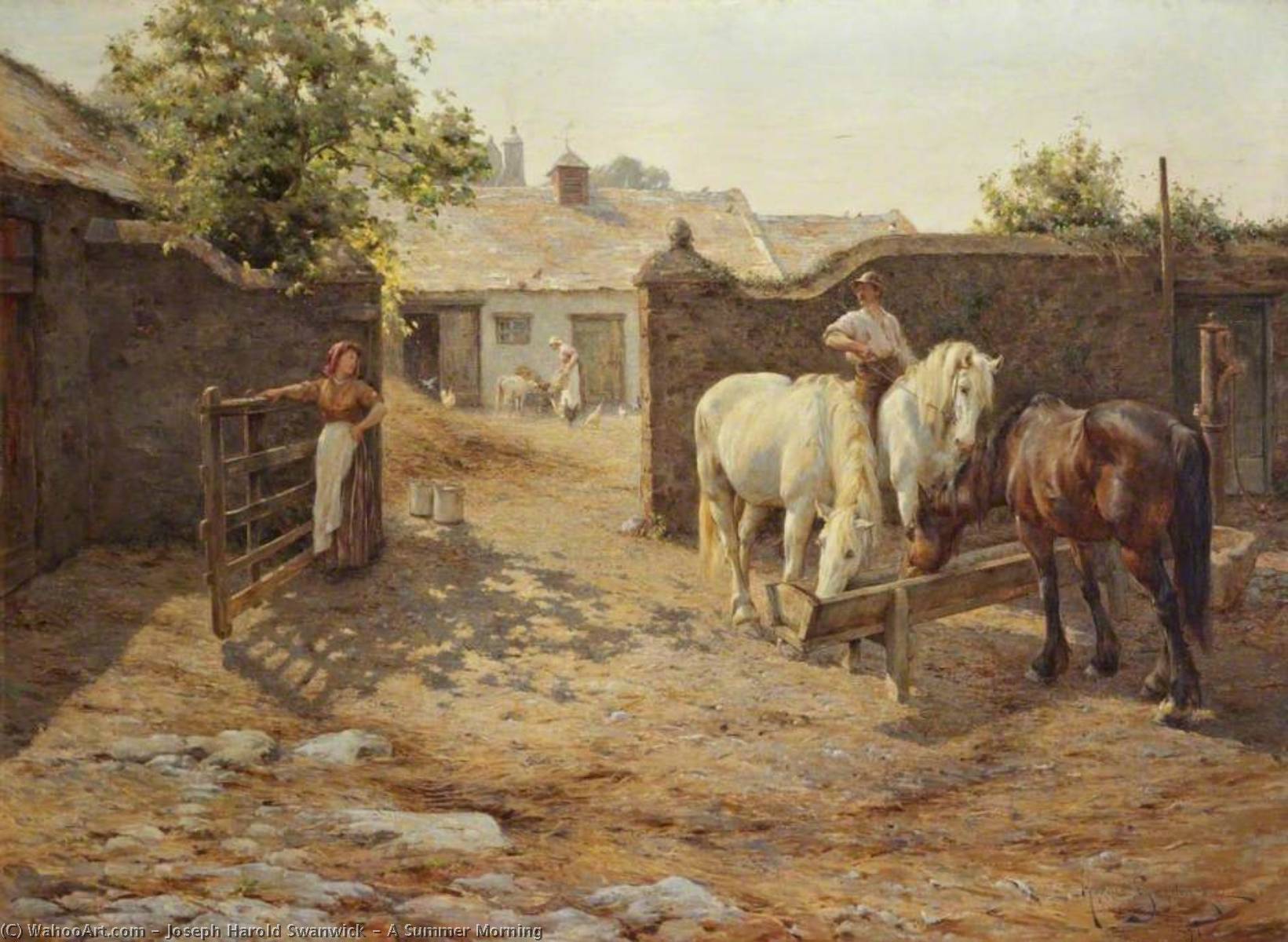
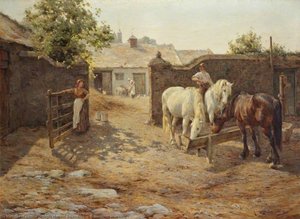
A Summer Morning
 1897
1897 123.0 x 184.0 cm
 Walker Art Gallery
 Read More
Hand Made Oil Reproduction
Hand-painted oil on canvas in your size and frame, made to order by our artists. ( Buy Print Buy Image)




































Pick from our preset sizes that match the artwork's original proportions.

You may enter your own dimensions to fit a specific frame or space. If your selected size does not match the original image's proportions, we will either crop the artwork or extend the painting with additional hand-painted elements. A digital mockup will be sent for your approval before production begins.
Please note that the on-screen preview does not reflect the actual cropping or extension. Only the mockup will accurately show the final composition.
While custom sizes are available, we recommend selecting a dimension from the predefined list to preserve the original proportions.
After order, ArtsDot.com team will email client for instructions and provide a mockup preview
Worldwide Delivery () in 3/4 weeks instead of standard 5 weeks. (17 August). No compromise on quality.

Free Worldwide Express Shipping

High-Quality Linen Canvas

Full Shipping Insurance

Customs Tax Refund Guarantee

True Color Matching Guarantee

60-Day Return Policy (Defects Only)

100% Money-Back Guarantee

Bulk Discount Offer
 Glass option is only available in size under 110 CM

A Summer Morning
Reproduction Medium
Reproduction Size
-


Total Price
$ 263
Artwork Description
The Painting's Composition
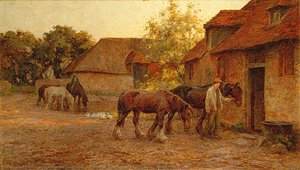
The painting depicts a woman standing next to a fence in front of two horses. The scene appears to be set in a rural area with a dirt road nearby. There are several people present in the painting, including the woman and other individuals who seem to be involved in tending to the horses or engaging in some form of work. A dog is also visible in the scene, which might be assisting with herding or providing company for the people. Key Elements of the painting include the use of warm colors, such as brown and green, which create a sense of tranquility and peace. The brushstrokes are bold and expressive, adding texture and depth to the piece. The composition is well-balanced, with the woman and horses placed centrally in the scene.Artist and Style
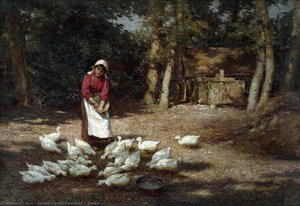
Joseph Harold Swanwick was a British artist known for his landscape and genre paintings. His style is characterized by the use of bold brushstrokes and vivid colors. A Summer Morning is a prime example of his work, showcasing his ability to capture the beauty of rural life.- Other notable works by Joseph Harold Swanwick include Ducks, which can be found on ArtsDot.com.
- The Walker Art Gallery is home to many other notable works, including pieces by Mattia Preti and Stephen Pearce, which can be viewed on ArtsDot.com.
The painting A Summer Morning by Joseph Harold Swanwick is a beautiful representation of rural life in the late 19th century. Its use of warm colors, bold brushstrokes, and well-balanced composition make it a captivating piece. For more information on this painting and others like it, visit ArtsDot.com.
Related Artworks

Artist Biography
Joseph Harold Swanwick: A Sussex Visionary of Rural Life
The art world often seeks grand narratives, sweeping movements, and revolutionary techniques. Yet, the most compelling stories frequently reside in the quiet dedication of individual artists who capture a specific place and time with remarkable honesty and sensitivity. Joseph Harold Swanwick, born in Middlewich, Cheshire, in 1866, was precisely such an artist – a master of depicting the evocative landscapes and working lives of rural Sussex, England, during his decades-long career.
Swanwick’s early life instilled within him a deep appreciation for art. His father, a doctor who later turned to farming, recognized his son's artistic talent and encouraged his pursuit. This familial support led to studies at the South Liverpool School of Art, followed by formative years at the Slade School of Fine Art in London and, crucially, the Académie Julian in Paris. The Parisian experience proved pivotal, exposing him to the Impressionist movement and fostering a looser, more atmospheric approach to painting – a departure from the rigid academic styles prevalent at the time. His exposure to Legros, a friend of Manet, further shaped his artistic sensibilities.
The Sussex Landscape: A Painter’s Obsession
Swanwick's most enduring legacy lies in his profound engagement with the South Downs and the surrounding countryside of Sussex. He established a home in Wilmington, Polegate, around 1909, effectively becoming a permanent fixture within this landscape he so deeply loved. This relocation wasn’t merely a change of address; it represented a fundamental shift in his artistic focus. He began to meticulously observe and record the rhythms of rural life – the farmers tending their fields, the animals grazing peacefully, the ever-changing light upon the rolling hills.
His paintings are characterized by a remarkable realism, yet they transcend mere documentation. Swanwick possessed an extraordinary ability to capture not just the visual appearance of his subjects but also the atmosphere and mood of each scene. He employed a distinctive technique – often working in both oil and watercolour – that allowed him to build up layers of colour and texture, creating a sense of depth and luminosity. His use of light was particularly masterful, transforming ordinary landscapes into scenes of breathtaking beauty. The “Last Load,” exhibited at the Royal Academy, exemplifies this skill perfectly, capturing the weariness and dignity of farm labourers returning from their day’s work.
Influences and Artistic Development
While Swanwick's Parisian training undoubtedly influenced his style, he drew inspiration from a diverse range of sources. The Pre-Raphaelites, with their emphasis on beauty and narrative, are evident in the romanticism of some of his compositions. The influence of Constable’s meticulous observation of the English countryside is also palpable, particularly in his depictions of farm animals – “Her Kitten” being a poignant example of this connection.
His artistic development wasn't static; he continually refined his technique and explored new subjects throughout his career. Early works often featured coastal scenes and glimpses of European landscapes, reflecting his travels. However, as he settled in Sussex, his focus increasingly turned to the familiar rhythms of rural life, culminating in a body of work that is both deeply personal and universally resonant.
Recognition and Legacy
Swanwick’s dedication was recognized by several prestigious organizations. He was elected into the Royal Institute of Painters in Watercolours (RI) and the Royal Institute of Oil Painters (ROI), signifying his acceptance as a leading figure within the British art world. His work was regularly exhibited at major venues, including the Royal Academy, the Walker Galleries, and various regional institutions. His paintings are now held in collections across the United Kingdom, including the Towner Art Gallery in Eastbourne, demonstrating the enduring appeal of his vision.
Joseph Harold Swanwick died in 1929, leaving behind a rich legacy of evocative landscapes that continue to captivate viewers with their honesty, beauty, and profound understanding of rural life. He wasn’t merely a painter; he was a chronicler of a disappearing world – a testament to the enduring power of observation and artistic skill.
joseph harold swanwick
1866 - 1929
Quick Facts
- Artistic Movement Or Style: Realist Landscape
- Artists Or Movements Influenced By This Artist: ['None listed']
- Artists Who Influenced This Artist: ['Manet']
- Date Of Birth: 1866
- Date Of Death: 1929
- Full Name: Joseph Harold Swanwick
- Nationality: British
- Notable Artworks:
- A Summer Morning
- Ducks
- The Harrow
- Place Of Birth: Clive, Middlewich, Cheshire