 Preview
 Send
Send Share
Share
 Details

 Download
 Similars
 X-Ray
X-Ray Diaporama
The Expulsion of Hagar
 Acrylic On Canvas
- WallArt
- Baroque Landscape
 1668
1668 107.0 x 140.0 cm
 Alte Pinakothek
 Read More
Hand Made Oil Reproduction
Hand-painted oil on canvas in your size and frame, made to order by our artists. ( Buy Print Buy Image)




P118B $10

P118H $10

P118W $10

P438Z $10

P508JH $12

P508YH $12

P805H $10

P805Z $10

P919BZ $10

P919G $10

P919XJ $10

P959ZH $10

P968JZ $12

W106C $8

W218G $10

W218JH $8

W218Y $10

W307PJ $10

W316G $10

W316PJ $8

W316Y $10

W398PJ $8

W4111J $10

W500HY $15

W500JH $15

W692G $12

W849H $8

W940BG $15

W953PJ $8




Pick from our preset sizes that match the artwork's original proportions.

You may enter your own dimensions to fit a specific frame or space. If your selected size does not match the original image's proportions, we will either crop the artwork or extend the painting with additional hand-painted elements. A digital mockup will be sent for your approval before production begins.
Please note that the on-screen preview does not reflect the actual cropping or extension. Only the mockup will accurately show the final composition.
While custom sizes are available, we recommend selecting a dimension from the predefined list to preserve the original proportions.
After order, ArtsDot.com team will email client for instructions and provide a mockup preview
Worldwide Delivery () in 3/4 weeks instead of standard 5 weeks. (17 August). No compromise on quality.

Free Worldwide Express Shipping

High-Quality Linen Canvas

Full Shipping Insurance

Customs Tax Refund Guarantee

True Color Matching Guarantee

60-Day Return Policy (Defects Only)

100% Money-Back Guarantee

Bulk Discount Offer
 Glass option is only available in size under 110 CM

The Expulsion of Hagar
Reproduction Medium
Reproduction Size
-


Total Price
$ 263
Artwork Description
A Landscape of Exile and Divine Justice
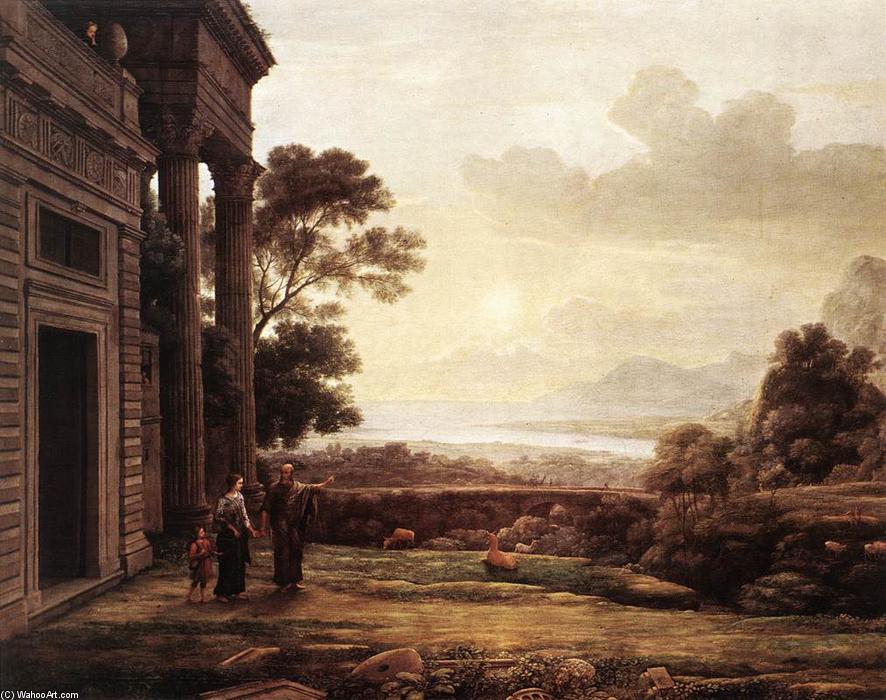
Claude Lorrain’s “The Expulsion of Hagar and Ishmael” (1668) isn't merely a depiction of a biblical narrative; it’s a profound meditation on displacement, familial bonds, and the weighty judgment of divine law. Painted during his most celebrated period in Rome, this monumental canvas exemplifies Lorrain’s signature style – a harmonious blend of classical idealism and atmospheric realism that captivated European audiences. The scene unfolds within a meticulously rendered Italian landscape, bathed in the golden light of late afternoon, creating an immediate sense of serenity despite the underlying drama.
At first glance, the composition appears deceptively tranquil. Abraham, a figure of dignified authority, stands poised and resolute as he gestures towards the distant horizon, effectively dismissing Hagar and her son Ishmael from his land. The figures themselves are rendered with remarkable grace and detail – Abraham’s weathered face conveying both compassion and unwavering conviction, while Hagar, clad in simple garments, embodies sorrow and vulnerability. Ishmael, a young boy, clings desperately to his mother's skirts, mirroring the universal experience of abandonment and loss. Yet, it is not simply a portrait of familial distress; Lorrain masterfully employs classical principles of perspective and composition to elevate the scene beyond a mere recounting of a tragic event.
The Language of Light and Shadow
Lorrain’s technical prowess is immediately apparent in his masterful manipulation of light and shadow. The warm, diffused sunlight casts long shadows across the landscape, creating a sense of depth and volume that draws the viewer into the scene. Notice how he uses subtle gradations of tone to define the contours of the distant hills, the meandering river, and the scattered trees – elements that contribute not only to the realism of the composition but also to its overall emotional impact. The artist’s meticulous attention to detail extends to the rendering of the figures themselves, each line and curve executed with a delicate precision that underscores their humanity.
- Technique: Lorrain employed a technique known as “alla prima,” working directly onto the canvas without underdrawing. This allowed for rapid execution and immediate responsiveness to the changing light conditions.
- Color Palette: The painting’s palette is dominated by earthy tones – ochres, browns, and greens – punctuated by flashes of gold and crimson in the sky. These colors evoke a sense of warmth and nostalgia, while also subtly hinting at the tragedy unfolding before the viewer.
- Composition: Lorrain utilizes a pyramidal composition, with Abraham as the central figure and Hagar and Ishmael positioned on the lower levels. This arrangement creates a sense of stability and balance, reinforcing the painting’s overall message of order and justice.
Symbolism and Biblical Narrative
The story depicted in “The Expulsion of Hagar” is drawn from Genesis 21:8-21, where Abraham, driven by divine command, sends his servant to cast out Hagar and her son Ishmael into the wilderness. The narrative serves as a powerful allegory for displacement, exile, and the consequences of transgression. However, Lorrain doesn’t simply present a straightforward retelling of the biblical tale; he imbues it with layers of symbolic meaning.
Hagar represents marginalized women and those cast aside by society, while Ishmael symbolizes the future of God's covenant. Abraham’s decision to exile them reflects both divine justice and the harsh realities of patriarchal power. The vastness of the landscape serves as a metaphor for the uncertainty and vulnerability experienced by the exiled family.A Legacy of Pastoral Idealism
“The Expulsion of Hagar” stands as a testament to Claude Lorrain’s enduring legacy as one of the most influential landscape painters of the Baroque era. His ability to seamlessly blend classical ideals with contemporary sensibilities, coupled with his mastery of light and color, continues to inspire artists and captivate audiences today. Reproductions of this iconic work offer a window into a world of serene beauty and profound emotional depth – a timeless reminder of the complexities of human experience and the enduring power of art to illuminate our shared humanity.
Related Artworks
Artist Biography
Claude Lorrain (Claude Gellée): A Life in Light and Landscape
Early Life and Training
Born around 1600 in Chamagne, a small village in the Duchy of Lorraine (modern-day France), Claude Lorrain – originally Claude Gellée – remains one of the most celebrated landscape painters of the Baroque period. His early life is shrouded in some mystery, with conflicting accounts of his apprenticeship. One account, by Joachim von Sandrart, suggests a humble beginning as an apprentice to a pastry baker before finding employment with artists in Rome. Another, from Filippo Baldinucci, details earlier training in Naples with Goffredo Wals and later in Rome under Agostino Tassi.
Rise to Prominence
By the 1630s, Claude Lorrain had firmly established himself as the leading landscapist in Italy. His paintings quickly gained recognition for their atmospheric qualities and command high prices. He skillfully blended Italianate landscapes with classical and biblical themes, creating scenes that were both visually stunning and intellectually engaging.
Artistic Style and Key Characteristics
- Luminous Sunlight: A defining feature of Claude’s work is his masterful depiction of light. He was among the first artists to consistently portray sunlight streaming through landscapes, creating a sense of atmosphere and realism previously unseen.
- Classical Influences: His compositions often draw inspiration from classical antiquity, incorporating Roman ruins, mythological figures, and architectural elements.
- Idealized Landscapes: Claude didn’t aim for strict topographical accuracy; instead, he created idealized landscapes that evoked a sense of harmony and tranquility.
- Detailed Drawings: He was a prolific draughtsman, creating numerous sketches and studies in pen, watercolor wash, and chalk – many preserved in his Liber Veritatis.
Influences and Development
Claude’s early influences included the landscape traditions of Northern Europe, particularly those of the Flemish painters. He also studied the works of Italian Renaissance masters like Titian and Raphael. Over time, his style evolved from darker, more dramatic compositions to lighter, airier scenes characterized by a golden glow.
Notable Works
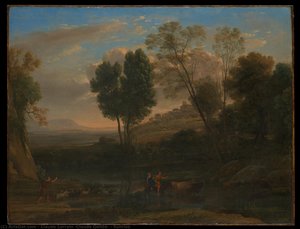
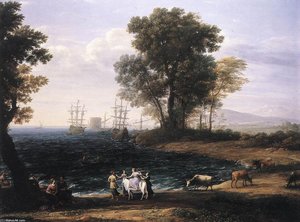
- Landscape with Peasants Returning with their Herds
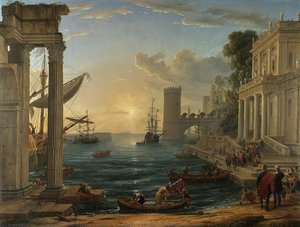
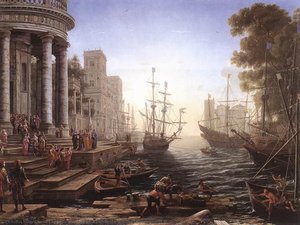
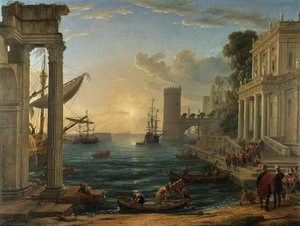
- Seaport with the Embarkation of the Queen of Sheba
- Sunrise
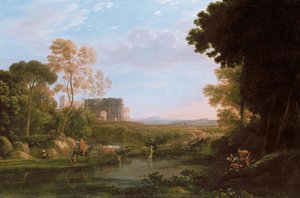
- Pastoral Landscape: The Roman Campagna
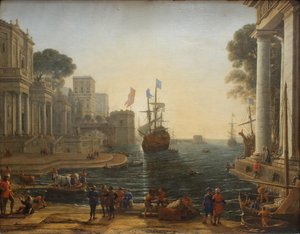
- The Disembarkation of Cleopatra at Tarsus
Historical Significance and Legacy
Claude Lorrain’s impact on landscape painting is immeasurable. He elevated the genre to a level of prestige previously reserved for historical and religious subjects. His works influenced generations of artists, including J.M.W. Turner and Impressionist painters who sought to capture the fleeting effects of light and atmosphere. Today, his paintings are highly valued and can be found in major museums worldwide, particularly the National Gallery (London) and the Art Gallery of South Australia.
Later Life and Death
Claude Lorrain passed away on November 23, 1682, in Rome. His tombstone in the church of San Luigi dei Francesi bears a simple inscription: “Claude / peintre de / rome / mort / le 23 novembre 1682”. He left behind a legacy as one of the most important and influential landscape painters in Western art history.
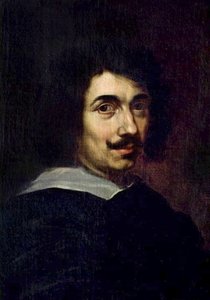
claude lorrain (claude gellée)
1600 - 1682
Quick Facts
- Birth_Date: c. 1600
- Birth_Place: Chamagne, Vosges, Duchy of Lorraine
- Death_Date: November 23, 1682
- Influenced_By:
- Goffredo Wals
- Agostino Tassi
- Movement: Baroque
- Name: Claude Lorrain (Claude Gellée)
- Nationality: French (Lorraine)
- Notable_Works:
- Landscape with Peasants returning with their herds
- Seaport with the Embarkation of the Queen of Sheba
Related Articles
Claude Lorrain: Master of Light & Landscape in the Golden Age
Explore the luminous landscapes of Claude Lorrain, a Baroque master renowned for his masterful use of light & atmosphere. Discover his life, techniques, key works & enduring influence on art history.

Beyond the Horizon: 10 Landscape Masterpieces for Your Home Decor
Journey through 10 breathtaking landscape paintings by Monet, Van Gogh & more! Explore iconic artworks, artistic techniques & find inspiration for your home decor. Museum-quality reproductions at ArtsDot.com. Discover all masterpieces on ArtsDot.com
Monet's Masterpieces: 25 Iconic Artworks to Transform Your Home
Journey through 25 iconic Claude Monet masterpieces! Explore Impressionism’s beauty, from Water Lilies to Rouen Cathedral. Discover stunning art reproductions & curated decor ideas – explore the full collection online at ArtsDot.com.

John Constable's Masterpieces: Explore 25 Iconic Landscapes for Your Home
Journey through John Constable's 25 most celebrated landscapes. Explore Romanticism, Dedham Vale & his masterful use of light in iconic paintings like 'Hay Wain'. Find museum-quality art reproductions and elevate your home decor on ArtsDot.com.

Evocations of Place: A Historical Journey Through Landscape Art
Explore the rich history of landscape art with ArtsDot. Discover renowned artists, movements like Impressionism & Romanticism, and expert guidance for collecting timeless pieces. Find your perfect serene escape today!