 Preview
 Send
Send Share
Share
 Details

 Download
 Similars
 X-Ray
X-Ray Diaporama
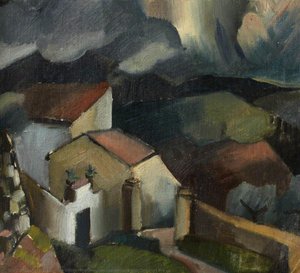
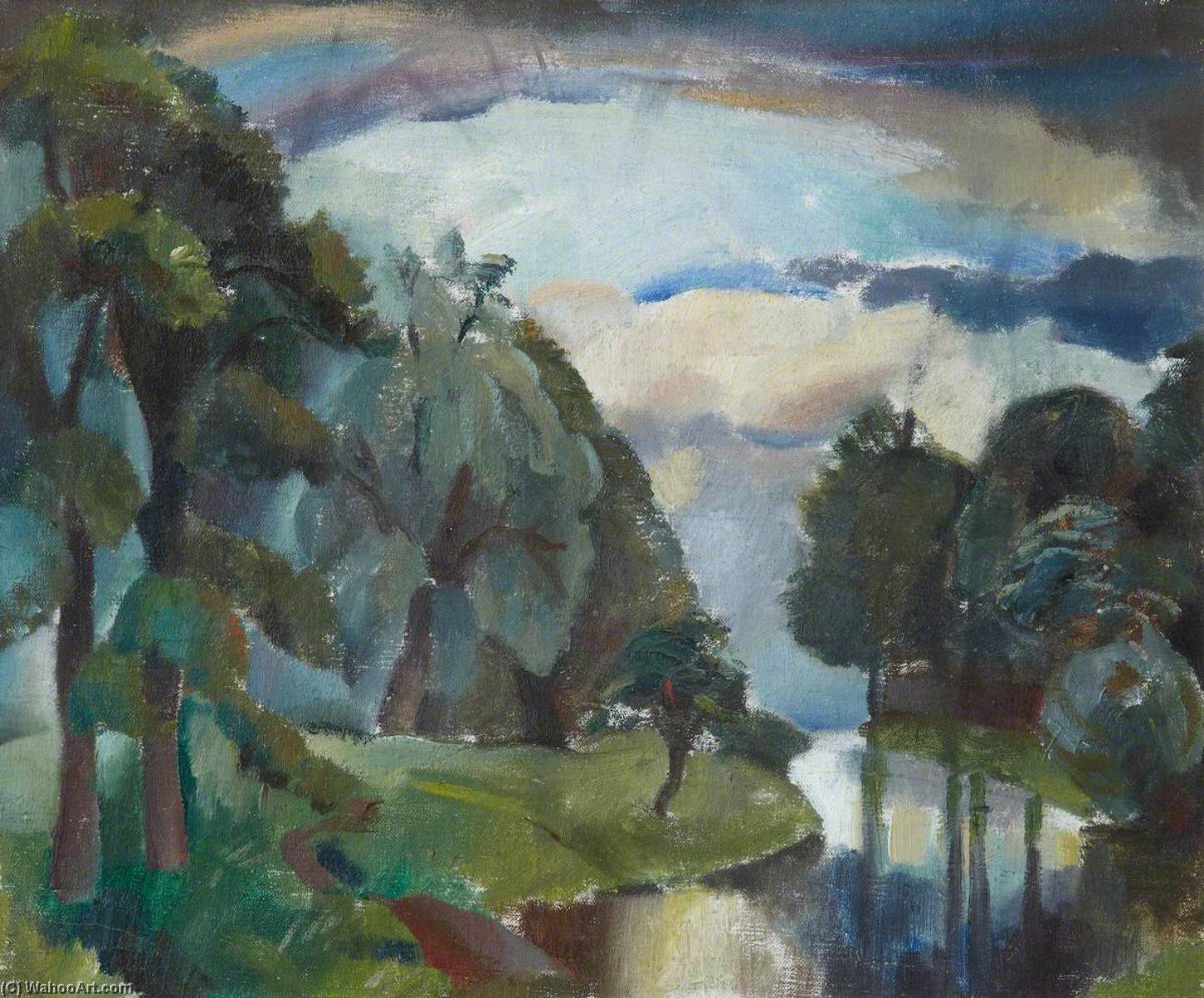
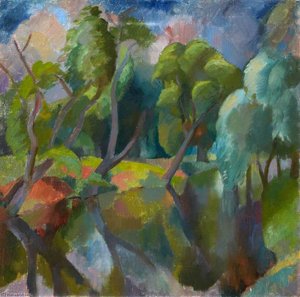
Park on the Tyne, Haddington
 Acrylic On Canvas
- WallArt
- Cubist Influences
 1924
1924 38.0 x 46.0 cm
 Royal Scottish Academy of Art - Architecture
 Read More
Giclée / Art Print
Museum-quality giclée or canvas print with fast production and flexible finish options. ( Buy Hand Made Painting Buy Image)




P118B $10

P118H $10

P118W $10

P438Z $10

P508JH $12

P508YH $12

P805H $10

P805Z $10

P919BZ $10

P919G $10

P919XJ $10

P959ZH $10

P968JZ $12

W106C $8

W218G $10

W218JH $8

W218Y $10

W307PJ $10

W316G $10

W316PJ $8

W316Y $10

W398PJ $8

W4111J $10

W500HY $15

W500JH $15

W692G $12

W849H $8

W940BG $15

W953PJ $8




Pick from our preset sizes that match the artwork's original proportions.

You may enter your own dimensions to fit a specific frame or space. If your selected size does not match the original image's proportions, we will either crop the artwork or extend the image with a mirrored or solid-fill edge. A digital mockup will be sent for your approval before production begins.
Please note that the on-screen preview does not reflect the actual cropping or extension. Only the mockup will accurately show the final composition.
While custom sizes are available, we recommend selecting a dimension from the predefined list to preserve the original proportions.
Worldwide Delivery () in 2 weeks instead of standard 4/5 weeks. (22 August)

Free Worldwide Express Shipping

High-Quality Linen Canvas

Full Shipping Insurance

Customs Tax Refund Guarantee

True Color Matching Guarantee

60-Day Return Policy (Defects Only)

100% Money-Back Guarantee

Bulk Discount Offer
 Glass option is only available in size under 110 CM

Park on the Tyne, Haddington
Giclée / Art Print
Reproduction Size
-


Total Price
$ 63
Collectible Description
A Moment Frozen in Time: William George Gillies’ “Park on the Tyne, Haddington”
William George Gillies' "Park on the Tyne, Haddington," painted circa 1924-30, isn’t merely a depiction of a rural scene; it’s a carefully constructed meditation on solitude, memory, and the melancholic beauty of the Scottish landscape. The painting captures a solitary figure standing within a vast, rolling field, bordered by the muted greens and browns of trees that seem to both embrace and observe him. The River Tyne snakes its way through this idyllic vista, reflecting the overcast sky above – a subtle indication of the emotional weight carried by the scene. It’s a work imbued with a quiet intensity, inviting contemplation rather than immediate visual gratification.
Gillies, born in Haddington and deeply rooted in the East Lothian countryside, was a master of capturing the essence of his native land. His artistic journey began with an exploration of Cubism, influenced by figures like Picasso and Braque, as evidenced by the fragmented forms and geometric arrangements present in earlier works. However, a pivotal encounter with Paul Klee in 1934 dramatically shifted his approach. Klee’s emphasis on color, childlike imagination, and emotional expression profoundly impacted Gillies, leading him to embrace a more intuitive and evocative style – one that is powerfully evident in “Park on the Tyne.” The painting showcases this transition beautifully; the muted palette of earlier works gives way to richer, more layered hues, suggesting a deeper engagement with the subject’s inner world.
Technique and Composition: A Study in Light and Shadow
The painting's strength lies not just in its subject matter but also in Gillies’ masterful technique. He employs a loose, expressive brushstroke – particularly noticeable in the depiction of the trees and the flowing river – creating a sense of movement and atmosphere. The light is diffused, casting long shadows that emphasize the vastness of the landscape and the figure's isolation. Gillies utilizes atmospheric perspective; distant elements are rendered paler and less distinct, drawing the viewer’s eye towards the central subject. Note the careful layering of paint – thin washes build up to bolder strokes, creating a tactile quality and adding depth to the scene. The composition itself is deliberately balanced, with the figure positioned slightly off-center, inviting the viewer to share his contemplative gaze.
- Medium: Oil on Canvas
- Size: 38 x 46 cm (approximately)
- Style: A blend of Cubist influence and Klee-inspired emotional expressionism.
Symbolism and Emotional Resonance
The solitary figure in “Park on the Tyne” is a potent symbol of introspection and perhaps even melancholy. He’s not actively engaged with his surroundings; instead, he seems lost in thought, contemplating the vastness of nature and, potentially, his own place within it. The landscape itself can be interpreted as a reflection of the human psyche – the rolling hills representing challenges and uncertainties, while the river symbolizes the flow of time and memory. The muted colors contribute to a sense of quiet sadness, suggesting a longing for something lost or unattainable. It’s a scene that resonates with a universal feeling of isolation and the beauty found in solitude.
Historical Context: A Scottish Vision
Painted during a period of significant artistic experimentation and social change, “Park on the Tyne” reflects Gillies' engagement with both modernism and his deep connection to Scotland. As a teacher at the Edinburgh College of Art for over 40 years, he played a crucial role in shaping the next generation of Scottish artists. His work embodies a distinctly Scottish sensibility – a reverence for the landscape, a sensitivity to light and atmosphere, and an exploration of themes related to identity and memory. The painting’s creation coincided with a time when artists were increasingly interested in capturing subjective experience rather than simply replicating reality, aligning Gillies' approach with broader trends in 20th-century art.
Related Artworks
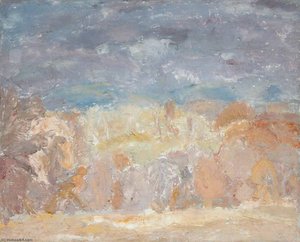
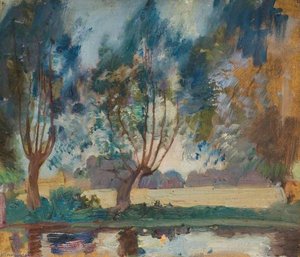
Artist Biography
Sir William George Gillies: A Life in Scottish Art
Early Life and Education
- Born: Haddington, East Lothian, United Kingdom, 1898.
- Gillies initially enrolled at the Edinburgh College of Art but his studies were interrupted by service in World War I with the Royal Engineers.
- Following the war, he returned to complete his education at the Edinburgh College of Art, graduating and subsequently becoming a dedicated teacher there for over 40 years.
Artistic Development and Influences
- Gillies’ artistic journey began with an exploration of Cubism after studying under André Lhote in Paris (1923) and traveling to Italy (1924).
- Early works, like “Two Pots, Saucer and Fruit” (1933), demonstrate this influence, showing a Cézanne-inspired arrangement with Braque and Picasso’s understated color palettes.
- A pivotal moment came in 1934 when he encountered the work of Paul Klee, inspiring him to adopt a more imaginative use of colour and childlike qualities in his compositions.
- He gradually moved away from strict Cubism, developing a distinctive style rooted in Scottish landscape and still life traditions.
The 1922 Group and Collaborative Spirit
- In 1922, Gillies co-founded the “1922 Group” alongside fellow artists including William Crozier, William Geissler, and William MacTaggart.
- This exhibition society provided a platform for emerging Scottish artists to showcase their work at the New Gallery in Edinburgh for a decade.
- The group fostered a sense of community and innovation within the Scottish art scene.
Themes and Subject Matter
- Landscapes: Gillies is renowned for his depictions of the Lothian, Fife, and Border regions of Scotland. He captured the essence of these landscapes with a sensitive eye.
- Still Lifes: Still life compositions were another significant focus, often featuring ceramics created by his younger sister, Emma Smith Gillies, whose premature death in 1936 deeply affected him.
- Portraiture: While he experimented with portraiture early in his career, landscapes and still lifes became his primary subjects.
Major Achievements and Recognition
- Gillies served as Principal of the Edinburgh College of Art from 1959 until his retirement in 1966.
- His prolific output and dedication to teaching had a profound influence on generations of Scottish painters.
- He was elected a Royal Academician (RA), signifying significant recognition within the art world.
Historical Significance and Legacy
- Sir William George Gillies is considered one of Scotland’s most important 20th-century painters.
- His work bridges the gap between early modernism and a distinctly Scottish artistic identity.
- Legacy: His influence extends beyond his paintings, shaping the direction of Scottish art through his teaching and mentorship.
- He died in 1973, leaving behind a rich body of work that continues to be celebrated for its beauty, sensitivity, and enduring relevance.
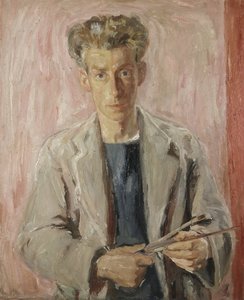
sir william george gillies
1898 - 1973 , United Kingdom
Quick Facts
- Birth Date: 1898
- Birth Place: Haddington, United Kingdom
- Death Date: 1973
- Influenced By:
- André Lhote
- Cézanne
- Braque
- Picasso
- Paul Klee
- Movement:
- Cubism
- Scottish Colourists
- Name: Sir William George Gillies
- Nationality: Scottish
- Notable Works:
- Young Boy with a Teapot
- Mediterranean Landscape with Overcast Sky
- Still Life – Yellow Jug and Striped Cloth
- The Origin of the Milky Way (after Jacopo Tintoretto)
Related Articles
Georges Braque's Masterpieces: 25 Paintings That Defined Cubism & Modern Art | ArtsDot
Explore 25 iconic Georges Braque paintings that revolutionized Cubism & modern art. Discover the stories behind his masterpieces, from Fauvism to Analytical Cubism. Find museum-quality reproductions & elevate your home decor with ArtsDot.com.
Georges Seurat's Masterpieces: 25 Paintings That Defined Pointillism | ArtsDot
Explore 25 iconic Georges Seurat paintings & discover the brilliance of Pointillism. From 'La Grande Jatte' to his harbor scenes, delve into art history with ArtsDot.com. Find museum-quality reproductions for your home decor. Explore the full collection online!
Sir William George Gillies: A Scottish Colourist's Journey Through Landscape & Abstraction
Explore the captivating world of Sir William George Gillies, a leading Scottish Colourist. Discover his journey from Cubism to iconic landscapes & still lifes. Expert insights for collectors and art enthusiasts.
George Paul Chalmers: Rediscovering the Angus Rembrandt & Scottish Colourist Roots
Explore the captivating world of George Paul Chalmers (1833-1878), a pivotal Scottish painter. Discover his landscapes, portraits & connection to the Aesthetic Movement and Colourists. Learn about this 'Angus Rembrandt's' legacy with ArtsDot.

Romantic Landscapes: 10 Masterpieces for Your Home | ArtsDot
Journey through 10 Romantic landscape masterpieces by Friedrich, Turner & Cole. Explore emotional art, sublime nature scenes & iconic 19th-century paintings. Find museum-quality reproductions for your home at ArtsDot.com – discover the full collection online!