 Preview
 Send
Send Share
Share
 Details

 Download
 Similars
 X-Ray
X-Ray Diaporama
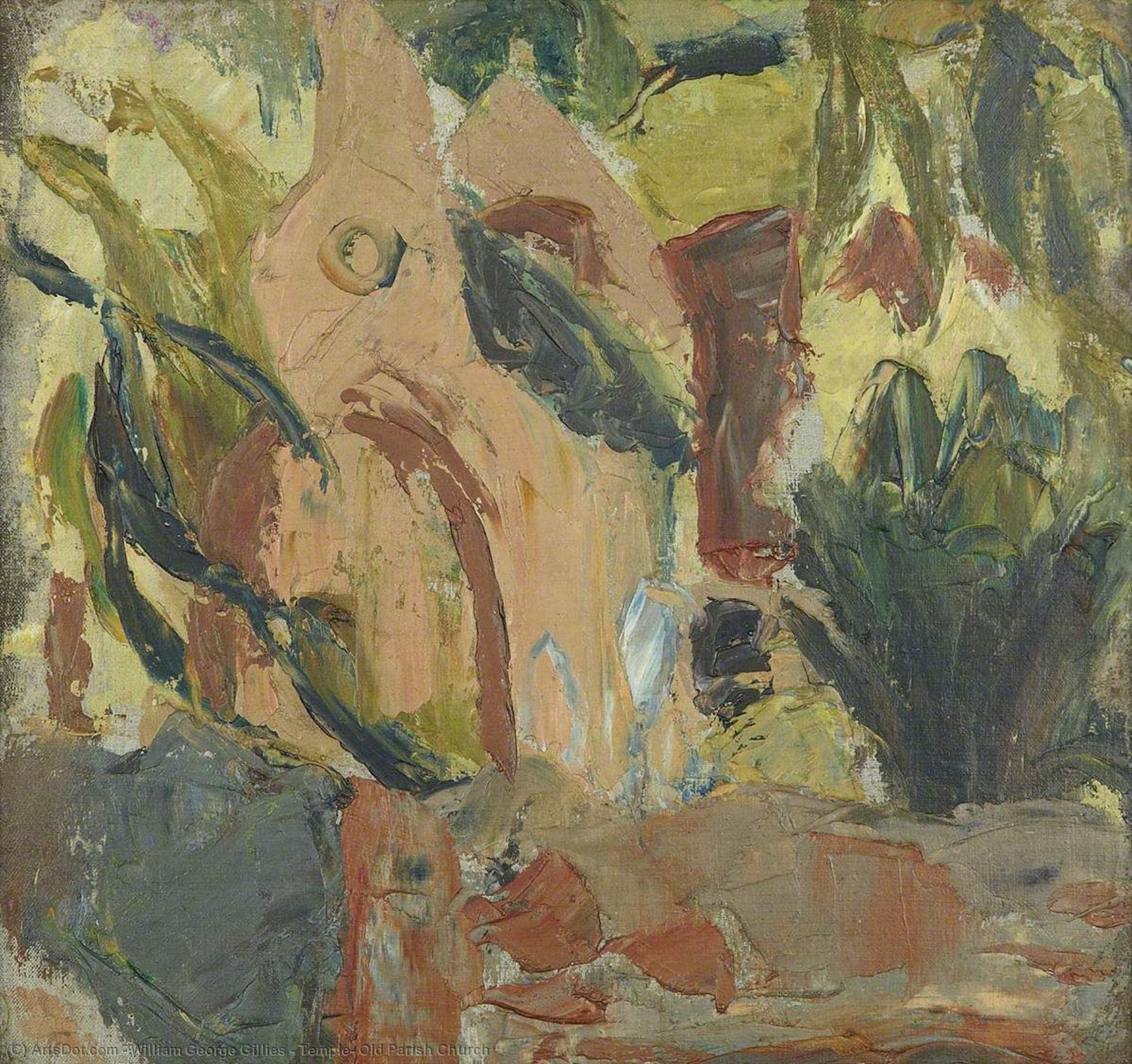
Temple, Old Parish Church


 Read More
Hand Made Oil Reproduction
Hand-painted oil on canvas in your size and frame, made to order by our artists. ( Buy Print Buy Image)




P118B $10

P118H $10

P118W $10

P438Z $10

P508JH $12

P508YH $12

P805H $10

P805Z $10

P919BZ $10

P919G $10

P919XJ $10

P959ZH $10

P968JZ $12

W106C $8

W218G $10

W218JH $8

W218Y $10

W307PJ $10

W316G $10

W316PJ $8

W316Y $10

W398PJ $8

W4111J $10

W500HY $15

W500JH $15

W692G $12

W849H $8

W940BG $15

W953PJ $8




Pick from our preset sizes that match the artwork's original proportions.

You may enter your own dimensions to fit a specific frame or space. If your selected size does not match the original image's proportions, we will either crop the artwork or extend the painting with additional hand-painted elements. A digital mockup will be sent for your approval before production begins.
Please note that the on-screen preview does not reflect the actual cropping or extension. Only the mockup will accurately show the final composition.
While custom sizes are available, we recommend selecting a dimension from the predefined list to preserve the original proportions.
After order, ArtsDot.com team will email client for instructions and provide a mockup preview
Worldwide Delivery () in 3/4 weeks instead of standard 5 weeks. (25 August). No compromise on quality.

Free Worldwide Express Shipping

High-Quality Linen Canvas

Full Shipping Insurance

Customs Tax Refund Guarantee

True Color Matching Guarantee

60-Day Return Policy (Defects Only)

100% Money-Back Guarantee

Bulk Discount Offer
 Glass option is only available in size under 110 CM

Temple, Old Parish Church
Reproduction Medium
Reproduction Size
-


Total Price
$ 263
Artwork Description
Temple, Old Parish Church – A Vision of Scottish Pastoral
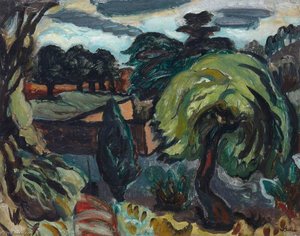
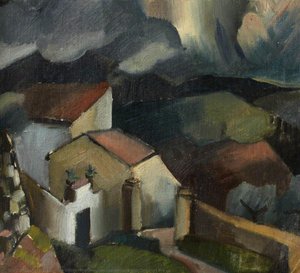
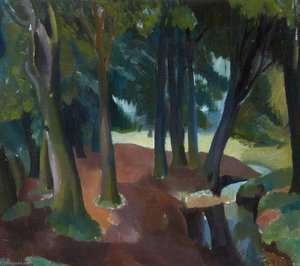
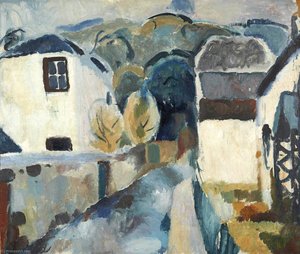
William George Gillies’ “Temple, Old Parish Church,” painted circa 1939–1940, stands as a testament to the enduring influence of Cézanne and Klee on British landscape painting during the interwar period. Executed in oil on canvas, this artwork captures a serene depiction of St. Mary's Episcopal Church nestled within the rolling hills of East Lothian, Scotland – a scene imbued with both meticulous observation and imaginative interpretation.
Gillies’ artistic journey began with an embrace of Cubism after formative studies under André Lhote in Paris (1923), exposing him to the revolutionary techniques pioneered by Picasso and Braque. However, his subsequent encounter with Paul Klee proved equally transformative, fostering a stylistic shift towards a more lyrical approach characterized by vibrant color palettes and childlike spontaneity. This duality is palpable in “Temple,” where geometric forms subtly underpin a richly textured surface dominated by hues of ochre, emerald green, and sapphire blue.
The painting’s composition prioritizes atmospheric perspective—a technique championed by Cézanne—to convey the grandeur of the Scottish landscape. Gillies skillfully renders the church building as a monumental presence against the backdrop of undulating hillsides and dense foliage. The steeple rises majestically, anchoring the viewpoint while simultaneously directing the gaze upwards towards the heavens. Detailed brushstrokes capture the intricacies of tree bark, leaf veins, and distant mountain peaks, demonstrating Gillies’ unwavering commitment to capturing the essence of his subject matter.
Beyond its technical prowess, “Temple” resonates with symbolic significance. The church itself represents faith, tradition, and spiritual contemplation—themes prevalent in Scottish Presbyterian culture during Gillies' time. The surrounding landscape evokes feelings of tranquility, solitude, and connection to nature – sentiments that align perfectly with the broader artistic currents of the era. It’s a painting designed not merely to represent a place but to evoke an emotional response, inviting viewers to contemplate beauty and serenity.
Gillies' legacy extends beyond individual artworks; he profoundly shaped the landscape art movement in Scotland. His dedication to teaching at Edinburgh College of Art ensured that his stylistic innovations would continue to inspire generations of artists. “Temple,” Old Parish Church” remains a captivating exemplar of Gillies’ artistic vision—a masterpiece that embodies both meticulous observation and imaginative expression.
Related Artworks
Artist Biography
Sir William George Gillies: A Life in Scottish Art
Early Life and Education
- Born: Haddington, East Lothian, United Kingdom, 1898.
- Gillies initially enrolled at the Edinburgh College of Art but his studies were interrupted by service in World War I with the Royal Engineers.
- Following the war, he returned to complete his education at the Edinburgh College of Art, graduating and subsequently becoming a dedicated teacher there for over 40 years.
Artistic Development and Influences
- Gillies’ artistic journey began with an exploration of Cubism after studying under André Lhote in Paris (1923) and traveling to Italy (1924).
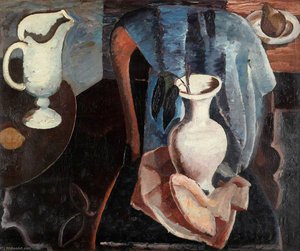
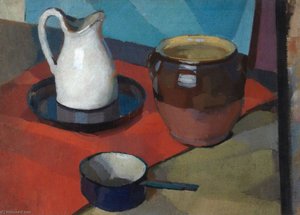
- Early works, like “Two Pots, Saucer and Fruit” (1933), demonstrate this influence, showing a Cézanne-inspired arrangement with Braque and Picasso’s understated color palettes.
- A pivotal moment came in 1934 when he encountered the work of Paul Klee, inspiring him to adopt a more imaginative use of colour and childlike qualities in his compositions.
- He gradually moved away from strict Cubism, developing a distinctive style rooted in Scottish landscape and still life traditions.
The 1922 Group and Collaborative Spirit
- In 1922, Gillies co-founded the “1922 Group” alongside fellow artists including William Crozier, William Geissler, and William MacTaggart.
- This exhibition society provided a platform for emerging Scottish artists to showcase their work at the New Gallery in Edinburgh for a decade.
- The group fostered a sense of community and innovation within the Scottish art scene.
Themes and Subject Matter
- Landscapes: Gillies is renowned for his depictions of the Lothian, Fife, and Border regions of Scotland. He captured the essence of these landscapes with a sensitive eye.
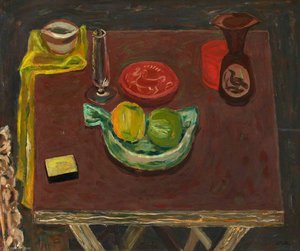
- Still Lifes: Still life compositions were another significant focus, often featuring ceramics created by his younger sister, Emma Smith Gillies, whose premature death in 1936 deeply affected him.
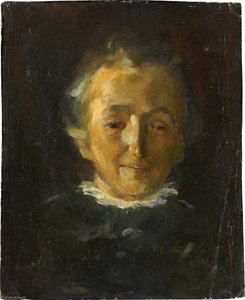
- Portraiture: While he experimented with portraiture early in his career, landscapes and still lifes became his primary subjects.
Major Achievements and Recognition
- Gillies served as Principal of the Edinburgh College of Art from 1959 until his retirement in 1966.
- His prolific output and dedication to teaching had a profound influence on generations of Scottish painters.
- He was elected a Royal Academician (RA), signifying significant recognition within the art world.
Historical Significance and Legacy
- Sir William George Gillies is considered one of Scotland’s most important 20th-century painters.
- His work bridges the gap between early modernism and a distinctly Scottish artistic identity.
- Legacy: His influence extends beyond his paintings, shaping the direction of Scottish art through his teaching and mentorship.
- He died in 1973, leaving behind a rich body of work that continues to be celebrated for its beauty, sensitivity, and enduring relevance.
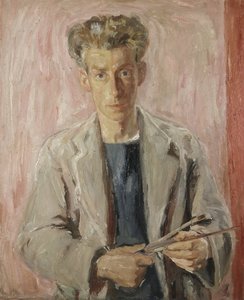
sir william george gillies
1898 - 1973 , United Kingdom
Quick Facts
- Birth Date: 1898
- Birth Place: Haddington, United Kingdom
- Death Date: 1973
- Influenced By:
- André Lhote
- Cézanne
- Braque
- Picasso
- Paul Klee
- Movement:
- Cubism
- Scottish Colourists
- Name: Sir William George Gillies
- Nationality: Scottish
- Notable Works:
- Young Boy with a Teapot
- Mediterranean Landscape with Overcast Sky
- Still Life – Yellow Jug and Striped Cloth
- The Origin of the Milky Way (after Jacopo Tintoretto)
Related Articles

Georges Braque's Masterpieces: 25 Paintings That Defined Cubism & Modern Art | ArtsDot
Explore 25 iconic Georges Braque paintings that revolutionized Cubism & modern art. Discover the stories behind his masterpieces, from Fauvism to Analytical Cubism. Find museum-quality reproductions & elevate your home decor with ArtsDot.com.

Cézanne's Masterpieces: 25 Iconic Artworks to Transform Your Space
Journey through 25 iconic artworks by Paul Cézanne – a master of Impressionism and Post-Impressionism. Explore his landscapes, still lifes, and the stories behind these timeless masterpieces. Discover museum-quality reproductions & curated decor at ArtsDot.com.
Sir William George Gillies: A Scottish Colourist's Journey Through Landscape & Abstraction
Explore the captivating world of Sir William George Gillies, a leading Scottish Colourist. Discover his journey from Cubism to iconic landscapes & still lifes. Expert insights for collectors and art enthusiasts.

Georges Seurat's Masterpieces: 25 Paintings That Defined Pointillism | ArtsDot
Explore 25 iconic Georges Seurat paintings & discover the brilliance of Pointillism. From 'La Grande Jatte' to his harbor scenes, delve into art history with ArtsDot.com. Find museum-quality reproductions for your home decor. Explore the full collection online!
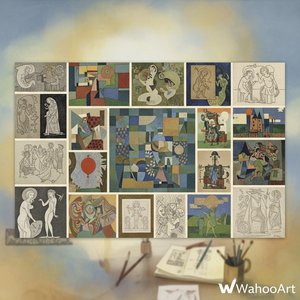
Paul Klee's Masterpieces: Explore 25 Iconic Paintings & Prints | ArtsDot
Journey through Paul Klee's 25 most iconic paintings & prints. Explore his abstract style, Bauhaus influence, and vibrant color palettes. Find museum-quality art reproductions & decor ideas at ArtsDot.com. Discover all masterpieces online.