 Preview
 Send
Send Share
Share
 Details

 Download
 Similars
 X-Ray
X-Ray Diaporama
Rose Hill Memorial Baptist Church


 Read More
Giclée / Art Print
Museum-quality giclée or canvas print with fast production and flexible finish options. ( Buy Hand Made Painting Buy Image)




P118B $10

P118H $10

P118W $10

P438Z $10

P508JH $12

P508YH $12

P805H $10

P805Z $10

P919BZ $10

P919G $10

P919XJ $10

P959ZH $10

P968JZ $12

W106C $8

W218G $10

W218JH $8

W218Y $10

W307PJ $10

W316G $10

W316PJ $8

W316Y $10

W398PJ $8

W4111J $10

W500HY $15

W500JH $15

W692G $12

W849H $8

W940BG $15

W953PJ $8




Pick from our preset sizes that match the artwork's original proportions.

You may enter your own dimensions to fit a specific frame or space. If your selected size does not match the original image's proportions, we will either crop the artwork or extend the image with a mirrored or solid-fill edge. A digital mockup will be sent for your approval before production begins.
Please note that the on-screen preview does not reflect the actual cropping or extension. Only the mockup will accurately show the final composition.
While custom sizes are available, we recommend selecting a dimension from the predefined list to preserve the original proportions.
Worldwide Delivery () in 2 weeks instead of standard 4/5 weeks. (31 August)

Free Worldwide Express Shipping

High-Quality Linen Canvas

Full Shipping Insurance

Customs Tax Refund Guarantee

True Color Matching Guarantee

60-Day Return Policy (Defects Only)

100% Money-Back Guarantee

Bulk Discount Offer
 Glass option is only available in size under 110 CM

Rose Hill Memorial Baptist Church
Giclée / Art Print
Reproduction Size
-


Total Price
$ 63
A Visionary Sanctuary in Color
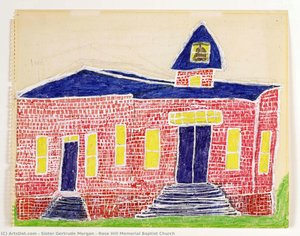
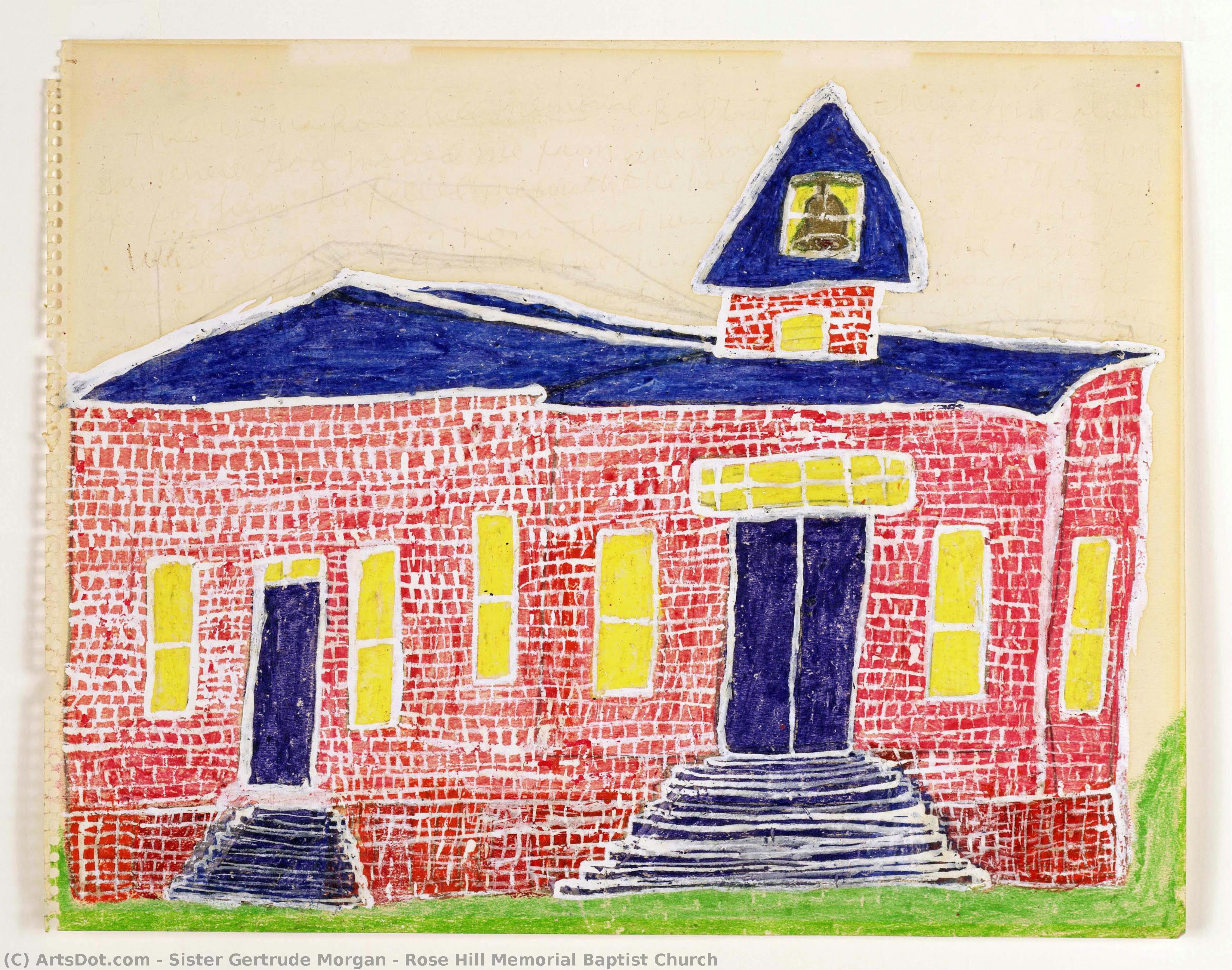
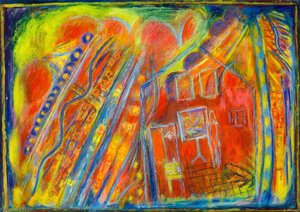
In the vibrant landscape of American folk art, few works possess the spiritual clarity and rhythmic charm of Sister Gertrude Morgan’s Rose Hill Memorial Baptist Church. Created in 1965, this painting serves as more than a mere architectural study; it is a profound window into the soul of a woman who saw the divine in every brushstroke. The composition centers on a striking red brick church, rendered with a bold, almost childlike simplicity that belies its deep emotional resonance. With its bright yellow windows and a striking blue roof and doors, the structure stands as a beacon of light against its backdrop. Every element, from the meticulously placed clock to the soaring bell tower, contributes to a sense of sacred order and communal peace.
The technique employed by Morgan is characteristic of her unique visionary style. Eschewing traditional academic perspective for a more flattened, graphic approach, she utilizes high-contrast colors to command the viewer's attention. The interplay between the warm, earthy tones of the red brick and the cool, celestial blues creates a visual harmony that is both grounding and uplifting. This method of painting—often described as prophetic or visionary—allows the artist to strip away the distractions of the physical world, leaving behind an essential, symbolic truth. For collectors and designers alike, this piece offers a captivating focal point that brings a sense of nostalgic warmth and spiritual tranquility to any curated space.
Historical Resonance and Spiritual Legacy
To understand this masterpiece, one must look toward the life of the artist herself. Born in Alabama and later becoming a central figure in the New Orleans art scene, Sister Gertrude Morgan was a self-taught polymath—a preacher, musician, and poet whose work was inseparable from her faith. This painting is deeply rooted in her personal history, specifically her connection to the Rose Hill Memorial Baptist Church. The artwork functions as a visual testimony, documenting her spiritual journey and her devotion to the congregation that shaped her identity. There is an undeniable intimacy in the way she depicts the building; it is not just a structure of stone and wood, but a living vessel for prayer and community.
For those looking to integrate art into a sophisticated interior, this reproduction offers a unique opportunity to possess a piece of American cultural heritage. The painting’s ability to evoke emotion through its bright, primary palette makes it an excellent choice for modern spaces seeking a touch of "folk-modernism." It invites conversation about the nature of creativity and the power of faith, making it a profound addition to a collection focused on outsider art or historical narratives. In every stroke, Morgan reminds us that beauty is found in the most sincere expressions of the human spirit, offering an enduring sense of hope and architectural grace.
Related Artworks

Artist Biography
A Visionary Voice: The Life and Spirit of Sister Gertrude Morgan
The history of American art is profoundly enriched by the singular, prophetic voice of Sister Gertrude Morgan. A self-taught African-American artist, musician, poet, and preacher, Morgan did not merely create art; she channeled a divine mission onto canvas. Born Gertrude Williams in 1900 in the rural landscape of Lafayette, Alabama, her early life was marked by the hardships of poverty. Leaving school before completing the third grade, she spent her formative years working as a servant and nursemaid. It was not until much later in life, after relocating to the vibrant, culturally complex atmosphere of New Orleans in 1939, that her spiritual and artistic identities would coalesce into the legendary figure known to history.
Morgan’s journey was inextricably linked to her faith. Her religious devotion began in her late teens at the Rose Hill Memorial Baptist Church in Columbus, Georgia. This deep-seated spirituality became the primary engine of her creativity. For Morgan, painting was an extension of her ministry—a way to document the divine presence and the shifting tides of church leadership. Her works, such as The Rose Hill Memorial Baptist Church, Columbus GA, serve as both historical records and spiritual testimonies, blending the personal with the eternal.
The Language of Folk Art and Divine Symbolism
The aesthetic language of Sister Gertrude Morgan is one of unmistakable power and immediacy. Characterized by vibrant colors and a raw, expressive technique, her work falls within the tradition of visionary folk art. Her paintings often bypassed traditional academic perspective in favor of a flattened, symbolic space that prioritized spiritual truth over physical realism. In her compositions, one frequently encounters angels, biblical scenes, and celestial figures that seem to emerge directly from a prophetic trance.
Her style is marked by several defining elements:
- Vibrant Color Palettes: The use of bold, saturated hues that evoke the intensity of her religious fervor.
- Narrative Iconography: A reliance on recognizable religious symbols to communicate complex theological messages.
- Spiritual Immediacy: A sense that the figures and events depicted are occurring in a timeless, sacred realm rather than a historical one.
This approach allowed her to bridge the gap between the earthly and the divine, making her art accessible yet profoundly mysterious. Her ability to weave together text and image—often incorporating writing directly into her paintings—further emphasized her role as a messenger of the word.
Legacy and Historical Significance
As the 1970s dawned, the art world began to recognize the profound importance of Morgan’s contribution to American culture. Her work became a cornerstone of groundbreaking exhibitions focused on visionary and folk art, earning her critical acclaim from collectors and historians alike. Today, her masterpieces are preserved in some of the most prestigious institutions in the United States, including the New Orleans Museum of Art and the Smithsonian American Art Museum.
The significance of Sister Gertrude Morgan extends far beyond the boundaries of a canvas. She stands as a pioneer for African-American artists, proving that profound artistic truth can emerge from the most humble beginnings through the sheer force of conviction. Her legacy is one of resilience and revelation, reminding us that art can serve as a powerful vessel for the soul's deepest convictions. Through her paintings, Morgan continues to invite viewers into a world where the spiritual and the visual are one.
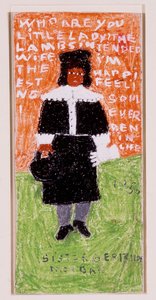
sister gertrude morgan
1900 - 1980 , United States of America
Quick Facts
- Artists Or Movements Influenced By This Artist: ['']
- Artists Who Influenced This Artist: ['']
- Date Of Birth: 1900
- Date Of Death: 1980
- Nationality: American
- Notable Artworks: ['']
- Place Of Birth: WahooArt
Related Articles

Slate Blue Masterpieces: 10 Iconic Paintings & Timeless Home Decor Ideas
Immerse yourself in the captivating world of slate blue! Explore 10 iconic paintings by Monet, Van Gogh & Renoir. Discover their stories, techniques & find museum-quality art reproductions for your home at .
The Allure of Azure: Exploring the Symbolic & Aesthetic Depths of Blue in Art History
Explore the rich history of blue in art! Discover its symbolism, from ancient pigments to modern masterpieces by Kandinsky & Seurat. Uncover the psychological impact and cultural meanings behind this captivating hue.

Crimson Threads of Narrative: Exploring Symbolism & Representation in Artworks Featuring the Red Dress
Explore the rich symbolism of the red dress in art history! From ancient power displays to iconic portraits like Cézanne’s 'Madame Cezanne', discover the cultural and artistic significance behind this captivating color. Expert analysis & insights.
Azure Visions: Exploring Representations of the Blue Dress in Western Art History
Explore the rich history of the blue dress in Western art! Discover its symbolism, from Renaissance masterpieces to modern interpretations by artists like Martin & Schiele. Uncover cultural meanings and artistic techniques.

Echoes of Tradition: Exploring the Enduring Legacy of Folk Art Movements
Explore the rich history of folk art movements worldwide! Discover definitions, notable artists, and the enduring legacy of this captivating tradition. Expert insights & high-quality reproductions at ArtsDot.