 Preview
 Send
Send Share
Share
 Details

 Download
 Similars
 X-Ray
X-Ray Diaporama
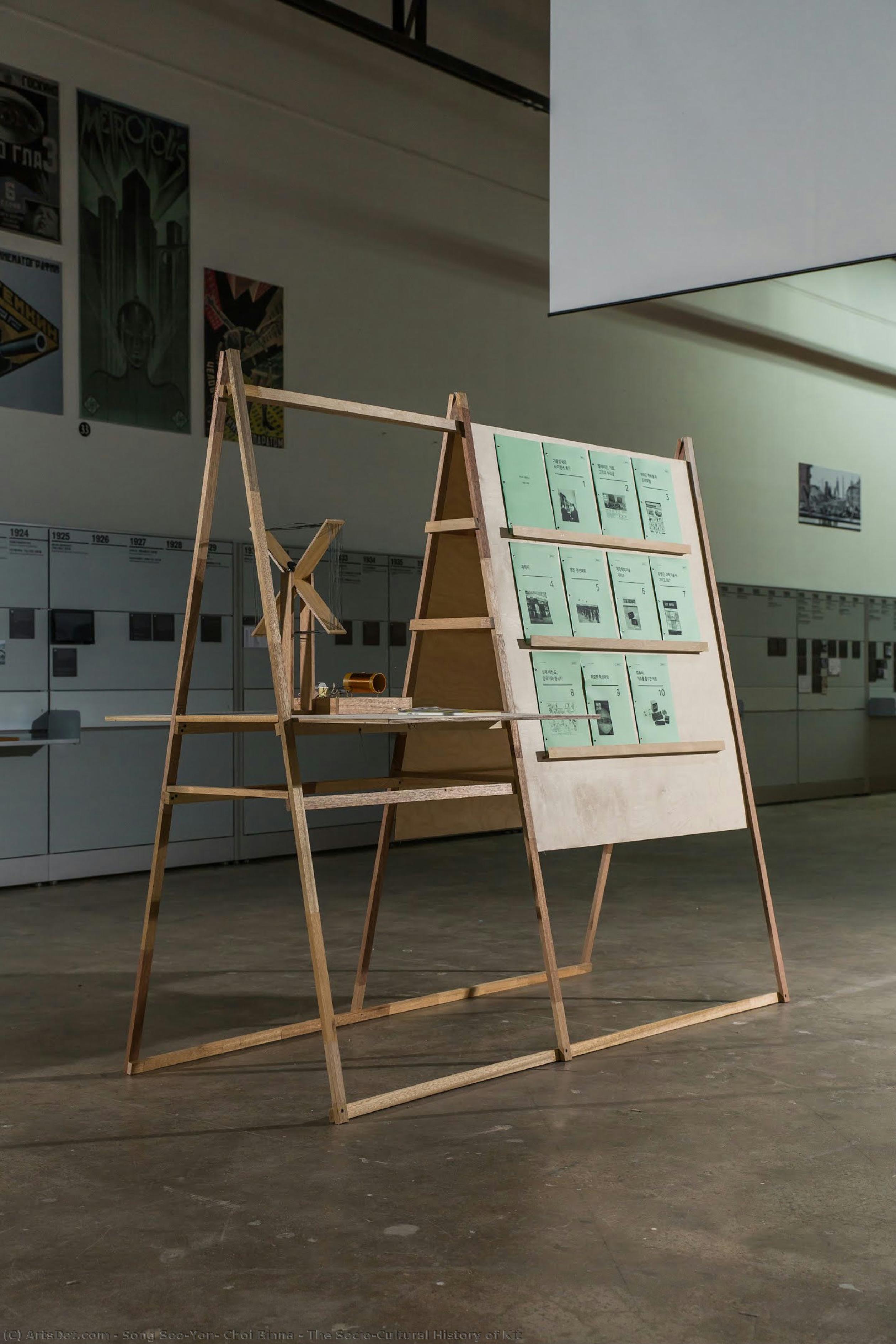
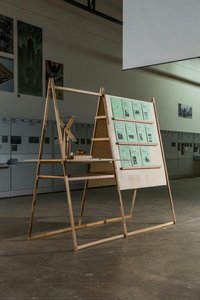
The Socio-Cultural History of Kit
 300.0 x 150.0 cm
 Gwangju Design Biennale
 Read More
Giclée / Art Print
Museum-quality giclée or canvas print with fast production and flexible finish options. ( Buy Hand Made Painting Buy Image)




































Pick from our preset sizes that match the artwork's original proportions.

You may enter your own dimensions to fit a specific frame or space. If your selected size does not match the original image's proportions, we will either crop the artwork or extend the image with a mirrored or solid-fill edge. A digital mockup will be sent for your approval before production begins.
Please note that the on-screen preview does not reflect the actual cropping or extension. Only the mockup will accurately show the final composition.
While custom sizes are available, we recommend selecting a dimension from the predefined list to preserve the original proportions.
Worldwide Delivery () in 2 weeks instead of standard 4/5 weeks. (2 September)

Free Worldwide Express Shipping

High-Quality Linen Canvas

Full Shipping Insurance

Customs Tax Refund Guarantee

True Color Matching Guarantee

60-Day Return Policy (Defects Only)

100% Money-Back Guarantee

Bulk Discount Offer
 Glass option is only available in size under 110 CM

The Socio-Cultural History of Kit
Giclée / Art Print
Reproduction Size
-


Total Price
$ 63
Related Artworks








Artist Biography
The Algorithmic Unmaking: The Visionary World of unmake lab
In the rapidly accelerating pulse of the digital age, where every human movement is translated into a stream of data, the artistic duo known as unmake lab stands as a profound critical force. Comprising South Korean artists Song Soo-Yon and Choi Binna, this collective emerged from Seoul in 2016 with a mission that is as much philosophical as it is technological. They do not merely use technology as a tool; they engage in a deliberate, poetic disruption of the very algorithms that seek to predict and categorize our existence. Their work functions as a "forking" of utopian circuits, a way to break the seamless loop of datafication to reveal the hidden biases, errors, and human textures buried beneath the smooth surface of machine perception.
The intellectual foundation of unmake lab is deeply rooted in a cross-cultural dialogue between Korean contemporary sensibilities and European curatorial rigor. Choi Binna, born in 1977, brought with her a sophisticated understanding of the intersection between art and social structures, having honed her expertise at De Appel in Amsterdam and later serving as director at the Casco Art Institute in Utrecht. This background in curation and institutional critique provided the perfect scaffolding for her collaboration with Song Soo-Yon. Together, they developed a practice that transcends traditional media art, moving into the realm of what might be called techno-ecology—a study of how humans, non-humans, and machines inhabit a shared, often distorted, sensory landscape.
Deconstructing the Digital Mirror
The artistic methodology of unmake lab is characterized by a fascinating process of reverse-tracing. Rather than celebrating the efficiency of modern technology, they seek out its glitches, its distortions, and its failures. By amplifying algorithmic errors, they transform technical "mistakes" into visual and linguistic mechanisms that challenge our trust in digital certainty. Their work often moves from the abstract logic of computation to sculptural, tactile compositions that invite a more visceral engagement with the concept of the post-human.
In their celebrated series, such as Computation/Operation and Whole Data Catalog, the duo explores the way data is harvested and categorized. They delve into the deep structures of contemporary life—real-time algorithms, emotion recognition systems, and generative language models like GPT—to deconstruct the mythical frameworks these technologies produce. Their installations often function as sensory interfaces; for instance, in Rumor in the City and the City, they utilize audio modules and sensors to weave a narrative out of the "rumors" that circulate within information technology societies, treating digital noise as a vital historical record of the unseen.
Their recent explorations have expanded into even more complex territories, including:
- Utopian Extraction: A performance-based inquiry into the ways resources and data are pulled from environments.
- The Variable of Sisyphus: An exploration of repetitive algorithmic labor and its existential implications.
- Ecology for Non-Future: A deep dive into the relationship between technological advancement and ecological survival.
Legacy and the New Cartography of Art
The significance of unmake lab lies in their ability to construct a new cartography of technological aesthetics. They are not merely documenting the present; they are questioning the very direction of our future. Their work is deeply informed by non-Western technological sensibilities, offering a perspective that challenges the dominant, often Eurocentric, narratives of digital progress. By integrating themes of East Asia’s developmental history with post-human sensory systems, they create a space where technology is viewed through a lens of irony, allegory, and profound human vulnerability.
Their growing international prestige has been solidified by prestigious recognitions, most notably being selected as finalists for the 2025 Korea Artist Prize by the National Museum of Modern and Contemporary Art (MMCA). From exhibitions at the Nam June Paik Art Center to showcases in Amsterdam and Abu Dhabi, unmake lab continues to push the boundaries of what media art can achieve. They remind us that even in a world governed by predictive code, there is still room for the unexpected, the unmappable, and the beautifully unmade.
song soo-yon, choi binna
South Korea
Quick Facts
- Artistic Movement Or Style: Algorithmic art
- Full Name: Song Soo-yon; Choi Binna
- Nationality: Korean
- Notable Artworks:
- Rumor in the city and the city
- The socio-cultural history of kit
- Place Of Birth: South Korea