

 Preview
 Send
Send Share
Share
 Details

 Download
 Similars
 X-Ray
X-Ray Diaporama
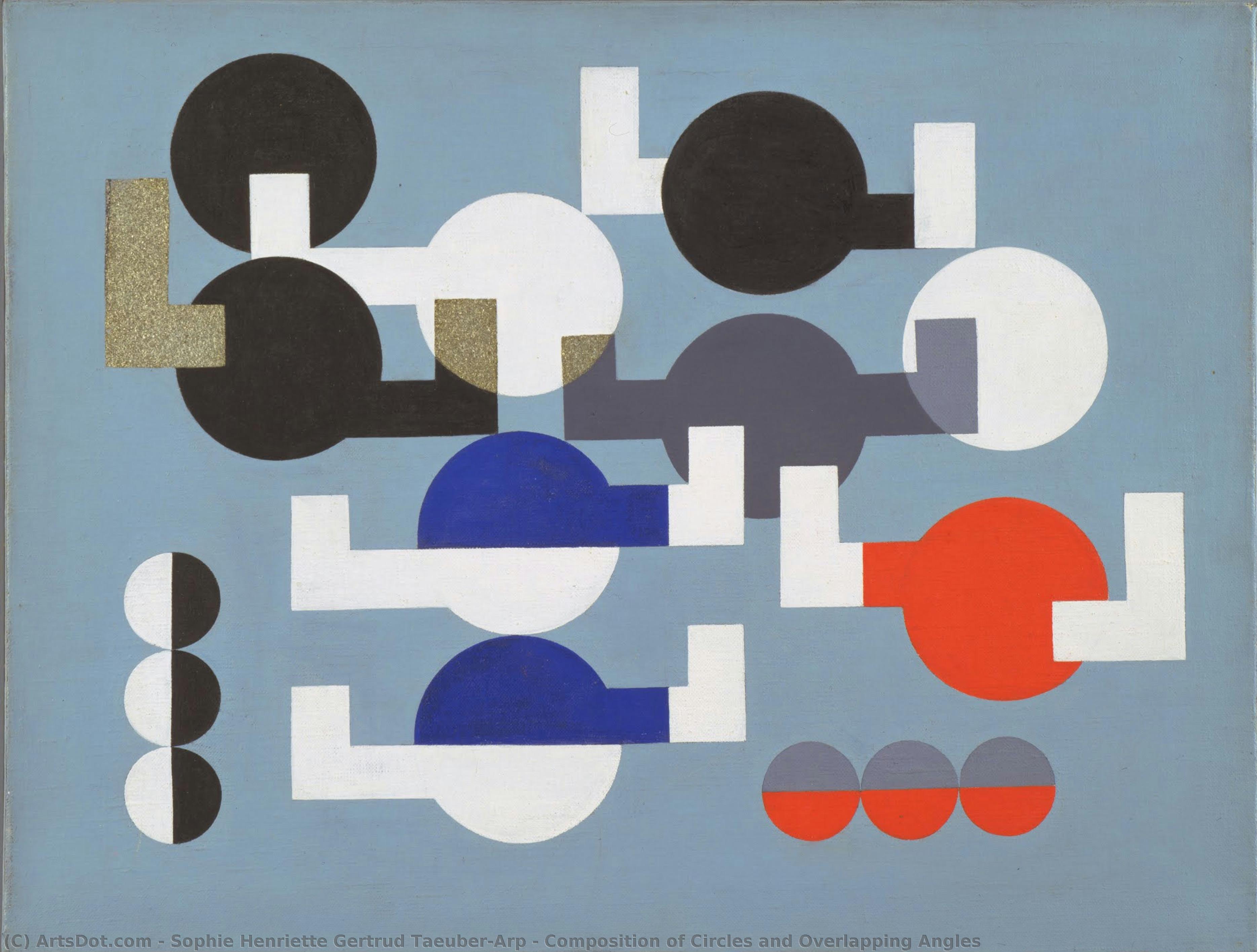
Composition of Circles and Overlapping Angles
 Acrylic On Canvas
- WallArt
- Constructivism
 1930
1930 49.0 x 64.0 cm
 MOMA - Museum of Modern Art
 Read More
Purchase a high-resolution, enhanced digital image, far superior to the online preview.
Each file is meticulously prepared by our in-house specialists using advanced tools and expert manual retouching. We ensure every image has exceptional clarity, precise color accuracy, and fine detail.
The final file is delivered via email within 72 hours, optimized for immediate use in professional, editorial, and print environments. This is the same quality trusted by top-tier design studios, publishers, and galleries.
Digital Image
Download a high-resolution file for personal display, printing, and creative projects. ( Buy Print Buy Hand Made Painting)
Included in Every Digital Image Order
Expert Digital Delivery, Guaranteed
When you choose ArtsDot.com, you're not just getting an image - you're receiving a professionally enhanced digital artwork, crafted with precision and backed by a satisfaction guarantee. Here's everything that comes with your order, automatically:

Fast Email Delivery
Your high-resolution digital image file will be emailed to you within 72 hours of ordering - ready for immediate use.

AI-Enhanced Digital File
Your artwork is professionally optimized using advanced AI tools and manual editing, ensuring maximum detail, clarity, and color accuracy.

Free Lifetime Re-Delivery
Accidentally deleted or lost your file? No worries - we'll resend it to you anytime, free of charge.

No Import Fees - Ever
Enjoy your artwork instantly with zero customs, duties, or delivery fees - digital downloads are always tax-free.

Color Accuracy Guarantee
We ensure your digital image reflects the original colors as closely as possible using professional tools and color management.

60-Day Satisfaction Guarantee
If you're not satisfied with your digital image, we'll revise it or refund 100% within 60 days - no questions asked.

100% Money-Back Guarantee
Not satisfied? Get a full refund within 60 days of receiving your digital file - no questions asked.

Bulk Order Discounts
Buy 3 images, save 10% - Buy 5, save 15% - Buy 10+, save 20%. Great for creative projects, galleries, and agencies.
Collectible Description
Sophie Taeuber-Arp: Composition of Circles and Overlapping Angles – A Geometric Echo of Dada’s Rebellion
Sophie Henriette Gertrud Taeuber-Arp (1889 – 1943) stands as a singular figure in the constellation of early twentieth-century avant-garde art, embodying a remarkable fusion of artistic disciplines—painting, sculpture, textile design, furniture creation, and dance performances. Born in Davos, Switzerland, her journey into artistic expression began with foundational studies at Gewerbeschule St. Gallen, honing skills crucial for crafting functional objects alongside an unwavering passion for visual arts. This dual focus would become the hallmark of her distinctive style: a deliberate juxtaposition of organic forms and geometric precision—a conscious rebellion against prevailing aesthetic conventions that mirrored the turbulent spirit of the Dada movement.The Genesis of Geometric Abstraction
Taeuber’s formative years were steeped in artistic exploration, culminating in enrollment at Bauhaus in Germany where she absorbed the principles of Constructivism – a movement advocating for art as a tool for social reform and rejecting representational illusionism. This influence profoundly shaped her approach to composition, prioritizing clarity and structural integrity over subjective emotion. The resulting artworks eschewed traditional perspective and narrative storytelling, instead presenting simplified shapes—primarily circles and intersecting angles—arranged in harmonious patterns that challenged viewers to reconsider their understanding of visual space. Her exploration into the realm of abstraction wasn’t merely stylistic; it was a deliberate response to the anxieties of the era – a refusal to succumb to the comforting narratives of bourgeois society amidst the horrors of World War I.“Composition of Circles and Overlapping Angles”: A Dada Manifestation
Painted in 1930, “Composition of Circles and Overlapping Angles” exemplifies Taeuber’s commitment to Cercle et Carré—a collective of abstract artists who sought to counteract Surrealism's preoccupation with dreams and irrationality. Executed in oils on canvas with metallic pigments, the artwork embodies a masterful blend of technique and conceptual intent. The careful layering of colors – predominantly blues and whites – contributes to an ethereal quality that belies the geometric rigor underpinning its structure. More than just aesthetically pleasing, it’s a visual embodiment of Dada's core tenets: chance, spontaneity, and a rejection of established artistic hierarchies.Symbolism Within Geometric Precision
The seemingly simple arrangement of circles and angles transcends mere formal consideration; they carry symbolic weight reflecting Taeuber’s fascination with the interplay between order and chaos. Circles represent wholeness and unity—a counterpoint to the fragmented experience of modern life—while intersecting angles symbolize dynamism and transformation, mirroring the movement toward a new artistic language. The artist's deliberate use of these motifs underscores her belief that art could serve as a catalyst for intellectual and emotional engagement, prompting viewers to confront fundamental questions about perception and representation.A Legacy Beyond Form
Sophie Taeuber-Arp’s contribution to the history of art extends far beyond stylistic innovation. Her unwavering dedication to exploring new artistic horizons—from textile design to architectural collaborations—established her as a pioneer of multidisciplinary creativity. “Composition of Circles and Overlapping Angles,” like much of her oeuvre, stands as testament to her conviction that art should be both intellectually stimulating and emotionally resonant – a timeless reminder of the transformative power of geometric abstraction in confronting the complexities of the 20th century.Related Artworks


Artist Biography
The Architect of Abstraction: The Life and Legacy of Sophie Taeuber-Arp
In the turbulent landscape of early 20th-century modernism, few figures possessed the multidisciplinary vision of Sophie Henriette Gertrud Taeuber-Arp. Born in 1889 in the serene Swiss town of Davos, her journey would eventually lead her to the very heart of the avant-garde revolution. She was not merely a painter or a sculptor; she was a weaver of worlds, an artist who dissolved the boundaries between fine art and functional design. Her life’s work stands as a testament to the power of geometric precision married to the spontaneous energy of the human spirit, creating a visual language that remains strikingly contemporary.
Taeuber-Arp’s artistic foundation was built upon a rigorous dedication to craft. Her early education at the Gewerbeschule in St. Gallen provided her with a profound understanding of textiles and design, a skill set that would later become a cornerstone of her abstract vocabulary. This technical mastery was further refined through her studies at influential German art schools, most notably the Bauhaus. It was here that she absorbed the revolutionary principles of modernism—the idea that art should be integrated into the fabric of daily life. Her marriage to the renowned artist Jean Arp in 1922 did more than unite two souls; it forged a creative partnership that would propel her into the epicenter of the Dada movement.
A Rebellion in Form: Dada and the Geometric Spirit
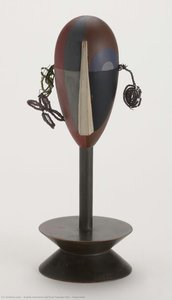
When the shadows of World War I descended upon Europe, Taeuber-Arp found herself part of the radical Dadaist circle in Cologne. While many associated Dada with chaos and nihilism, Sophie brought a unique structural discipline to its rebellion. She embraced the movement's anti-rationalist ethos, yet she infused it with a meticulous sense of composition. Her iconic “Dada Head” serves as a breathtaking example of this duality; by utilizing assemblage techniques involving geometric shapes and textile fragments, she rejected traditional sculptural norms in favor of a new, fragmented reality that mirrored the fractured world around her.
As her career progressed, her work transitioned from the provocative spontaneity of Dada toward the structured elegance of Constructivism and Concrete Art. This evolution is beautifully captured in her various masterpieces:
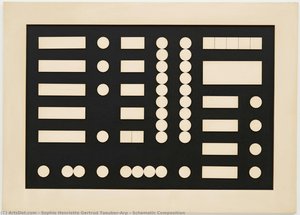
- Schematic Composition (1933): A vibrant oil on board that demonstrates her ability to use color and geometry to create a sense of playful, rhythmic movement.
- Composition of Circles and Overlapping Angles (1930): An iconic exploration of how geometric precision can evoke organic, fluid energy within a Constructivist framework.
- Shells and Flowers (1938): A delicate paper cut that showcases her mastery of minimalism, using radial design and stark contrast to find beauty in the simplest of forms.
The Enduring Resonance of a Visionary
The historical significance of Sophie Taeuber-Arp lies in her refusal to be confined by medium or label. She moved seamlessly between the tactile world of textile design, the structural demands of furniture creation, and the ethereal realms of dance and painting. Her ability to blend organic forms with mathematical precision allowed her to bridge the gap between the natural world and the industrial age. She did not just observe the changing tides of modernism; she helped direct them.
Though her life was tragically cut short in 1943, her influence continues to ripple through the history of abstract art. Today, we recognize her as a pioneer who saw the potential for profound beauty in the grid, the circle, and the line. Her legacy is found in every modern design that seeks harmony between function and aesthetic, reminding us that true innovation often requires the courage to break old forms to build entirely new ones.
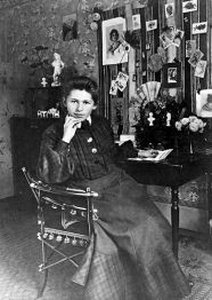
sophie henriette gertrud taeuber-arp
1889 - 1943 , Switzerland
Quick Facts
- Artistic Movement Or Style: Dada, Constructivism & Concrete Art
- Artists Or Movements Influenced By This Artist: ['Vienna Exhibition']
- Artists Who Influenced This Artist: ['Jean Arp']
- Date Of Birth: 19 January 1889
- Date Of Death: 13 January 1943
- Full Name: Sophie Henriette Gertrud Taeuber-Arp
- Nationality: Swiss
- Notable Artworks:
- Dada Head
- Plate (folio 24)
- Sophie Taeuber-Arp
- Place Of Birth: Davos, Switzerland

