

 Preview
 Send
Send Share
Share
 Details

 Download
 Similars
 X-Ray
X-Ray Diaporama
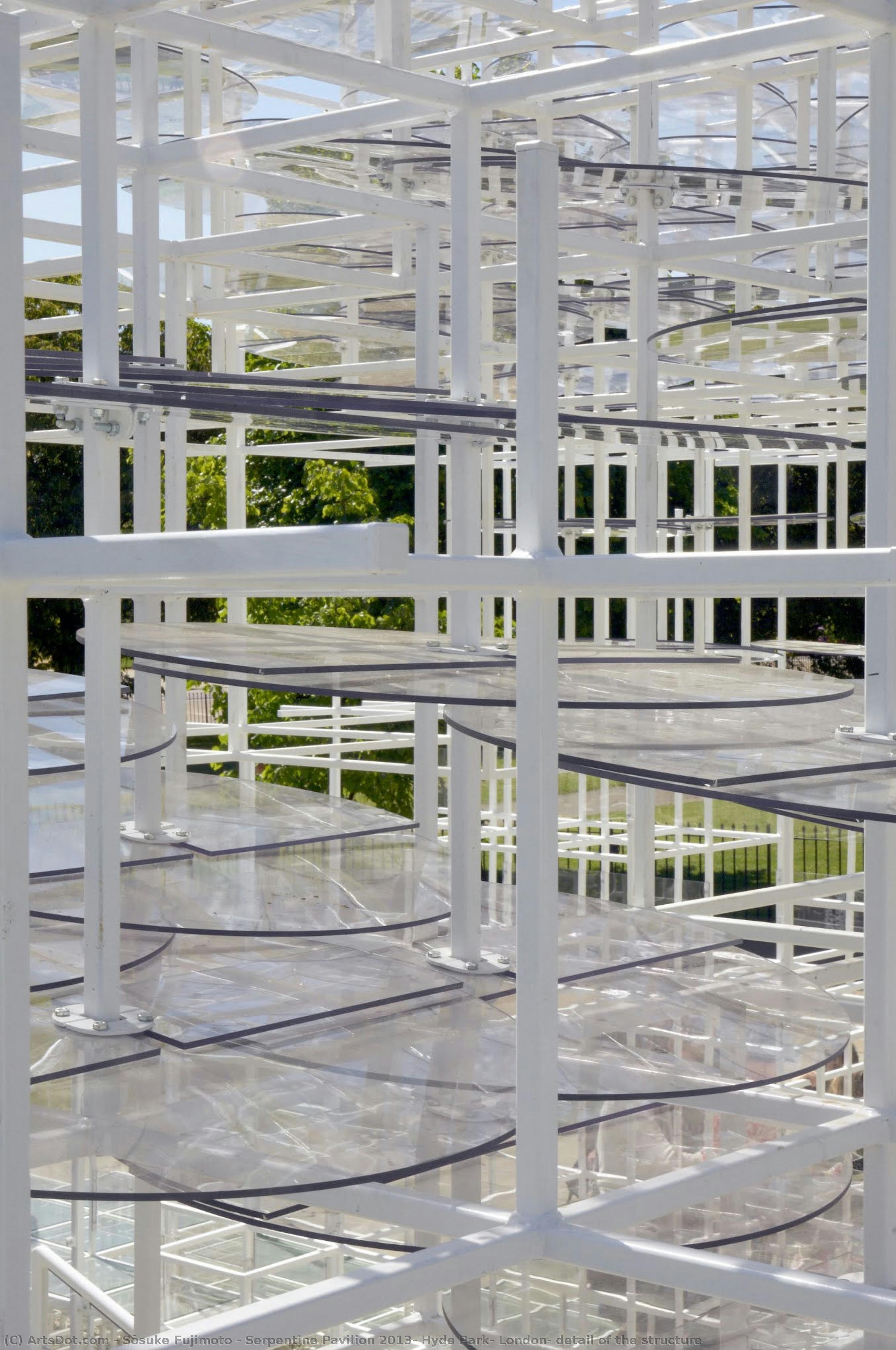
Serpentine Pavilion 2013, Hyde Park, London: detail of the structure


 Read More
Purchase a high-resolution, enhanced digital image, far superior to the online preview.
Each file is meticulously prepared by our in-house specialists using advanced tools and expert manual retouching. We ensure every image has exceptional clarity, precise color accuracy, and fine detail.
The final file is delivered via email within 72 hours, optimized for immediate use in professional, editorial, and print environments. This is the same quality trusted by top-tier design studios, publishers, and galleries.
Digital Image
Download a high-resolution file for personal display, printing, and creative projects. ( Buy Print Buy Hand Made Painting)
Included in Every Digital Image Order
Expert Digital Delivery, Guaranteed
When you choose ArtsDot.com, you're not just getting an image - you're receiving a professionally enhanced digital artwork, crafted with precision and backed by a satisfaction guarantee. Here's everything that comes with your order, automatically:

Fast Email Delivery
Your high-resolution digital image file will be emailed to you within 72 hours of ordering - ready for immediate use.

AI-Enhanced Digital File
Your artwork is professionally optimized using advanced AI tools and manual editing, ensuring maximum detail, clarity, and color accuracy.

Free Lifetime Re-Delivery
Accidentally deleted or lost your file? No worries - we'll resend it to you anytime, free of charge.

No Import Fees - Ever
Enjoy your artwork instantly with zero customs, duties, or delivery fees - digital downloads are always tax-free.

Color Accuracy Guarantee
We ensure your digital image reflects the original colors as closely as possible using professional tools and color management.

60-Day Satisfaction Guarantee
If you're not satisfied with your digital image, we'll revise it or refund 100% within 60 days - no questions asked.

100% Money-Back Guarantee
Not satisfied? Get a full refund within 60 days of receiving your digital file - no questions asked.

Bulk Order Discounts
Buy 3 images, save 10% - Buy 5, save 15% - Buy 10+, save 20%. Great for creative projects, galleries, and agencies.
Related Artworks







Artist Biography
A Vision of Primitive Futures: The Architectural Poetry of Sou Fujimoto
Born in 1971 on the northern Japanese island of Hokkaido, Sosuke Fujimoto emerged as a distinctive voice in contemporary architecture—a voice not shouting for attention but whispering possibilities. His work isn’t about imposing structures onto landscapes; it's about coaxing them forth, revealing latent connections between nature and human existence. Fujimoto’s childhood explorations within the wooded expanses of Hokkaido proved formative, instilling a deep reverence for the natural world that would become the cornerstone of his design philosophy. He wasn’t captivated by grand monuments but by the subtle intricacies of forests, caves, and the ephemeral qualities of light filtering through leaves—experiences he later described as foundational to his understanding of space.
Early Life and Academic Foundations
Fujimoto pursued formal training at the University of Tokyo's Faculty of Engineering, graduating in 1994. This academic grounding provided a technical framework for his burgeoning ideas, but it was after establishing his own practice, Sou Fujimoto Architects, in 2000 that his unique vision truly began to take shape. Early projects, though relatively small in scale, immediately signaled a departure from conventional architectural norms. He wasn’t interested in defining buildings by their function alone; instead, he sought to create spaces that were open-ended, adaptable, and responsive to the rhythms of human life. The Aomori Museum of Art Design Competition Proposal in 2000, where he received an Award of Merit, marked a pivotal moment—a public recognition of his innovative approach.
The “Primitive Future” Philosophy
Central to Fujimoto’s work is the concept of "primitive future," a notion articulated in his influential book of the same name published in 2008. This isn't a nostalgic yearning for bygone eras but rather an exploration of humanity’s earliest relationships with shelter and environment. He draws inspiration from caves, grottoes—spaces where form is dictated by natural processes and human behavior organically shapes the interior. This philosophy translates into designs that prioritize permeability, lightness, and a blurring of boundaries between inside and outside. His structures often appear to dissolve into their surroundings, fostering a sense of harmony rather than dominance. He aims for an architecture that isn’t simply *in* nature but *of* nature.
Major Achievements and International Recognition
Fujimoto's career has been punctuated by a series of critically acclaimed projects that have garnered international attention. The Serpentine Gallery Pavilion in London (2013) was a watershed moment, showcasing his delicate lattice-like structure—a cloud-like form inviting interaction and contemplation. Other notable works include House NA (2011), a residence designed as a series of interconnected platforms; the Musashino Art University Library (2010), which reimagines the library as a dynamic social space; and L’Arbre Blanc in Montpellier, France (2019)—a striking residential complex resembling a cluster of white trees. More recently, his appointment as Site Design Producer for Expo 2025 Osaka, Kansai, Japan, underscores his growing influence on the global stage, particularly with the ambitious Grand Ring project—the largest wooden structure in the world.
Historical Significance and Lasting Impact
Sou Fujimoto’s contribution to architecture lies not merely in aesthetic innovation but in a fundamental shift in perspective. He challenges the traditional notion of buildings as static objects, instead envisioning them as dynamic ecosystems that evolve with their inhabitants and surroundings. His work resonates deeply within contemporary discussions about sustainability, community, and the human-nature connection. He has inspired a new generation of architects to prioritize experiential qualities over purely functional concerns, fostering a more holistic and sensitive approach to design. Fujimoto’s legacy is not simply in the structures he creates but in the questions he poses—questions about how we inhabit space, how we relate to the natural world, and what it means to build for a future that embraces both innovation and tradition. His architecture isn't just about shelter; it’s about creating moments of wonder, fostering connection, and reminding us of our place within the larger tapestry of life.

sōsuke fujimoto
1971 - , Japan
Quick Facts
- Artistic Movement Or Style: Primitive Future
- Artists Who Influenced This Artist: ['Antonio Gaudi']
- Date Of Birth: 1971
- Full Name: Sosuke Fujimoto
- Nationality: Japanese
- Notable Artworks:
- Final Wooden House
- House N
- Serpentine Pavilion
- Place Of Birth: Hokkaido, Japan

