 Preview
 Send
Send Share
Share
 Details

 Download
 Similars
 X-Ray
X-Ray Diaporama
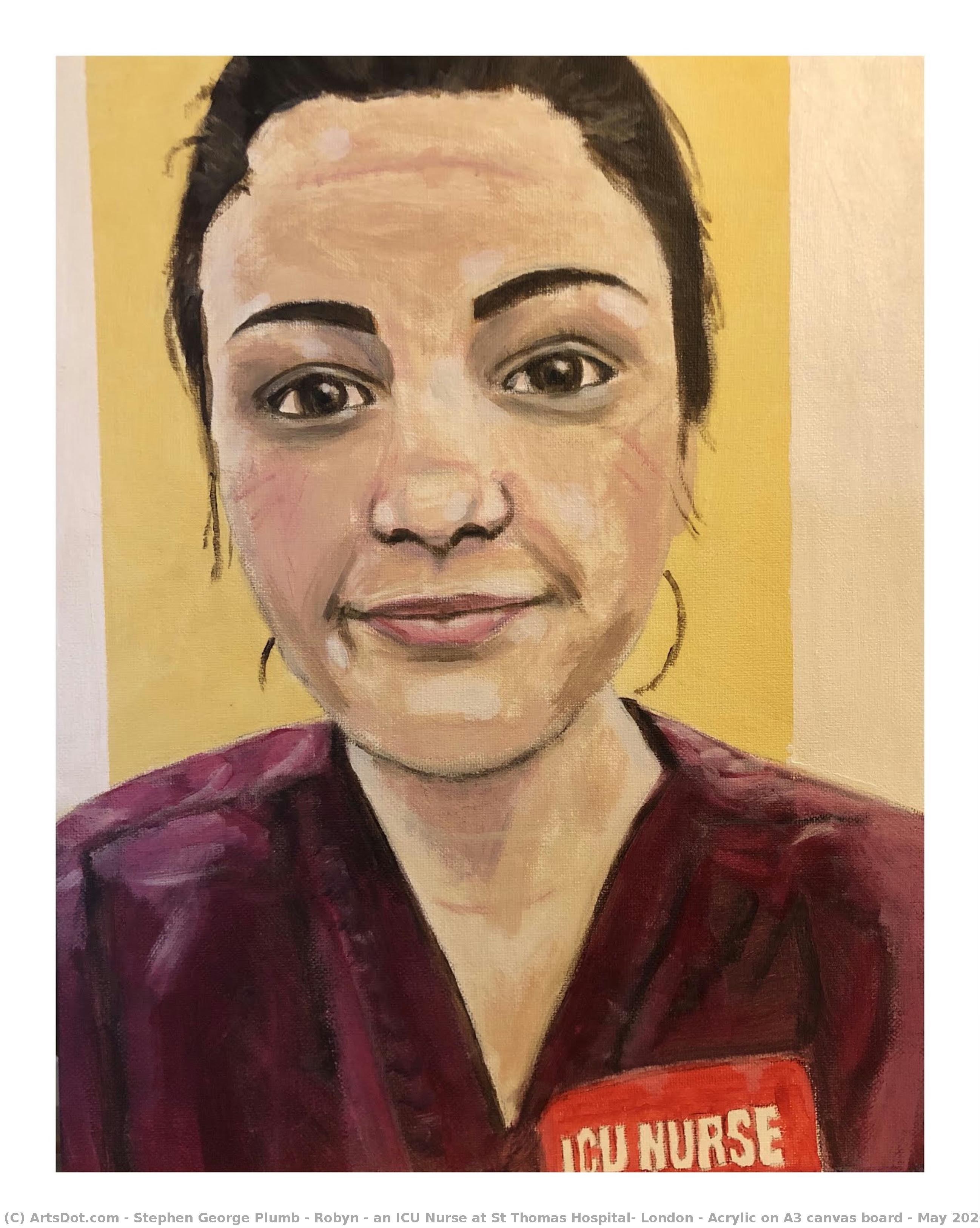
Robyn - an ICU Nurse at St Thomas Hospital, London - Acrylic on A3 canvas board - May 2020)
 2020
2020 32.0 x 24.0 cm
 Paintings in Hospitals
 Read More
Hand Made Oil Reproduction
Hand-painted oil on canvas in your size and frame, made to order by our artists. ( Buy Print Buy Image)




































Pick from our preset sizes that match the artwork's original proportions.

You may enter your own dimensions to fit a specific frame or space. If your selected size does not match the original image's proportions, we will either crop the artwork or extend the painting with additional hand-painted elements. A digital mockup will be sent for your approval before production begins.
Please note that the on-screen preview does not reflect the actual cropping or extension. Only the mockup will accurately show the final composition.
While custom sizes are available, we recommend selecting a dimension from the predefined list to preserve the original proportions.
After order, ArtsDot.com team will email client for instructions and provide a mockup preview
Worldwide Delivery () in 3/4 weeks instead of standard 5 weeks. (27 August). No compromise on quality.

Free Worldwide Express Shipping

High-Quality Linen Canvas

Full Shipping Insurance

Customs Tax Refund Guarantee

True Color Matching Guarantee

60-Day Return Policy (Defects Only)

100% Money-Back Guarantee

Bulk Discount Offer
 Glass option is only available in size under 110 CM

Robyn - an ICU Nurse at St Thomas Hospital, London - Acrylic on A3 canvas board - May 2020)
Reproduction Medium
Reproduction Size
-


Total Price
$ 263
Related Artworks








Artist Biography
Henri Matisse: A Life Painted in Color
Born Henri Émile Benoît Matisse on December 31, 1869, in Cateau-Cambrésis, France, Matisse’s journey to becoming one of the most influential artists of the 20th century was marked by a relentless pursuit of color and form. His life spanned nearly nine decades, witnessing and profoundly shaping the evolution of modern art. From his early struggles with artistic recognition to his later mastery of decorative abstraction, Matisse's career is a testament to the power of observation, experimentation, and an unwavering belief in the expressive potential of visual language.
Early Years and Artistic Development
Matisse’s formal training began at the École des Beaux-Arts in Paris, where he initially focused on academic painting. However, he quickly grew disillusioned with the rigid conventions of the time, seeking a more personal and vibrant approach to art. Influenced by Impressionism and Post-Impressionism – particularly the bold color palettes of Paul Gauguin and Vincent van Gogh – Matisse began to develop his distinctive style. His early works, such as *Woman with a Hat* (1905) and *The Joy of Life* (1906), demonstrate this shift, showcasing flattened forms, simplified figures, and an increasingly expressive use of color. These pieces established him as part of the burgeoning Fauvist movement, characterized by its intense, non-naturalistic hues.
Fauvism and Beyond: A Search for Harmony
The term “Fauves” (French for "wild beasts") was initially applied to Matisse and his fellow artists – André Derain, Maurice de Vlaminck, and Raoul Dufy – due to the startling intensity of their color palettes. Matisse’s exploration continued beyond the purely chromatic, delving into a more refined approach that sought harmony between form and color. He moved to Nice in 1917, seeking respite from the pressures of Paris and embracing the Mediterranean light and landscape. This period saw the development of his signature style – characterized by bold outlines, simplified shapes, and a focus on decorative patterns. Works like *The Red Studio* (1911) exemplify this shift towards abstraction, prioritizing visual impact over realistic representation.
Mature Style and Legacy
In his later years, Matisse’s style became increasingly lyrical and introspective. He experimented with paper cutouts – a technique he discovered while recovering from illness – creating collages that celebrated the beauty of simple shapes and vibrant colors. These works, often imbued with a sense of tranquility and joy, represent a culmination of his lifelong pursuit of harmony and balance. His influence on subsequent generations of artists is undeniable; he paved the way for abstract expressionism and continues to inspire artists today with his innovative use of color and form. Matisse’s legacy extends beyond painting, impacting design, textiles, and even theater.
Key Works and Historical Significance
- Woman with a Hat (1905): A pivotal work demonstrating the early adoption of Fauvist techniques.
- The Red Studio (1911): A landmark example of Matisse’s exploration of decorative abstraction.
- Dance (1909): Captures movement and rhythm through simplified forms and vibrant colors.
- Blue Nude (1908): Illustrates his interest in exploring the human figure with a focus on color and form.
- Paper Cutouts (1930s-1954): A late-career innovation that showcased his mastery of composition and color.
Henri Matisse died on November 3, 1954, leaving behind a vast and influential body of work. His unwavering commitment to artistic exploration, coupled with his profound understanding of color and form, cemented his place as one of the most important artists of the 20th century – an artist who dared to paint joyfully, boldly, and without compromise.
stephen george plumb
1954 - , United Kingdom
Quick Facts
- Artistic Movement Or Style: Fauvism, Modernism, Post-Impressionism
- Artists Or Movements Influenced By This Artist:
- André Derain
- Maurice de Vlaminck
- Fauvism
- Artists Who Influenced This Artist:
- Paul Gauguin
- Vincent van Gogh
- Edgar Degas
- Date Of Birth: December 31, 1869
- Date Of Death: November 3, 1954
- Full Name: Henri Matisse
- Nationality: French
- Notable Artworks:
- Woman with a Hat
- The Joy of Life
- Blue Nude (Souvenir de Biskra)
- Dance
- Red Studio
- The Snail
- Place Of Birth: Le Cateau-Cambrésis, France