

 Preview
 Send
Send Share
Share
 Details

 Download
 Similars
 X-Ray
X-Ray Diaporama
Fazenda (Ilustração para


 Read More
Purchase a high-resolution, enhanced digital image, far superior to the online preview.
Each file is meticulously prepared by our in-house specialists using advanced tools and expert manual retouching. We ensure every image has exceptional clarity, precise color accuracy, and fine detail.
The final file is delivered via email within 72 hours, optimized for immediate use in professional, editorial, and print environments. This is the same quality trusted by top-tier design studios, publishers, and galleries.
Digital Image
Download a high-resolution file for personal display, printing, and creative projects. ( Buy Print Buy Hand Made Painting)
Included in Every Digital Image Order
Expert Digital Delivery, Guaranteed
When you choose ArtsDot.com, you're not just getting an image - you're receiving a professionally enhanced digital artwork, crafted with precision and backed by a satisfaction guarantee. Here's everything that comes with your order, automatically:

Fast Email Delivery
Your high-resolution digital image file will be emailed to you within 72 hours of ordering - ready for immediate use.

AI-Enhanced Digital File
Your artwork is professionally optimized using advanced AI tools and manual editing, ensuring maximum detail, clarity, and color accuracy.

Free Lifetime Re-Delivery
Accidentally deleted or lost your file? No worries - we'll resend it to you anytime, free of charge.

No Import Fees - Ever
Enjoy your artwork instantly with zero customs, duties, or delivery fees - digital downloads are always tax-free.

Color Accuracy Guarantee
We ensure your digital image reflects the original colors as closely as possible using professional tools and color management.

60-Day Satisfaction Guarantee
If you're not satisfied with your digital image, we'll revise it or refund 100% within 60 days - no questions asked.

100% Money-Back Guarantee
Not satisfied? Get a full refund within 60 days of receiving your digital file - no questions asked.

Bulk Order Discounts
Buy 3 images, save 10% - Buy 5, save 15% - Buy 10+, save 20%. Great for creative projects, galleries, and agencies.
Collectible Description
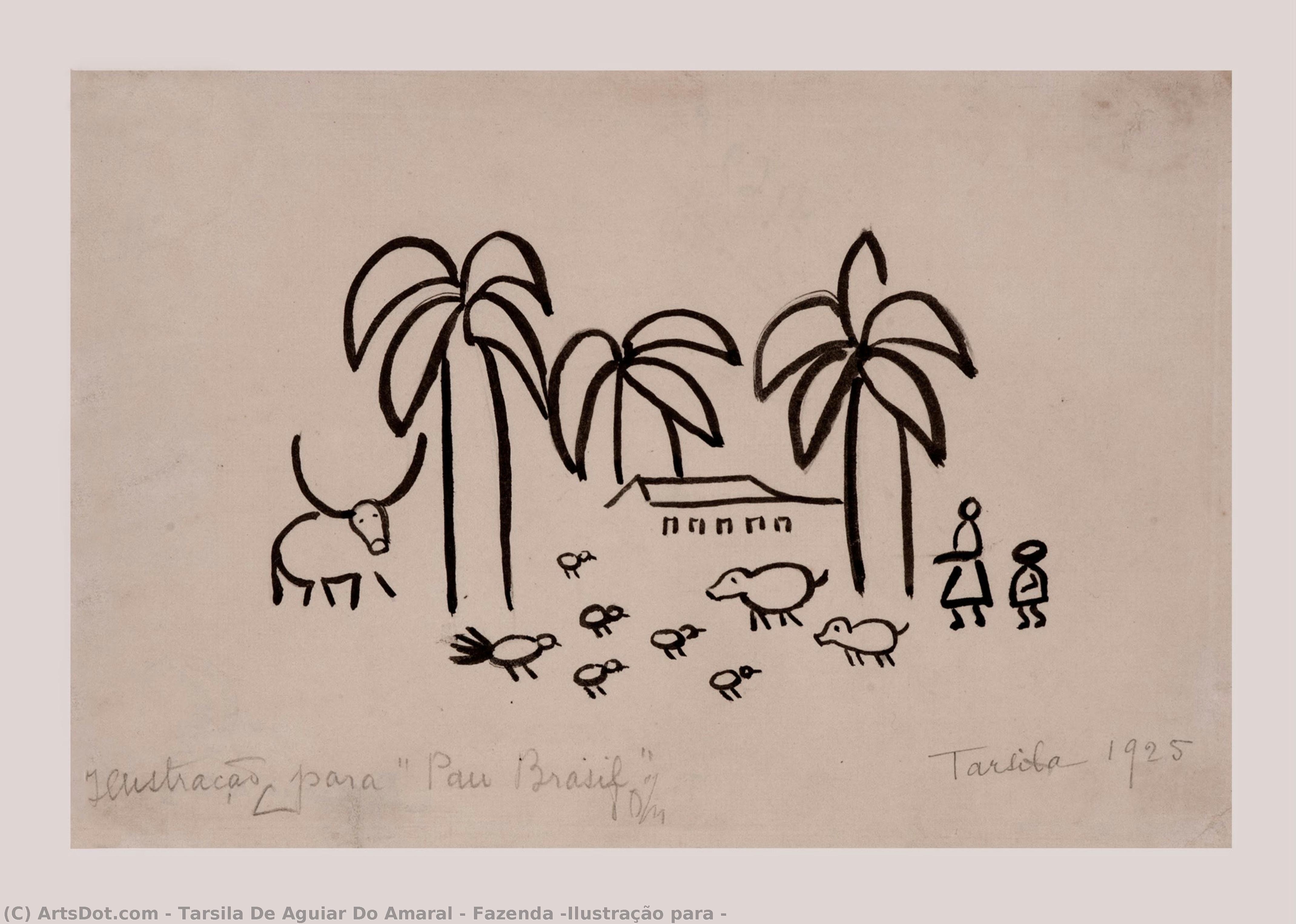
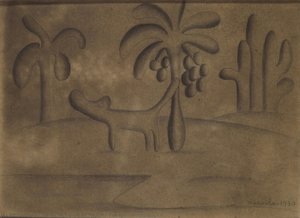
Fazenda (Ilustração para “Pau Brasil”) – A Vision of Brazilian Identity
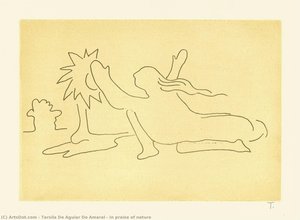
The artwork presents a stylized and simplified depiction of a farm scene, likely inspired by Brazilian rural life. It’s rendered in black ink on what appears to be off-white paper, creating a monochromatic aesthetic. The composition is relatively simple, with elements arranged across the frame without a strong sense of depth or perspective. This deliberate flatness speaks to the broader modernist movement's rejection of traditional representational conventions and aligns powerfully with Tarsila do Amaral’s pioneering approach to capturing the spirit of Brazil in the 1920s.Composition & Visual Elements
The artwork utilizes a central grouping of figures and animals around which the scene revolves. Palm trees dominate the background, acting as vertical anchors on either side of the composition. A man riding a horse occupies a prominent position in the foreground, while various farm animals (cows, sheep, an elephant, birds) are scattered across the midground. The arrangement feels somewhat flattened and lacks traditional perspective cues—a conscious decision that prioritizes conveying emotion and symbolic resonance over realistic spatial representation. Lines are paramount; they define shapes and forms with a purposeful simplicity, contributing to the artwork’s graphic quality. Outlines are prominent, emphasizing the contours of figures and objects.Style & Technique: Embracing Cubism's Influence
The style is best described as modernist, heavily influenced by Cubism and early Brazilian modernism—specifically mirroring Tarsila do Amaral’s artistic explorations during her formative years in Paris. Like Picasso and Braque, she fragmented forms into geometric planes, disrupting conventional viewpoints to express a more profound understanding of the subject matter. The technique involves direct line drawing without shading or blending; this deliberate restraint enhances the artwork's clarity and focuses attention on essential visual elements. It’s a masterful demonstration of how simplification can amplify artistic impact.Symbolism & Emotional Resonance
Beyond its aesthetic qualities, “Fazenda” carries symbolic weight, reflecting Tarsila do Amaral’s broader engagement with Antropofagia – “cannibalization of European culture.” The inclusion of an elephant—a creature rarely depicted in Brazilian art at the time—represents a deliberate challenge to established artistic conventions and serves as a visual metaphor for embracing indigenous traditions alongside Western influences. The artwork evokes a sense of nostalgia, capturing the essence of rural Brazil’s beauty and simplicity while subtly hinting at a critique of its perceived limitations. It's an invitation to contemplate identity and heritage through a uniquely modernist lens.Historical Context & Artistic Legacy
Created in 1925, “Fazenda” emerged during a period of intense artistic experimentation in Brazil—a movement spearheaded by artists like Oswald de Andrade and Anita Malfatti who sought to forge a distinctly Brazilian visual language. Tarsila do Amaral’s work stands as a cornerstone of this era, establishing her reputation as one of Latin America's foremost modernist painters. Her distinctive style continues to inspire contemporary artists and collectors alike, cementing “Fazenda”’s place within the canon of Brazilian art history.Related Artworks

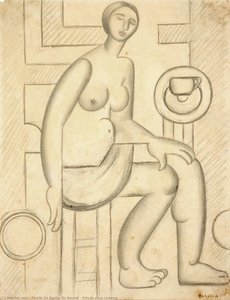
Artist Biography
A Brazilian Visionary: The Life and Art of Tarsila do Amaral
Tarsila do Amaral emerged as a pivotal figure in the vibrant tapestry of early 20th-century Brazilian art, a painter who dared to distill the essence of her nation’s identity onto canvas with bold colors and an innovative spirit. Born on September 1, 1886, in Capivari, São Paulo, into a prosperous coffee-producing family, Tarsila's upbringing afforded her opportunities uncommon for women of her time. This privilege allowed her to pursue artistic training, initially under the guidance of Pedro Alexandrino Borges before embarking on a transformative journey to Paris in 1920. It was within the walls of the Académie Julian and later the Académie Moderne that she encountered the avant-garde currents reshaping the art world – Cubism, Futurism, and Expressionism – influences that would profoundly shape her artistic trajectory. The mentorship of Fernand Léger, Albert Gleizes, and André Lhote proved particularly impactful, encouraging her to synthesize European modernism with a distinctly Brazilian sensibility.Forging a National Identity Through Art
Upon returning to Brazil in the early 1920s, Tarsila became a central force in defining a uniquely Brazilian modernist tradition. She wasn’t simply importing European styles; she was actively seeking to create an art that spoke to the soul of her nation, reflecting its landscapes, people, and cultural complexities. This quest led her to collaborate with a group of like-minded artists and intellectuals – Anita Malfatti, Menotti Del Picchia, Mário de Andrade, and Oswald de Andrade – collectively known as *Grupo dos Cinco*. Together, they challenged conventional artistic norms and spearheaded a movement that sought to break free from academic constraints and embrace a new visual language. Tarsila’s contribution was particularly significant in articulating this vision through her paintings, which often depicted scenes of Brazilian life with a dreamlike quality and vibrant palette.The Power of *Abaporu* and the Antropofagia Movement
Perhaps no single work embodies Tarsila's artistic philosophy more powerfully than *Abaporu* (1928). This iconic painting, depicting a solitary figure with oversized feet seated amidst a surreal landscape, became the catalyst for one of Brazil’s most influential cultural movements: Antropofagia – or “cannibalism.” Inspired by Oswald de Andrade's manifesto of the same name, Antropofagia proposed that Brazilian artists should "devour" foreign influences and transform them into something uniquely their own. *Abaporu* visually captured this concept, representing a rejection of colonial imitation and an embrace of cultural hybridity. The painting’s imagery – the large feet rooted in the land, the enigmatic expression – resonated deeply with a nation grappling with its identity in the wake of independence. It wasn't merely a work of art; it was a declaration of artistic sovereignty. Beyond *Abaporu*, works like *A Negra* (1923) and *Morro da Favela* demonstrated her engagement with social themes, portraying marginalized communities and challenging prevailing societal norms.Legacy and Enduring Influence
Throughout her long and prolific career, Tarsila do Amaral continued to explore the complexities of Brazilian identity through a diverse body of work. Her paintings are characterized by their bold colors, simplified forms, and dreamlike atmosphere, often blending elements of realism with surrealism and abstraction. She didn’t shy away from experimentation, constantly evolving her style while remaining true to her core vision. Her influence extended beyond the realm of painting, inspiring generations of Brazilian artists and shaping the nation's cultural landscape. Today, Tarsila do Amaral’s works are held in prestigious collections worldwide, including the Museu de Valores do Banco Central do Brasil and the Museu de Arte do Rio Grande do Sul. Her art continues to captivate audiences with its vibrant energy, poetic imagery, and profound exploration of what it means to be Brazilian. She passed away on January 17, 1973, leaving behind a legacy as one of Latin America’s most important modernist artists – a visionary who dared to paint her nation's soul.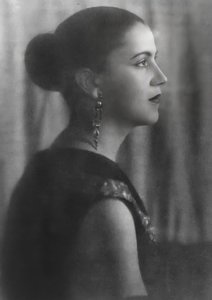
Tarsila do Amaral
1886 - 1973 , Brazil
Quick Facts
- Artistic Movement Or Style: Brazilian Modernism
- Artists Or Movements Influenced By This Artist: ['Antropofagia movement']
- Artists Who Influenced This Artist:
- Fernand Léger
- Albert Gleizes
- André Lhote
- Date Of Birth: September 1, 1886
- Date Of Death: January 17, 1973
- Full Name: Tarsila do Amaral
- Nationality: Brazilian
- Notable Artworks:
- Abaporu
- A Negra
- Morro da favela
- Urutu Snake
- Landscape VII
- Place Of Birth: São Paulo, Brazil

