 Preview
 Send
Send Share
Share
 Details

 Download
 Similars
 X-Ray
X-Ray Diaporama
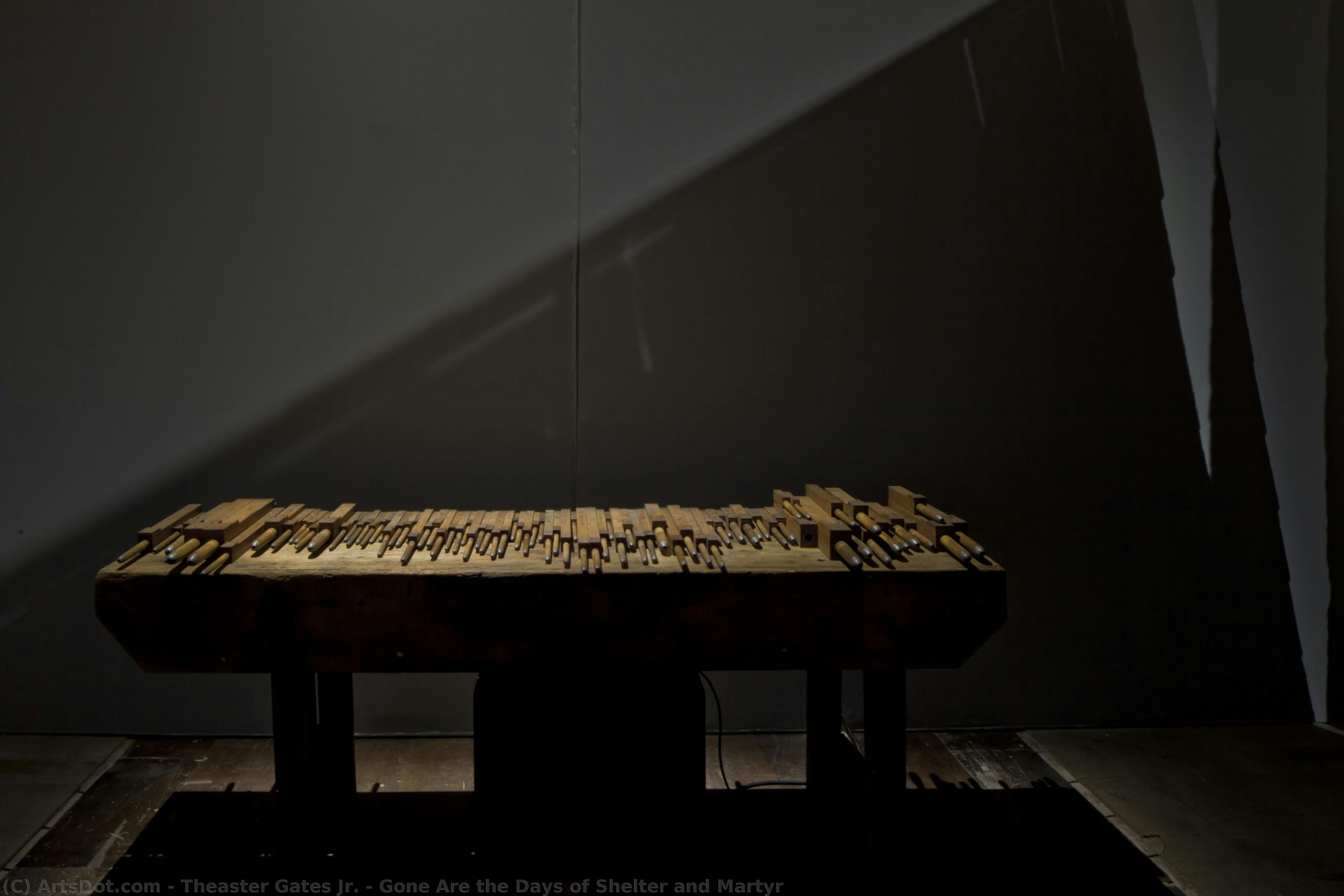
Gone Are the Days of Shelter and Martyr


 Read More
Giclée / Art Print
Museum-quality giclée or canvas print with fast production and flexible finish options. ( Buy Hand Made Painting Buy Image)




P118B $10

P118H $10

P118W $10

P438Z $10

P508JH $12

P508YH $12

P805H $10

P805Z $10

P919BZ $10

P919G $10

P919XJ $10

P959ZH $10

P968JZ $12

W106C $8

W218G $10

W218JH $8

W218Y $10

W307PJ $10

W316G $10

W316PJ $8

W316Y $10

W398PJ $8

W4111J $10

W500HY $15

W500JH $15

W692G $12

W849H $8

W940BG $15

W953PJ $8




Pick from our preset sizes that match the artwork's original proportions.

You may enter your own dimensions to fit a specific frame or space. If your selected size does not match the original image's proportions, we will either crop the artwork or extend the image with a mirrored or solid-fill edge. A digital mockup will be sent for your approval before production begins.
Please note that the on-screen preview does not reflect the actual cropping or extension. Only the mockup will accurately show the final composition.
While custom sizes are available, we recommend selecting a dimension from the predefined list to preserve the original proportions.
Worldwide Delivery () in 2 weeks instead of standard 4/5 weeks. (30 August)

Free Worldwide Express Shipping

High-Quality Linen Canvas

Full Shipping Insurance

Customs Tax Refund Guarantee

True Color Matching Guarantee

60-Day Return Policy (Defects Only)

100% Money-Back Guarantee

Bulk Discount Offer
 Glass option is only available in size under 110 CM

Gone Are the Days of Shelter and Martyr
Giclée / Art Print
Reproduction Size
-


Total Price
$ 63
The Alchemy of Memory: Reclaiming the Sacred
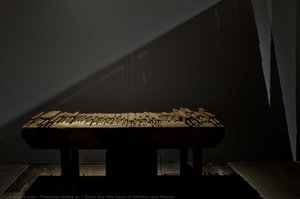
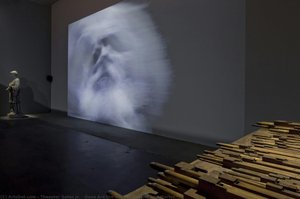
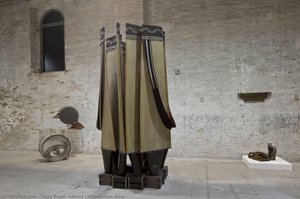
In the profound stillness of Theaster Gates Jr.’s 2014 installation, “Gone Are the Days of Shelter and Martyr,” one does not merely encounter an object, but rather a visceral encounter with history itself. Created for the prestigious Venice Biennale, this work serves as a hauntingly beautiful meditation on the intersection of urban decay and spiritual resilience. The piece is far more than a sculptural assemblage; it is a reconstructed sanctuary, pulling the viewer into a dialogue between what has been lost to time and what can be salvaged through the transformative power of art. Through his masterful use of reclaimed materials, Gates invites us to witness the heavy, palpable weight of memory that lingers in the spaces we inhabit.
The composition is anchored by a monumental table, a centerpiece that commands the room with its rugged, weathered presence. The surface, a striking fusion of old wood and concrete, bears the indelible scars of its previous life. This is not mere decoration; it is material alchemy. By utilizing structural timbers and concrete fragments salvaged from the demolished St. Laurence Catholic Church in Chicago’s South Side, Gates breathes new life into the debris of disinvestment. The table stands as a silent witness to the economic turbulence that has reshaped Black neighborhoods, turning the very remnants of a vanished parish into a foundation for contemporary contemplation.
A Symphony of Imperfection and Resilience
The aesthetic soul of this work is deeply rooted in the Japanese philosophy of wabi-sabi—the celebration of imperfection, transience, and the beauty found within the aged and broken. There is no attempt here to mask the cracks or smooth over the rough edges; instead, Gates elevates the patina of decay. The presence of a meticulously restored piano in the background adds a layer of melodic longing to the scene, suggesting that even within abandoned or neglected spaces, the potential for beauty and restorative action remains vibrant. This juxtaposition of the heavy, industrial concrete with the delicate, functional artistry of the piano creates a tension that is both melancholic and deeply hopeful.
For the discerning collector or interior designer, this piece offers an unparalleled emotional depth. It transcends the boundaries of traditional sculpture to become an architectural intervention that speaks to the soul of a space. To possess a reproduction of such a work is to bring into one's environment a narrative of social regeneration and strength. The monochromatic, stark atmosphere of the installation—reminiscent of a black-and-white photograph—allows the textures of the wood and the grit of the concrete to take center stage, making it a profound statement piece for any collection dedicated to the intersection of fine art and social history.
Ultimately, “Gone Are the Days of Shelter and Martyr” is an invitation to look closer at the fragments of our own lives. It challenges us to find sanctity in the discarded and to recognize that even when the structures of our past are demolished, the spirit of community and the essence of faith can be painstakingly reconstituted into something monumental, enduring, and profoundly beautiful.
Related Artworks

Artist Biography
The Alchemy of Urban Renewal: The Visionary World of Theaster Gates Jr.
In the heart of Chicago, where the echoes of industrial history meet the pressing realities of modern urban life, the work of Theaster Gates Jr. emerges as a profound dialogue between destruction and rebirth. Born in 1973, Gates did not merely observe the decay of his native city; he integrated its very marrow into his artistic practice. His journey is one of radical transformation, moving from the rhythmic spirituals of Black churches to the disciplined precision of pottery and urban planning. This unique trajectory has allowed him to develop a language where the boundaries between fine art, social activism, and architectural intervention dissolve, creating a singular form of social practice that seeks to heal the fractured landscapes of the American Midwest.
The essence of Gates’s work lies in his ability to find sanctity within the discarded. He operates with the soul of an alchemist, utilizing materials that carry the weight of history—tar, clay, fire hoses, and even the salvaged bricks of demolished structures. These are not merely medium choices; they are vessels of memory. By repurposing the fragments of abandoned buildings, Gates engages in a process of spatial reclamation, turning the debris of disinvestment into sculptural monuments of resilience. His practice is deeply informed by the concept of wabi-sabi—the beauty of imperfection and impermanence—allowing him to honor the scars of urban neglect while simultaneously celebrating the potential for new growth.
Architectural Interventions and the Rebuild Foundation
Beyond the gallery walls, Gates’s most significant contributions are found in the physical revitalization of Chicago’s South Side. Through his non-profit organization, the Rebuild Foundation, he has pioneered a model where art serves as the primary engine for community development. His projects are not merely aesthetic improvements but profound institutional shifts. He has transformed neglected spaces into vibrant cultural hubs, such as the Stony Island Arts Bank, which serves as a sanctuary for Black archives and communal gathering. In these spaces, the distinction between an art installation and a community center vanishes, replaced by a living, breathing ecosystem of cultural preservation.
This commitment to "building" extends to his use of architectural theory to address social justice. Influenced by thinkers like Henri Lefebvre, Gates views space as a political construct that can be reclaimed through intentional use. His work often involves:
- Repurposing Sacred Spaces: Transforming fragments of defunct churches into meditative installations that explore faith and endurance.
- Material Narratives: Using tar and salvaged wood to create "paintings" that function as tactile histories of labor and industry.
- Community Stewardship: Creating permanent infrastructures like the Black Cinema House and Archive House to protect endangered Black histories.
A Legacy of Resilience and Social Progress
The historical significance of Theaster Gates Jr. lies in his refusal to let art remain a passive observer of social struggle. His work embodies a "virtuous circle" where the proceeds from fine art sales are reinvested into the rehabilitation of entire city blocks, effectively turning the art market into a tool for urban planning. This revolutionary approach has earned him international acclaim, including the Smithsonian American Ingenuity Award and the Kurt Schwitters Prize. Yet, despite these accolades, his heart remains rooted in the transformative power of the local.
As a professor and a practitioner, Gates continues to challenge the conventional hierarchies of the art world. He reminds us that the most powerful art is often found not in the pristine white cube of a museum, but in the reclaimed brick of a community center or the soulful resonance of a choral performance by his ensemble, the Black Monks of Mississippi. His legacy is one of profound hope—a testament to the idea that through creativity, we can strip away the layers of neglect to reveal the enduring strength and beauty inherent in our shared human history.

theaster gates jr.
1973 - , United States of America
Quick Facts
- Artistic Movement Or Style: Social practice art; Urban planning
- Artists Or Movements Influenced By This Artist: ['Color field painting']
- Artists Who Influenced This Artist: ['Philip Guston']
- Date Of Birth: 1973
- Full Name: Theaster Gates Jr.
- Nationality: American
- Notable Artworks: ['Gone Are the Days of Shelter and Martyr']
- Place Of Birth: Chicago, United States
Related Articles

Bronze Sculptures That Defined Art History | ArtsDot
Journey through art history with our Top 10 bronze sculptures! Explore masterpieces by Rodin, Michelangelo & more. Discover stories behind iconic statues and find museum-quality reproductions for your home decor at ArtsDot.com.

The Enduring Form: Exploring Themes & Techniques in Sculpture Across Historical Periods
Explore the rich history of sculpture from ancient masterpieces to contemporary innovations. Discover key techniques, influential artists & investment potential for discerning art collectors.

The Enduring Form: Sculpture Across History, Technique & Emotional Resonance
Explore the rich history of sculpture with ArtsDot. Discover key techniques, influential artists & investment potential for discerning collectors. Expert insights into valuing and collecting timeless masterpieces.

Bronze Age to Modern Masters: 10 Sculptures That Redefined Art | ArtsDot
Journey through art history with 10 legendary bronze sculptures – from Michelangelo's David to Rodin’s Thinker. Explore the stories, techniques & timeless beauty of these masterpieces. Find museum-quality reproductions & elevate your home decor on ArtsDot.com.
The Enduring Legacy of Bronze Sculpture: History, Techniques & Contemporary Interpretations
Explore the rich history & enduring appeal of bronze sculpture. Learn about casting techniques, iconic artists, collecting tips, & contemporary interpretations. Expert insights for discerning art collectors.