 Preview
 Send
Send Share
Share
 Details

 Download
 Similars
 X-Ray
X-Ray Diaporama
Family Portrait
 Painting
- Contemporary Realism
 1976
1976- Contemporary
 300.0 x 220.0 cm
 Museum Kampa
 Read More
Giclée / Art Print
Museum-quality giclée or canvas print with fast production and flexible finish options. ( Buy Hand Made Painting Buy Image)




P118B $10

P118H $10

P118W $10

P438Z $10

P508JH $12

P508YH $12

P805H $10

P805Z $10

P919BZ $10

P919G $10

P919XJ $10

P959ZH $10

P968JZ $12

W106C $8

W218G $10

W218JH $8

W218Y $10

W307PJ $10

W316G $10

W316PJ $8

W316Y $10

W398PJ $8

W4111J $10

W500HY $15

W500JH $15

W692G $12

W849H $8

W940BG $15

W953PJ $8




Pick from our preset sizes that match the artwork's original proportions.

You may enter your own dimensions to fit a specific frame or space. If your selected size does not match the original image's proportions, we will either crop the artwork or extend the image with a mirrored or solid-fill edge. A digital mockup will be sent for your approval before production begins.
Please note that the on-screen preview does not reflect the actual cropping or extension. Only the mockup will accurately show the final composition.
While custom sizes are available, we recommend selecting a dimension from the predefined list to preserve the original proportions.
Worldwide Delivery () in 2 weeks instead of standard 4/5 weeks. (22 August)

Free Worldwide Express Shipping

High-Quality Linen Canvas

Full Shipping Insurance

Customs Tax Refund Guarantee

True Color Matching Guarantee

60-Day Return Policy (Defects Only)

100% Money-Back Guarantee

Bulk Discount Offer
 Glass option is only available in size under 110 CM

Family Portrait
Giclée / Art Print
Reproduction Size
-


Total Price
$ 63
Collectible Description
A Celestial Encounter: The Poetic Vision of Theodor Pištěk
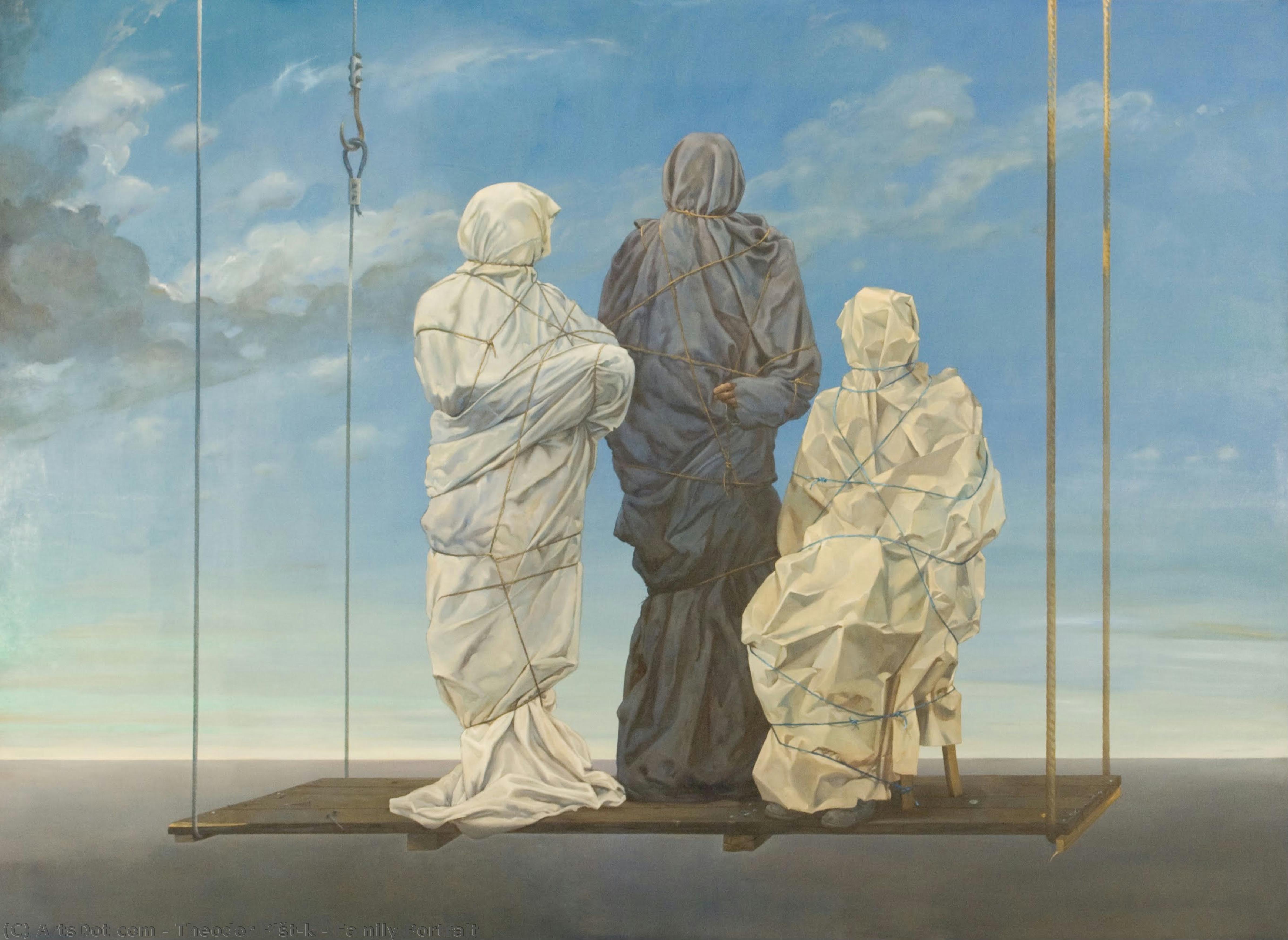
In the vast, sweeping expanse of Family Portrait, created in 1976, we encounter a moment suspended in time, where the boundaries between the human form and the infinite cosmos begin to blur. Theodor Pištěly, an artist whose lineage is deeply rooted in the theatrical and visual traditions of Prague, brings a cinematic grandeur to this monumental work. Measuring an imposing 300 x 220 cm, the painting does not merely sit upon a wall; it commands the space around it, inviting the viewer into a profound meditation on existence. The composition is a masterclass in balance and tension, featuring three figures positioned at varying heights that guide the eye upward, mirroring the very gaze of the subjects themselves.
The narrative of the piece unfolds through a striking, almost surrealist arrangement of figures against an ethereal sky. On the left, a woman draped in a pristine white dress provides a sense of classical purity, her form catching the light like a beacon. In the center, a man clad in black offers a grounding, somber contrast, acting as an anchor for the composition's emotional weight. Most provocative, however, is the third figure—a woman stripped of clothing, representing a raw, elemental vulnerability. This juxtaposition of the clothed and the nude, the structured and the primal, suggests a deep connection to the natural world, stripping away societal layers to reveal the soul's nakedness beneath the watchful eye of the heavens.
Technique and the Language of Light
Pištěk’s technique in this period reflects his unique ability to blend photorealistic precision with a dreamlike, atmospheric quality. The brushwork, while meticulous enough to capture the texture of fabric and the softness of skin, serves a higher purpose: the creation of light. The sky acts as more than just a backdrop; it is a living, breathing character in the portrait. Through subtle gradations of tone and a masterful command of luminosity, Pištěk creates a sense of depth that makes the heavens feel reachable. This interplay of light and shadow—the chiaroscuro of the natural world—imbues the figures with a sculptural presence, making them appear as if they are emerging from the ether itself.
For the discerning collector or interior designer, this piece offers an unparalleled opportunity to introduce a sense of profound scale and intellectual depth into a curated space. The painting’s ability to evoke both awe and introspection makes it a centerpiece capable of anchoring a grand salon or a contemporary gallery setting. It is a work that rewards repeated viewing, as the relationship between the figures and the vastness above reveals new layers of meaning with every glance. To possess a reproduction of such a significant work is to bring a fragment of the infinite into the domestic sphere, fostering an environment of contemplation and timeless elegance.
Related Artworks

Artist Biography
A Life Interwoven: The Art of Theodor Pištěk
Theodor Pištěk is a figure whose creative life defies easy categorization, a testament to the power of embracing diverse passions and talents. Born in Prague in 1932 into an artistic family—his parents were celebrated actors, Theodor Pištěk Sr. and Marie Ženíšková—he inherited a legacy steeped in performance and visual expression. Yet, his path wasn’t solely defined by this heritage; it was broadened by a fascination with speed, mechanics, and the burgeoning world of cinema. This unique confluence of influences would shape him into one of Czech Republic's most internationally recognized artists, celebrated not only for his photorealistic paintings but also for his groundbreaking contributions to costume and set design in film. The family’s connection to both artistic endeavor and the automotive world ran deep; his great-grandfather, František Ženíšek, was a painter, while his grandfather, Julius Ženíšek, played a pivotal role in bringing Ford Motor Company to Austria-Hungary, instilling within young Theodor an appreciation for both aesthetic beauty and engineering precision.From Canvas to Costume: A Multifaceted Career
Pištěk’s formal artistic training began at the School of Applied Arts in Prague, followed by studies at the Academy of Fine Arts under Vratislav Nechleba. It was a period marked not only by rigorous technical development but also by intellectual ferment and a burgeoning sense of artistic rebellion against the constraints of communist rule. Alongside future luminaries like Aleš Veselý and Milan Ressel, he explored modern art forms while honing his skills in traditional painting techniques. Simultaneously, a passion for racing ignited within him, leading to active participation in competitions from the age of eighteen onwards. This dual pursuit—the meticulous stillness of the canvas versus the exhilarating velocity of the racetrack—would become a defining characteristic of his artistic sensibility. His early exhibitions at the Film Club in Prague and with the Concretist Club from 1964-1968 signaled an emerging talent, but it was his foray into film that would catapult him to international acclaim. Collaborations with directors like František Vláčil on visually arresting films such as *Markéta Lazarová* and *The Valley of the Bees*, demonstrated a remarkable ability to create immersive cinematic worlds. He even co-wrote the screenplay for *Rally* with Vlácil, drawing directly from his own experiences behind the wheel. However, it was his work with Miloš Forman that cemented his legacy, culminating in an Academy Award for costume design on *Amadeus* (1984), a film that redefined historical drama and captivated audiences worldwide. A César Award nomination followed for *Valmont*, further solidifying his reputation as a master of visual storytelling through costume and set design.The Language of Realism and Symbolism
Pištěk’s paintings are immediately recognizable for their meticulous photorealism, a style he employs not merely as an exercise in technical skill but as a means to explore deeper thematic concerns. He doesn't simply replicate reality; he filters it through a lens of neo-romanticism, imbuing his works with emotional resonance and symbolic weight. Biblical themes and classical art often serve as inspiration, lending a timeless quality to his compositions. Yet, what truly sets his work apart is the recurring presence of automobiles and motorcycles—a direct reflection of his lifelong passion for racing. These machines are not merely subjects; they become potent symbols of power, speed, and the human condition. A particularly striking example is *Ecce Homo*, a painting that juxtaposes a race car driver with religious iconography, creating a provocative dialogue between modernity and tradition, secularity and spirituality. His paintings aren’t simply depictions of objects or people; they are narratives waiting to be deciphered, inviting viewers to contemplate the complexities of life, faith, and the pursuit of excellence.A Lasting Legacy
Theodor Pištěk stands as a unique figure in Czech cultural history—an artist who seamlessly bridged the gap between fine art and cinema, between tradition and innovation. His contributions have been widely recognized, including the Czech Lion Award for his unique contribution to Czech film in 2003, the Crystal Globe for Outstanding Artistic Contribution to World Cinema in 2013, and the Golden Slipper for Outstanding Contribution to Films for Children and Young People in 2017. His paintings are proudly displayed within the collection of the Národní galerie v Praze (National Gallery in Prague), a testament to his enduring artistic significance. Pištěk’s ability to excel across multiple disciplines—painting, costume design, set creation, even racing—highlights not only his versatility but also his unwavering commitment to creative exploration. He is more than just an artist; he is a cultural icon whose work continues to inspire and provoke thought, reminding us of the power of art to transcend boundaries and illuminate the human experience. His legacy lies in demonstrating that true creativity knows no limits, and that passion, when pursued with dedication and skill, can lead to extraordinary achievements.
Theodor Pištěk
1932 - , Czech Republic
Quick Facts
- Artistic Movement Or Style: Photorealism, Neo-Romanticism
- Date Of Birth: October 25, 1932
- Full Name: Theodor Pištěk
- Nationality: Czech
- Notable Artworks:
- Boxer
- Ecce Homo
- Family Portrait
- Place Of Birth: Prague, Czech Republic
Related Articles
White on Canvas: 10 Masterpieces & Timeless Elegance for Your Home Decor
Explore 10 iconic white paintings by Monet, Whistler & Rothko! Discover the stories behind these serene masterpieces and their impact on art history. Find museum-quality reproductions for your home decor at .

Dark Masterpieces: 10 Iconic Paintings Dominated by Black Tones |
Explore 10 iconic paintings dominated by black tones, from Rembrandt’s chiaroscuro to Goya's dark expressions. Discover the stories behind these masterpieces & find museum-quality art reproductions for your home at .

Monochrome Visions: Exploring the Aesthetic & Historical Significance of Black & White Photography
Explore the rich history & artistic power of black and white photography. From early techniques to iconic masters like Ansel Adams, discover why monochrome continues to captivate art lovers today. Expert insights for collectors.
Mars Black Masterpieces: 10 Iconic Paintings & Timeless Art Decor Ideas
Delve into the power of 'Mars Black' with 10 iconic paintings by masters like Rembrandt & Caravaggio. Explore dramatic chiaroscuro, gothic art, and timeless beauty. Find museum-quality reproductions & elevate your home decor on .
From Snapshot to Statement: Elevating Personal Photography Through Black & White Fine Art Reproduction
Transform cherished photos into timeless black & white fine art with ArtsDot. Our expert artists create museum-quality reproductions – a lasting legacy for your home and family. Discover the artistry today.