 Preview
 Send
Send Share
Share
 Details

 Download
 Similars
 X-Ray
X-Ray Diaporama
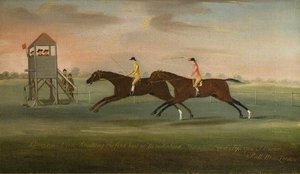
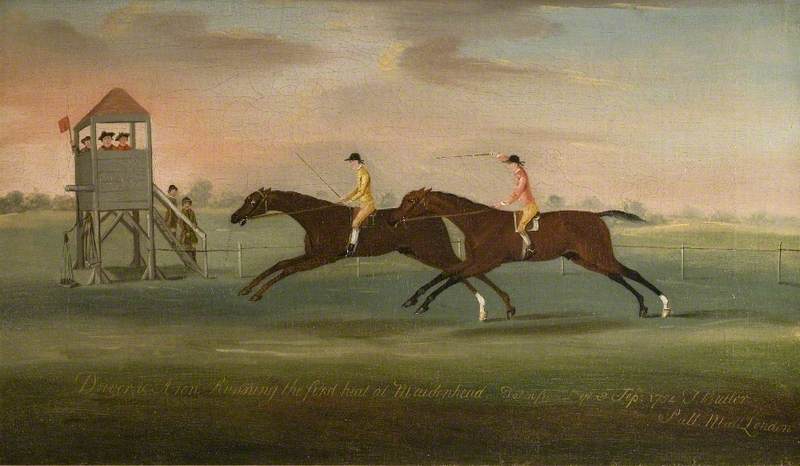
Race at Maidenhead, First Heat, 'Driver' and 'Anon'
 1750
1750 36.0 x 62.0 cm
 Read More
Hand Made Oil Reproduction
Hand-painted oil on canvas in your size and frame, made to order by our artists. ( Buy Print Buy Image)




































Pick from our preset sizes that match the artwork's original proportions.

You may enter your own dimensions to fit a specific frame or space. If your selected size does not match the original image's proportions, we will either crop the artwork or extend the painting with additional hand-painted elements. A digital mockup will be sent for your approval before production begins.
Please note that the on-screen preview does not reflect the actual cropping or extension. Only the mockup will accurately show the final composition.
While custom sizes are available, we recommend selecting a dimension from the predefined list to preserve the original proportions.
After order, ArtsDot.com team will email client for instructions and provide a mockup preview
Worldwide Delivery () in 3/4 weeks instead of standard 5 weeks. (23 August). No compromise on quality.

Free Worldwide Express Shipping

High-Quality Linen Canvas

Full Shipping Insurance

Customs Tax Refund Guarantee

True Color Matching Guarantee

60-Day Return Policy (Defects Only)

100% Money-Back Guarantee

Bulk Discount Offer
 Glass option is only available in size under 110 CM

Race at Maidenhead, First Heat, 'Driver' and 'Anon'
Reproduction Medium
Reproduction Size
-


Total Price
$ 263
Related Artworks









Artist Biography
A Chronicler of a Vanishing World: The Life and Art of Thomas Butler Gunn
Thomas Butler Gunn, born in England but forever linked to the vibrant, often tumultuous world of late 19th-century New York, occupies a unique space in art history. He wasn’t merely an illustrator; he was a keen observer, a social documentarian who captured the fleeting essence of a bohemian lifestyle rapidly giving way to modernity. While his name may not be as instantly recognizable as some of his contemporaries, Gunn's work offers a fascinating glimpse into a specific time and place – the New York of Delmonico’s Restaurant, horse racing at Jerome Park, and the artistic circles that thrived in the shadow of burgeoning industrialization. His diaries, meticulously kept throughout his life, provide invaluable context to his art, revealing not just *what* he painted but *why*, and the complex emotions driving his creative process. Gunn's early life remains somewhat shrouded in mystery; details are scarce beyond his English origins and a clear inclination towards artistic pursuits. He arrived in America in the 1870s, drawn by the energy of a nation undergoing dramatic transformation, and quickly found himself immersed in the city’s burgeoning art scene.The New York Bohemia: Subject Matter and Style
Gunn's subject matter was decidedly unconventional for his time. Eschewing grand historical narratives or idealized portraits, he focused on the everyday lives of those inhabiting the fringes of society – gamblers, actresses, artists, and the fashionable elite indulging in leisure activities. His paintings are filled with scenes from Delmonico’s, a renowned restaurant that served as a social hub for New York's upper crust, capturing their conversations, flirtations, and subtle power dynamics. He also developed a particular fascination with horse racing, not merely as a sport but as a microcosm of American ambition, risk-taking, and the pursuit of fortune. His depictions of Jerome Park racetrack are remarkably detailed, conveying both the excitement of the races and the underlying tension of the gambling world. Gunn’s style is characterized by a delicate realism, often infused with a touch of melancholy. He possessed an exceptional ability to capture light and shadow, creating atmospheric scenes that evoke a sense of intimacy and immediacy. His use of watercolor was particularly masterful, allowing him to achieve subtle gradations of tone and texture. He wasn’t interested in glorifying his subjects; rather, he sought to portray them with honesty and empathy.Influences and Artistic Development
While Gunn's style is distinctly his own, it’s possible to discern influences from several sources. The Pre-Raphaelite movement, with its emphasis on detailed observation and narrative storytelling, likely played a role in shaping his early aesthetic sensibilities. He also appears to have been influenced by the work of French Realists like Édouard Manet and Henri de Toulouse-Lautrec, particularly their focus on depicting modern life and unconventional subjects. However, Gunn quickly moved beyond mere imitation, developing a unique voice that reflected his own experiences and perspectives. His artistic development can be traced through his diaries, which reveal a constant experimentation with technique and subject matter. Initially focused on more traditional landscapes and portraits, he gradually gravitated towards the scenes of urban life that would define his career. The shift wasn’t abrupt; rather, it was a gradual process of discovery, driven by his growing fascination with the complexities of New York society.Major Achievements and Lasting Legacy
Gunn's major achievement lies not in creating a vast body of work but in capturing a specific moment in time with remarkable sensitivity and detail. His paintings offer a rare glimpse into the lives of those who inhabited the New York bohemian world, providing invaluable insights into their customs, values, and aspirations. While he exhibited his work during his lifetime, he never achieved widespread recognition. It wasn’t until decades after his death that his art began to receive the attention it deserved. Today, Gunn is recognized as a significant figure in American art history, celebrated for his unique perspective and masterful technique.- His paintings are held in major museum collections across the United States.
- His diaries have been published, providing scholars with invaluable insights into his life and work.
- He is considered a key figure in documenting the social history of late 19th-century New York.