

 Preview
 Send
Send Share
Share
 Details

 Download
 Similars
 X-Ray
X-Ray Diaporama
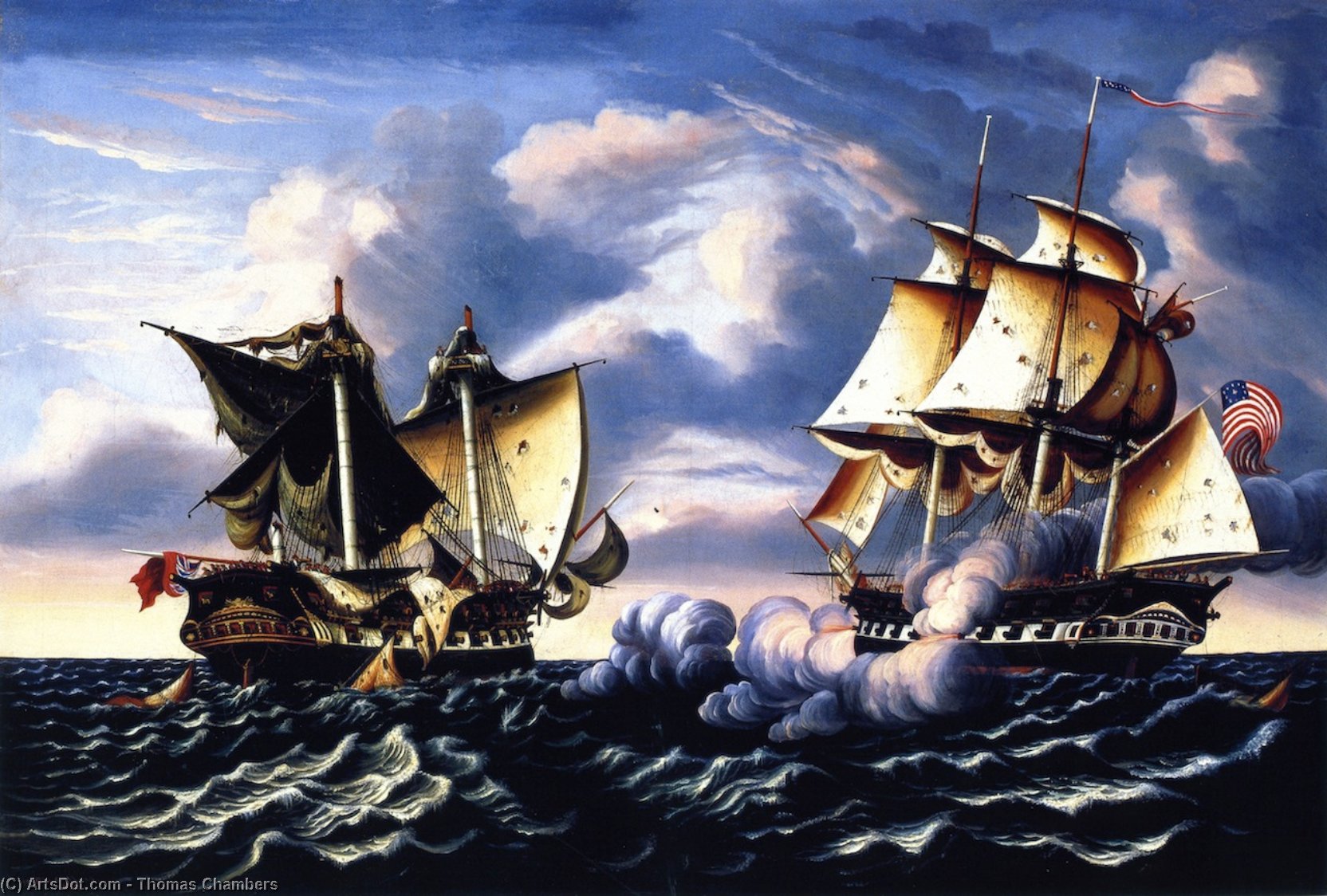
Capture of H.B.M. Frigate Macedonian by U.S.S. Frigate United States

 Read More
Purchase a high-resolution, enhanced digital image, far superior to the online preview.
Each file is meticulously prepared by our in-house specialists using advanced tools and expert manual retouching. We ensure every image has exceptional clarity, precise color accuracy, and fine detail.
The final file is delivered via email within 72 hours, optimized for immediate use in professional, editorial, and print environments. This is the same quality trusted by top-tier design studios, publishers, and galleries.
Digital Image
Download a high-resolution file for personal display, printing, and creative projects. ( Buy Print Buy Hand Made Painting)
Included in Every Digital Image Order
Expert Digital Delivery, Guaranteed
When you choose ArtsDot.com, you're not just getting an image - you're receiving a professionally enhanced digital artwork, crafted with precision and backed by a satisfaction guarantee. Here's everything that comes with your order, automatically:

Fast Email Delivery
Your high-resolution digital image file will be emailed to you within 72 hours of ordering - ready for immediate use.

AI-Enhanced Digital File
Your artwork is professionally optimized using advanced AI tools and manual editing, ensuring maximum detail, clarity, and color accuracy.

Free Lifetime Re-Delivery
Accidentally deleted or lost your file? No worries - we'll resend it to you anytime, free of charge.

No Import Fees - Ever
Enjoy your artwork instantly with zero customs, duties, or delivery fees - digital downloads are always tax-free.

Color Accuracy Guarantee
We ensure your digital image reflects the original colors as closely as possible using professional tools and color management.

60-Day Satisfaction Guarantee
If you're not satisfied with your digital image, we'll revise it or refund 100% within 60 days - no questions asked.

100% Money-Back Guarantee
Not satisfied? Get a full refund within 60 days of receiving your digital file - no questions asked.

Bulk Order Discounts
Buy 3 images, save 10% - Buy 5, save 15% - Buy 10+, save 20%. Great for creative projects, galleries, and agencies.
The Painting's Significance
The painting depicts the capture of the British frigate Macedonian by the American frigate United States on October 25, 1812. This event marked a significant victory for the United States during the War of 1812, demonstrating the country's growing naval power. The painting is not only a celebration of this triumph but also a tribute to the bravery and skill of the American sailors.Artistic Style and Technique
Thomas Chambers' work is characterized by his use of oil on canvas, which allows for rich, vibrant colors and intricate details. The painting's composition is carefully balanced, with the two ships positioned in a dramatic confrontation. The attention to detail is impressive, from the billowing sails to the cannons blazing on the decks.Museum and Collections
The Capture of H.B.M. Frigate Macedonian by U.S.S. Frigate United States is part of the permanent collection at the Smithsonian American Art Museum. This museum is renowned for its extensive collection of American art, including works by other notable artists such as Peter Paul Rubens and Frederick Childe Hassam. For more information on the museum's collections, visit /art/list/?Filter=A@D3CAYX-Discovering-the-Artworks-of-Thurrock-Museum-United-Kingdom.- View more paintings by Thomas Chambers at /art/list/?Filter=8XX7PJ-Thomas-Chambers-The-Constitution-and-the-Guerriere
- Learn about the Smithsonian American Art Museum and its collections at https://ArtsDot.com
For those interested in learning more about the War of 1812 and its significance in American history, visit Wikipedia at https://en.wikipedia.org/wiki/War_of_1812.
Related Artworks









Artist Biography
A Rediscovered Visionary: The Life and Art of Thomas Chambers
The name Thomas Chambers remained largely obscured for over a century, his vibrant canvases attributed simply as “American Folk Art” or “unsigned marine paintings.” Only in 1942 did the art world begin to recognize the distinct hand – and remarkably modern sensibility – behind these captivating works. Born in Whitby, Yorkshire, England, in 1808, Chambers’s journey was one of transatlantic migration, quiet dedication, and ultimately, posthumous acclaim. His father, a merchant sailor, instilled a deep connection to the sea, while his mother worked as a laundress; this humble upbringing likely shaped his keen observation of everyday life and a pragmatic approach to artistic creation. While formal training remains undocumented, it’s believed he collaborated with his brother George, a successful marine artist, laying the foundation for his own burgeoning talent.
From New Orleans to the Hudson: A Developing Style
Chambers emigrated to the United States in 1832, shortly after his brother received royal patronage. He initially settled in New Orleans, declaring his intent to become a naturalized citizen, before relocating to New York City around 1834. For nearly a decade, he worked as both a painter and restorer, honing his skills while navigating the bustling art scene of the burgeoning metropolis. His style began to coalesce during this period – a unique blend of realism and expressive color that set him apart from contemporaries steeped in academic tradition. He then moved to Boston (1843-1851) followed by Albany before returning to New York around 1857, painting scenes primarily along the Hudson River Valley. However, unlike artists associated with the Hudson River School, Chambers’s work wasn't driven by a romanticized vision of nature but rather a direct and often strikingly bold depiction of it.
The “First American Modern”
Chambers’s paintings are characterized by their dynamic compositions, vivid palettes, and an almost naive perspective that belies a sophisticated understanding of light and form. He rarely exhibited his work, preferring to sell directly through auctions – a practice that contributed to the anonymity surrounding his oeuvre for so long. His subjects ranged from dramatic naval battles, like “The Constitution & Guirriere”, capturing the energy and chaos of maritime conflict, to serene coastal scenes and idyllic landscapes such as “Cottages in a Landscape (also known as The Birthplace of Burns)”. What truly distinguishes his work is a sense of immediacy and an unconventional approach to perspective. He often worked *en plein air*, directly from nature, resulting in paintings that feel remarkably fresh and alive.
Unsigned Legacy & Rediscovery
The lack of signatures on nearly all of Chambers’s works proved a significant obstacle to his recognition during his lifetime. He faced hardship in his later years, eventually returning to England penniless and disabled around 1866, where he died in a Whitby workhouse in 1869. It wasn't until the groundbreaking exhibition at the Macbeth Gallery in New York City in 1942 that his paintings were definitively attributed to him. The discovery of a single signed work unlocked a wealth of previously unknown canvases, revealing a prolific and remarkably consistent body of work. Art historians like Kathleen A. Foster have championed his legacy, recognizing Chambers as a pivotal figure in American art history – a “First American Modern” whose bold style anticipated many of the developments of 20th-century painting.
Historical Significance & Enduring Appeal
Thomas Chambers occupies a unique position within the landscape of 19th-century American art. He stands apart from both the refined elegance of academic painting and the romantic idealism of the Hudson River School, forging his own path with an independent spirit and unwavering dedication to direct observation. His paintings offer a glimpse into a rapidly changing America – a nation grappling with industrialization, expansion, and evolving notions of identity. Today, Chambers’s work is celebrated for its raw energy, vibrant color, and enduring appeal. He represents a vital link between folk art traditions and the burgeoning modernism that would define the next century, reminding us that artistic innovation often flourishes outside the established boundaries of convention.
thomas chambers
1808 - 1869
Quick Facts
- Artistic Movement Or Style: Primitivist, Marine Landscape
- Artists Or Movements Influenced By This Artist: ['Hudson River School']
- Artists Who Influenced This Artist: ['George Chambers']
- Date Of Birth: 1808
- Date Of Death: 1869
- Full Name: Thomas Chambers
- Nationality: American
- Notable Artworks:
- Castles of the Mind
- Constitution & Guirriere
- Cottages in a Landscape

