 Preview
 Send
Send Share
Share
 Details

 Download
 Similars
 X-Ray
X-Ray Diaporama
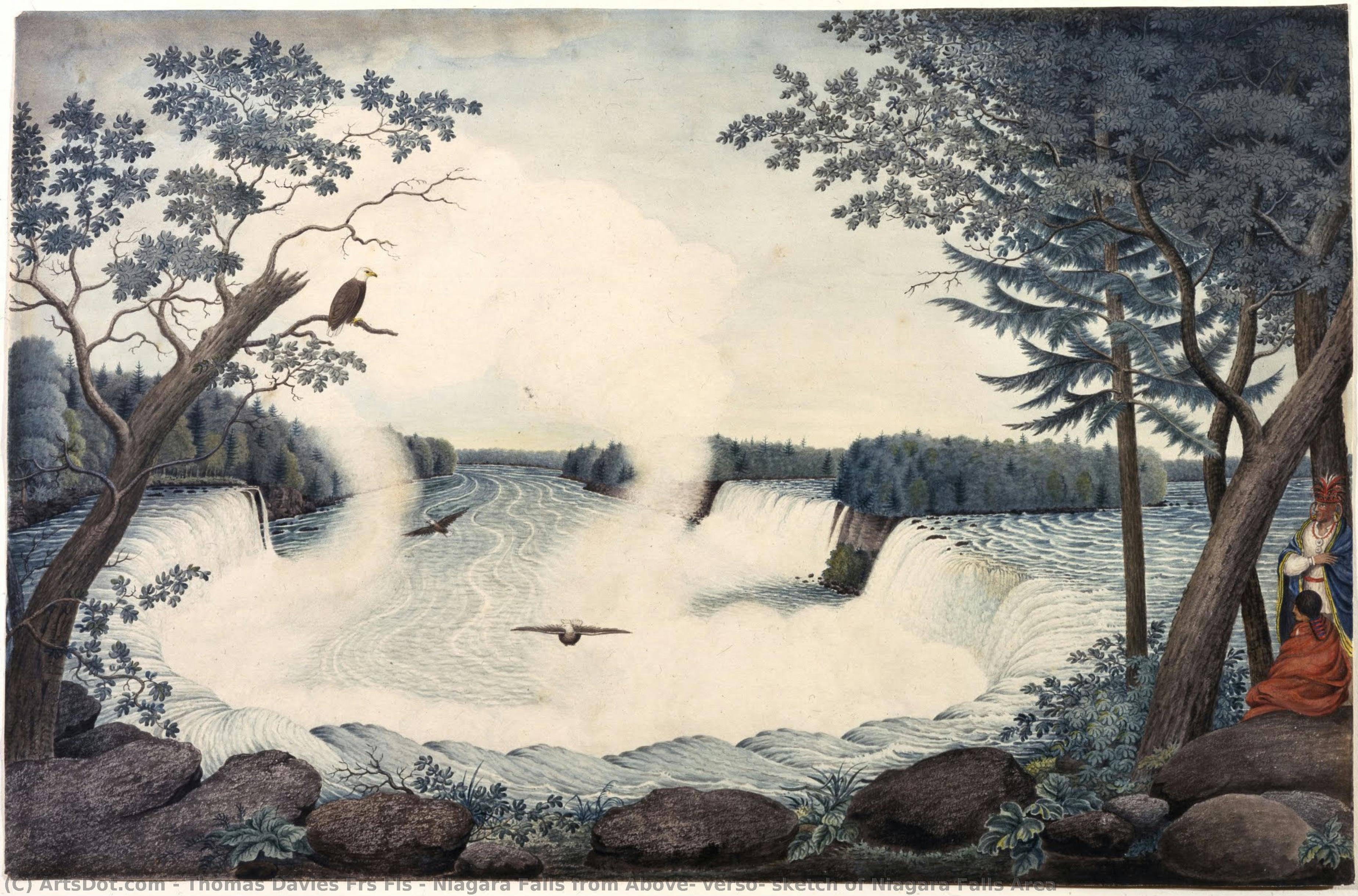
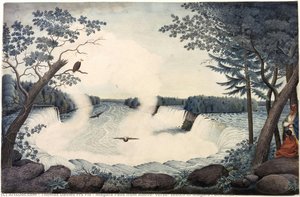
Niagara Falls from Above; verso: sketch of Niagara Falls Area
 1766
1766 34.0 x 52.0 cm
 Read More
Hand Made Oil Reproduction
Hand-painted oil on canvas in your size and frame, made to order by our artists. ( Buy Print Buy Image)




































Pick from our preset sizes that match the artwork's original proportions.

You may enter your own dimensions to fit a specific frame or space. If your selected size does not match the original image's proportions, we will either crop the artwork or extend the painting with additional hand-painted elements. A digital mockup will be sent for your approval before production begins.
Please note that the on-screen preview does not reflect the actual cropping or extension. Only the mockup will accurately show the final composition.
While custom sizes are available, we recommend selecting a dimension from the predefined list to preserve the original proportions.
After order, ArtsDot.com team will email client for instructions and provide a mockup preview
Worldwide Delivery () in 3/4 weeks instead of standard 5 weeks. (1 September). No compromise on quality.

Free Worldwide Express Shipping

High-Quality Linen Canvas

Full Shipping Insurance

Customs Tax Refund Guarantee

True Color Matching Guarantee

60-Day Return Policy (Defects Only)

100% Money-Back Guarantee

Bulk Discount Offer
 Glass option is only available in size under 110 CM

Niagara Falls from Above; verso: sketch of Niagara Falls Area
Reproduction Medium
Reproduction Size
-


Total Price
$ 263
Related Artworks






Artist Biography
The Soldier-Naturalist: The Dual Legacy of Thomas Davies
In the annals of British art and natural history, few figures possess a legacy as multifaceted or as unexpectedly profound as Thomas Davies. A man whose life was defined by the disciplined rigors of military command and the delicate precision of scientific observation, Davies occupied a unique space where the battlefield met the botanical garden. Born around 1737 in Shooter’s Hill, London, he was a product of the Enlightenment—an era that demanded both the courage to explore uncharted territories and the intellectual rigor to document them. As a Lieutenant-General in the Royal Artillery, his life was marked by the smoke of conflict and the strategic maneuvers of the Seven Years' War and the American Revolutionary War. Yet, beneath the uniform of a seasoned officer beat the heart of a pioneer, one capable of capturing the ephemeral beauty of the natural world with an eye that was as much scientific as it was aesthetic.
Davies’s artistic journey began not in a studio, but within the structured confines of the Woolwich Royal Military Academy. Enrolled in 1755, his training focused on the essential military skill of topographical drawing—a practice requiring absolute accuracy to map terrain and fortifications. This technical foundation would later become the bedrock of his artistic style. His watercolors were never merely decorative; they were vital visual records. During his deployments in North America, Davies transformed the chaos of war into structured compositions, documenting the siege of New York and the landscapes of Quebec with a clarity that bridged the gap between military intelligence and fine art. His work provided a window for Europeans to glimpse the untamed majesty of the New World, capturing everything from the thunderous power of Niagara Falls to the quiet dignity of indigenous life.
A Visionary of the Natural World
While his military service earned him distinction in the annals of the British Army, it was Davies’s contributions to ornithology and natural history that secured his immortality in the scientific community. He possessed a rare ability to blend meticulary realistic detail with an expressive sensitivity that breathed life into his subjects. This talent reached its zenith in his groundbreaking studies of avian life, most notably his role as the first individual to accurately illustrate and describe the magnificent superb lyrebird. To capture such a complex creature required more than just a steady hand; it required a deep, observational patience that mirrored his scientific dedication as a Fellow of the Royal Society (FRS) and the Linnean Society (FLS).
His artistic development saw him move beyond simple topographical sketches toward more vigorous and atmospheric compositions. In his mature works from the 1760s onwards, one observes the use of bold gouache accents and a sophisticated command of light that elevated his watercolors above mere documentation. His ability to render the "unspoiled natural world" allowed him to communicate the very essence of adventure and discovery. Whether he was depicting the swirling mists of a Canadian waterfall or the intricate plumage of a rare bird, Davies sought to capture the vitality of life itself, making his work an essential bridge between the era of exploration and the dawn of modern natural science.
Historical Significance and Enduring Influence
The true breadth of Thomas Davies’s genius remained largely hidden from the broader public for much of the nineteenth century, only resurfacing with renewed vigor following a significant 1953 auction from the Earl of Derby's library. This rediscovery allowed art historians to re-evaluate him not just as a chronicler of war, but as one of the most talented early North American artists. His work serves as a vital historical archive, preserving the visual memory of landscapes and species that were undergoing profound changes due to colonial expansion.
Today, the significance of Davies lies in his ability to synthesize seemingly disparate disciplines into a single, cohesive vision. His life reminds us that the boundaries between science, art, and service are often fluid. Through his eyes, we see:
- The Precision of the Soldier: A commitment to topographical accuracy that informed the mapping of a growing empire.
- The Eye of the Naturalist: A pioneering spirit that brought new species to the forefront of scientific consciousness.
- The Soul of the Artist: An expressive technique that captured the sublime beauty of the wild, far beyond the reach of mere documentation.
Thomas Davies remains a singular figure—a man who defended frontiers with steel and explored them with watercolor, leaving behind a legacy that continues to inspire wonder in both the scientific and artistic realms.
thomas davies frs fls
1812 , United Kingdom
Quick Facts
- Artistic Movement Or Style: Military Artist
- Artists Or Movements Influenced By This Artist: ['George Edwards']
- Artists Who Influenced This Artist:
- Paul Sandby
- Henri Rousseau
- Date Of Birth: c. 1737
- Date Of Death: 16 March 1812
- Full Name: Thomas Davies Frs Fls
- Nationality: British
- Notable Artworks:
- Niagara Falls from Above; verso: sketch of Niagara Falls Area
- Thomas Davies Frs Fls
- Place Of Birth: Shooters Hill, United Kingdom